
Telegram has evolved far beyond a messaging app. In 2026, it offers multiple built-in and external ways for creators, channel owners, bot developers, and mini app builders to earn revenue.
This guide explains the most practical Telegram monetization methods available in 2026, based on Telegram’s own platform features and widely documented industry practices.
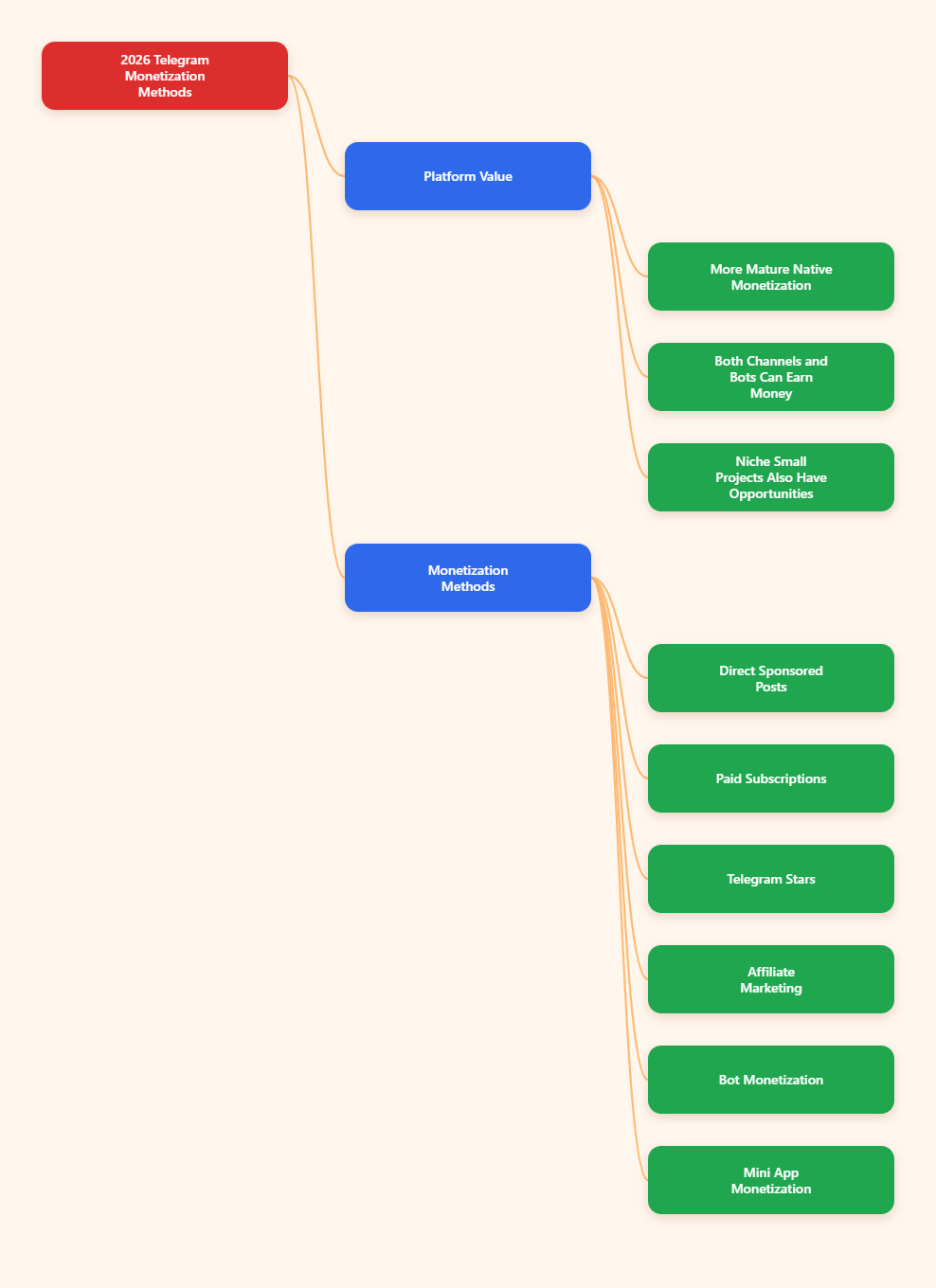
Why Telegram is a serious monetization platform in 2026
Telegram now supports several native creator and developer revenue systems.
- Ad revenue sharing for channels and bots: Telegram states that eligible owners can receive 50% of the revenue from ads displayed in their channels and bots.
- Telegram Stars: Stars are Telegram’s in-app virtual item used for digital goods, paid media, gifts, and creator support.
- Paid subscriptions: Channels can offer paid access through invite links priced in Stars.
- Affiliate programs: Telegram introduced affiliate tools for mini apps, allowing channels and users to earn commissions on referred purchases made with Stars.
- Bot and mini app payments: Bots and mini apps can sell digital goods with Stars, while physical goods and services can use Telegram’s Payments API with payment providers.
Telegram has also highlighted the scale of the ecosystem in official announcements. Public channels generate enormous view volume, and hundreds of millions of users interact with bots and mini apps monthly. That makes monetization possible even for focused niche projects, not only giant channels.
The main Telegram monetization methods
Below are the most important methods worth considering in 2026.
1. Telegram ad revenue sharing for public channels
This is the most official and easiest passive model for eligible public channel owners.
In 2024, Telegram launched revenue sharing for channel owners. According to Telegram’s official announcements and terms, owners of eligible public channels can receive 50% of the revenue generated from sponsored messages shown in their channels.
What is confirmed by Telegram:
- The revenue share is 50%.
- The system applies to eligible public channels.
- Telegram announced that public channels with at least 1,000 subscribers can be rewarded.
- Rewards are tied to valid ad impressions.
- Withdrawals are connected to Toncoin-based infrastructure.
Best for:
- Public channels with steady traffic
- News, education, finance, entertainment, and niche media channels
- Owners who want low-maintenance monetization
Pros:
- Native to Telegram
- No need to negotiate with advertisers manually
- Scales with channel view volume
Limits:
- Works for public channels, not private paid communities
- Earnings depend on impressions and advertiser demand
- You have less control than with direct sponsorship deals
Practical note: This model usually works best as a base layer, not the only revenue source. Many channel owners combine it with subscriptions, sponsorships, or product sales.
2. Direct sponsored posts
Direct sponsorships remain one of the most common Telegram monetization methods because they offer full commercial control.
In this model, a brand, project, or advertiser pays you directly to publish a promotional post in your channel. Unlike Telegram’s official ad platform, direct deals let you:
- Choose which sponsors to accept
- Set your own rates
- Decide the post format and placement
- Keep the full payment instead of a revenue split
Best for:
- Niche channels with engaged audiences
- Industry-specific channels in crypto, careers, software, investing, gaming, and education
- Creators with strong audience trust
Pros:
- Usually higher revenue per deal than native ad sharing
- Full control over message and frequency
- Can work even with relatively small but targeted audiences
Risks:
- Too many ads can damage trust
- Weak sponsor fit can reduce engagement
- You need to handle outreach, negotiation, pricing, and scheduling yourself unless you use a broker or marketplace
Best practices:
- Only accept sponsors relevant to your audience
- Label promotions clearly when appropriate
- Limit ad frequency to avoid fatigue
- Track views, clicks, and response quality so you can price future placements better
If your channel has a highly targeted audience, direct sponsorships often outperform broad ad revenue sharing on a per-post basis.
3. Paid subscriptions for private channels
Subscriptions are one of the strongest monetization models on Telegram because they create recurring revenue.
Telegram supports paid invite links for channels through Star-based subscriptions. Telegram’s API documentation states that channel administrators can create invite links that let users join a channel in exchange for a monthly payment in Telegram Stars.
How it works:
- You create a private channel
- You offer access through a paid invite link
- Users pay monthly in Stars
- The Stars are transferred to the channel balance
Best for:
- Premium research channels
- Trading communities
- Exclusive education content
- Private clubs and membership groups
- Creators with loyal audiences
Pros:
- Predictable monthly income
- Less dependence on ad markets
- A small committed audience can be more valuable than a large passive one
Challenges:
- You need consistent premium content or utility
- Retention matters more than one-time promotion
- Pricing has to match perceived value
What sells well in subscription channels:
- Daily market analysis
- Curated deals or job leads
- Exclusive tutorials
- Community Q&A access
- Members-only files, templates, or signals
For many creators, subscriptions are the most durable model because revenue comes from continued usefulness rather than one-off traffic spikes.
4. Telegram Stars from paid content and fan support
Telegram Stars are central to monetization in 2026.
Telegram describes Stars as a virtual item that users can spend on digital goods and services in bots and mini apps, access paid media, and support creators. Telegram also introduced Star Reactions and Star Subscriptions, giving creators more ways to receive support directly inside the app.
What Stars can be used for:
- Buying digital goods in bots and mini apps
- Unlocking paid content
- Subscribing to channels
- Supporting creators through reactions and related features
Why Stars matter:
- They provide a Telegram-native payment layer for digital products
- They are designed to comply with app store rules for in-app digital purchases
- Creators can convert earned Stars into Toncoin or use them for Telegram ads, according to Telegram’s official materials
Best for:
- Creators selling digital access
- Bot developers
- Mini app developers
- Channels offering premium posts or subscriber perks
Important limitation: Stars are mainly for digital goods and services inside Telegram’s ecosystem. For physical goods, Telegram’s separate payment infrastructure is the relevant route.
5. Selling digital products through bots or mini apps
If you have something digital to sell, Telegram bots and mini apps can function as lightweight storefronts.
Telegram officially supports digital goods and services sold for Stars in bots and mini apps. This makes Telegram especially useful for products that can be delivered instantly.
Examples of digital products that fit well:
- E-books
- Templates
- Courses or lessons
- Premium content packs
- AI credits or generations
- In-game items
- Software access
Best for:
- Developers
- Educators
- Media brands
- Tool creators
- Game builders
Why this model is attractive:
- Delivery can be automated
- There is no need to move users off-platform
- Users already familiar with Telegram can complete purchases with less friction
Mini apps are especially promising because Telegram has reported massive monthly usage. In 2024, Telegram said more than 400 million users interact with bots and mini apps every month, and later noted that more than 500 million users interact with mini apps monthly. That scale creates room for paid features, subscriptions, upgrades, and in-app purchases.
6. Affiliate marketing on Telegram
Affiliate marketing is still one of the simplest monetization methods when you do not have your own product.
There are now two practical affiliate paths on Telegram:
- Traditional affiliate marketing: You promote third-party products or services and earn commissions.
- Telegram affiliate programs for mini apps: Telegram introduced affiliate tools that let developers open programs for their mini apps, and channels or users can earn commissions on referred purchases made with Stars.
What Telegram officially introduced:
- Mini app developers can launch affiliate programs
- Channels and users can promote referral links
- Commissions are earned when referred users make qualifying purchases in the mini app
Best for:
- Review channels
- Deal and coupon channels
- Software and app recommendation channels
- Niche content creators who influence purchase decisions
Pros:
- No need to create your own product
- Works well with educational or review content
- Can be combined with sponsored posts and subscriptions
Risks:
- Poor-quality offers can hurt credibility
- Commission structures vary widely
- Conversions depend on audience intent, not just size
The strongest affiliate channels do not simply drop links. They explain why the product is useful, who it is for, and when it is worth paying for.
7. Monetizing Telegram bots
Bots can do more than automate tasks. They can be products in their own right.
Telegram’s official documentation confirms two major monetization routes for bots:
- Ad revenue sharing: eligible bot owners can receive 50% of ad revenue
- Payments for digital goods and services: via Stars
There is also Telegram’s broader Payments API for physical goods and services, where Telegram says it does not charge commission for using the payment platform itself, although payment providers may charge their own fees.
Bot monetization models include:
- Freemium access
- Paid commands or premium features
- Subscription access
- Digital downloads
- Lead generation for a paid service business
- Advertising revenue
Good bot categories for monetization:
- Productivity bots
- Education bots
- Signal or alert bots
- AI utility bots
- Community management bots
- Language and learning bots
What makes a bot monetizable:
- It saves time
- It automates a painful task
- It produces a repeatable result users value
- It is easier to use than a website or app alternative
8. Monetizing Telegram mini apps
Mini apps are one of the most flexible Telegram monetization methods in 2026.
Telegram mini apps can support:
- In-app purchases via Stars
- Paid subscriptions via Stars
- Affiliate commissions
- Advertising in some business models
Official Telegram documentation confirms that mini apps support paid subscriptions powered by Stars. Telegram has also documented affiliate programs for mini apps, where developers can share commissions with promoters.
Best mini app business models:
- Games selling items or boosts
- Utility tools with paid tiers
- AI products selling credits
- Education apps with gated lessons
- Communities with member-only features
Why mini apps stand out:
- They feel more interactive than channels
- They can combine content, payments, and retention in one interface
- They support repeat purchases better than static posts
However, mini apps are more development-heavy than channels or simple bots. They make the most sense when you are building an actual product, not just posting content.
How to choose the right Telegram monetization method
Not every method fits every project. Use the simplest model that matches your audience and offer.
If you run a public content channel:
- Start with ad revenue sharing if eligible
- Add direct sponsorships once you have stable engagement
- Use affiliate offers only if they are tightly relevant
If you run a premium niche community:
- Focus on paid subscriptions
- Add upsells like consultations, reports, or premium files
- Use free public content as your funnel
If you are a developer:
- Use Stars for digital goods
- Consider freemium bots or mini apps
- Add affiliate mechanics if you operate a mini app ecosystem
If you sell physical goods or real-world services:
- Use Telegram bots and the Payments API with payment providers
- Avoid relying on Stars for goods that are not digital
Final thoughts
The best Telegram monetization methods in 2026 are no longer limited to simple ad posts. Telegram now supports a broader creator economy that includes ad revenue sharing, paid subscriptions, Telegram Stars, digital goods, affiliate commissions, bots, and mini apps.