

When social media content gets views but attracts few followers, or generates likes without meaningful engagement, publishing more posts may not solve the problem. The real issue could be the topic, format, audience fit, distribution, or the next action a post encourages. Learning how to optimize social media content means understanding which part of the content journey is underperforming and improving that specific part. Instead of changing everything at once, businesses and creators need a repeatable way to identify weak signals, test better approaches, and connect content performance with their growth goals.
Start With the Result You Want, Not the Next Post
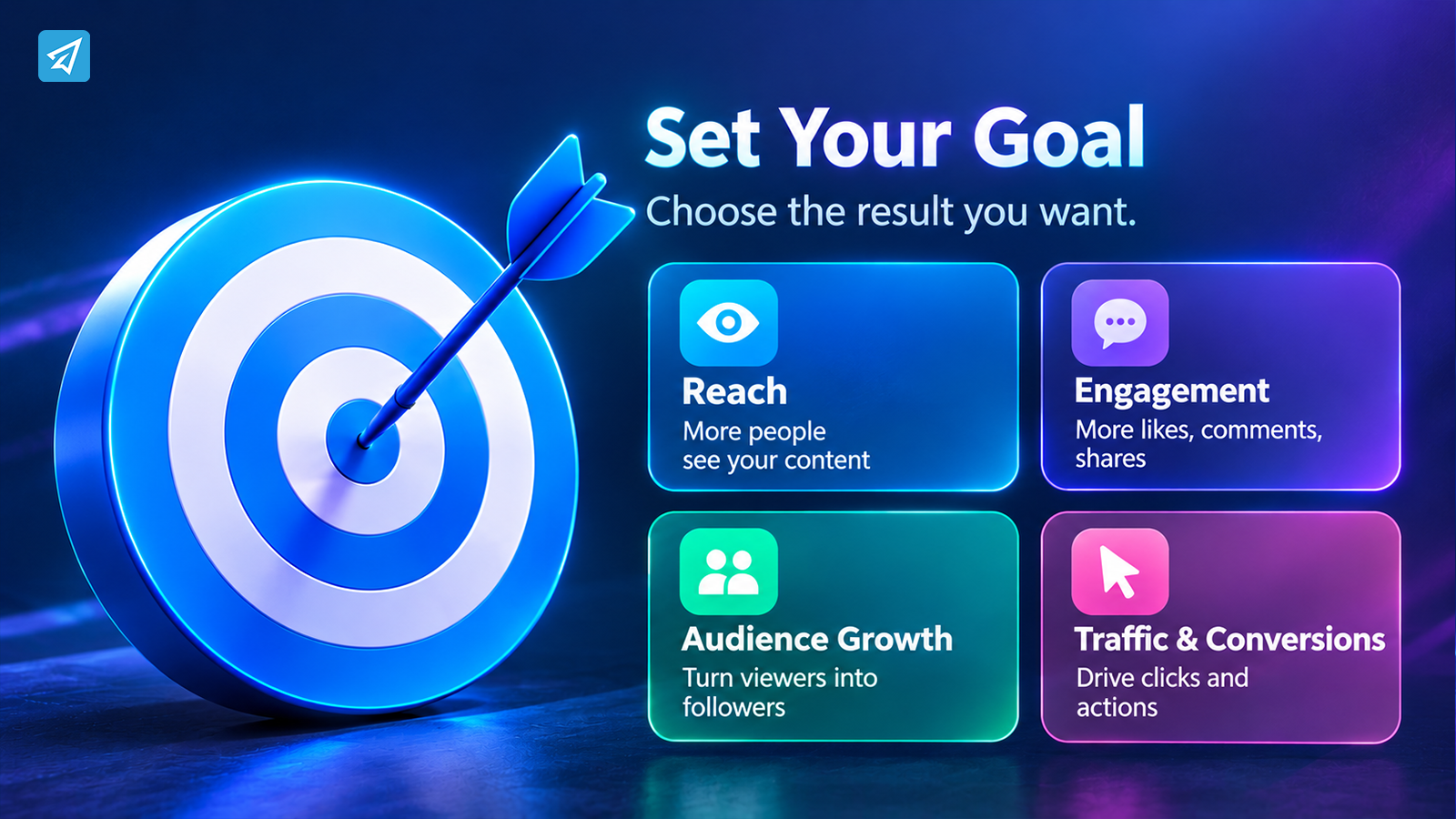
Content optimization becomes much easier when you define what a successful result actually looks like.
A business trying to increase brand awareness needs different content from a creator who wants to build a loyal community. Likewise, an established account trying to generate leads should not judge every post by the same standard as a new account trying to attract its first relevant followers.
Before editing a headline, redesigning a video, or changing your publishing schedule, choose one primary objective.
- Reach: Help more relevant people discover your content.
- Engagement: Encourage people to react, comment, share, or participate.
- Audience growth: Turn interested viewers into followers or channel members.
- Traffic and conversions: Encourage people to visit a website, explore an offer, or take another measurable action.
These objectives overlap, but they are not interchangeable. A post can reach thousands of people without generating meaningful interest. Another can attract fewer viewers but produce thoughtful discussions or qualified leads.
Choose a primary goal for each content campaign and use secondary metrics to understand what happened along the way. This prevents a common mistake: declaring content successful because one number increased while the actual business objective remained unchanged.
Diagnose the Weakest Link in Your Content Performance
When results disappoint, resist the temptation to replace your entire strategy. First, determine where the audience journey breaks down.
When reach is low, examine discoverability and relevance
If few people see a post, review its opening, topic, format, and distribution. Does the first frame or sentence communicate why someone should pay attention? Is the subject relevant to a recognizable audience? Does the content fit the platform where you published it?
A useful educational video may perform poorly if its opening takes too long to explain the problem. A valuable text post may struggle when its key point is buried in a lengthy introduction.
Improve the way the content communicates its value before assuming that you simply need to publish more frequently.
When views are high but engagement is weak, examine the promise
Attention is only the beginning. People may watch a video because its opening is intriguing but leave without responding because the rest offers little practical value.
Compare the promise made by the opening with what the content actually delivers. Make the central idea clear, provide a useful takeaway, and give the audience a natural reason to participate.
For example, a creator explaining common marketing mistakes could end with a specific question about which mistake followers encounter most often. That invitation is more relevant than a generic request to like and share.
When engagement is healthy but follower growth is slow, examine account positioning
Individual posts can be interesting without giving viewers a reason to follow the account.
Look at the relationship between successful posts and your overall content themes. If one post covers an occasional trend while the rest of the account focuses on unrelated subjects, new viewers may not understand what they will receive by following you.
A clear profile description, recognizable content pillars, and related follow-up posts help turn a single interaction into an ongoing audience relationship.
When results fluctuate, examine consistency and context
Not every post should perform equally. Topic demand, timing, creative quality, audience activity, and platform distribution can all influence results.
Compare similar content over a meaningful period rather than treating one unusually successful or unsuccessful post as proof that a strategy works or fails. The objective is to identify repeatable patterns, not chase every temporary spike.
Build Content Around a Clear Audience Need
Optimization begins before publication. If a post addresses the wrong problem, better editing alone is unlikely to produce sustained growth.
Start by identifying the people you want to reach and the questions they are trying to answer. Review comments, frequently asked questions, customer conversations, and recurring discussions in your niche. Look for problems that are specific enough to address in one useful piece of content.
Then organize your ideas into a small number of content pillars.
For a business selling productivity software, these might include workflow problems, practical tutorials, customer use cases, and product updates. Each pillar serves a different purpose: educating potential users, helping them evaluate solutions, building trust, or supporting existing customers.
A balanced content strategy should not make every post promotional. Educational content helps people solve problems; community content invites participation; demonstrations show how an approach works; and promotional content explains an offer when the audience has enough context to evaluate it.
The right balance depends on your audience and objective. If your account receives views but few meaningful interactions, test more useful or discussion-oriented content before increasing promotional posts. If people engage with educational posts but never explore your offer, clarify the connection between the problem you solve and the next step they can take.
Choose Formats That Serve the Message
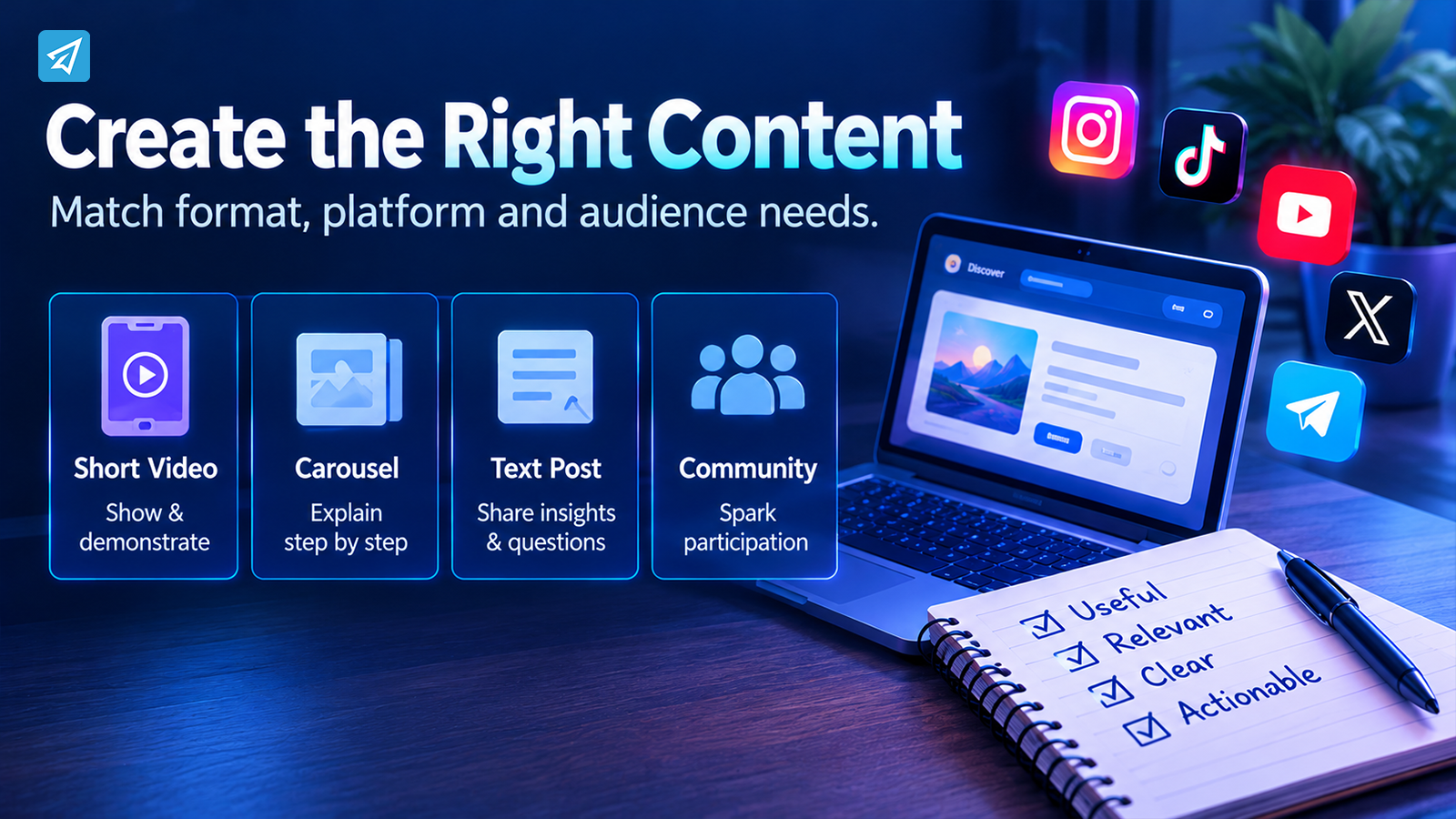
A format should make the central idea easier to understand, remember, or act on. It should not be selected simply because another account received strong results from it.
Use short-form video when demonstration or immediate attention matters. A clear opening, one central idea, readable on-screen text, and a focused ending can help viewers understand the value quickly. Remove unnecessary introductions and make sure the content delivers what the opening promises.
Use carousels or structured visual posts when people need to process several related ideas. Break a complicated explanation into a logical sequence. Each section should advance the argument rather than repeat the same point in different words.
Use text posts when the strength of the content is an insight, opinion, question, or useful explanation. Clear structure and a specific opening can help readers recognize the value without unnecessary decoration.
Use community-oriented content when the goal is participation. Ask focused questions, address recurring concerns, invite relevant experiences, or respond to discussions already happening around your subject.
The platform also matters. Instagram content often benefits from strong visual presentation and a recognizable profile identity. TikTok and YouTube Shorts can suit concise demonstrations and story-driven videos. YouTube can support deeper explanations, while Telegram channels can help maintain an ongoing relationship with an existing audience through useful updates and recurring content. Facebook and X may suit different combinations of community discussion, timely commentary, and information sharing, depending on the audience.
These are starting points, not rigid rules. Review how your intended audience actually consumes content on each platform, then adapt the presentation while keeping the underlying message consistent.
Make Each Post Easier to Discover and Understand
Even useful content can underperform when people cannot quickly understand what it offers.
Start with the opening. A strong first sentence or visual should identify a problem, reveal a useful outcome, or establish a clear reason to continue. Avoid openings that require extensive background knowledge before the main point becomes apparent.
Next, improve the content’s structure. Use concise paragraphs, readable text, descriptive captions, and visuals that support the message. For video, check whether the main idea is understandable without relying entirely on sound. For multi-part posts, make the sequence easy to follow.
Captions and relevant keywords should accurately describe the subject rather than merely repeat popular phrases. Hashtags, where appropriate, can provide additional context, but they cannot compensate for content that is irrelevant or difficult to understand.
Finally, consider distribution. A new post does not always need to remain in its original format. A detailed video may provide material for a short clip, a text summary, a carousel, or a Telegram channel update. Repurposing helps you reach people with different content preferences, provided each version is adapted to its destination.
Avoid copying the same caption and creative unchanged across every platform. Preserve the central idea, but tailor the opening, length, presentation, and call to action to the audience’s expectations.
Use Performance Metrics to Decide What to Change
Social media analytics become useful when they lead to a decision. Track a small set of metrics that correspond to your goal instead of collecting every available number.
| Goal or symptom | Metric to examine | What it may indicate | Next decision |
|---|---|---|---|
| Content is not reaching enough people | Reach or views | Weak discovery, limited distribution, or low initial interest | Test the topic, opening, and format |
| People see content but rarely respond | Comments, shares, or engagement rate | Limited relevance, value, or participation opportunities | Strengthen the takeaway and audience prompt |
| Posts attract attention but few followers | Follows attributed to content, where available | Weak account positioning or a mismatch between post and profile | Clarify content pillars and profile value |
| Video viewers leave early | Watch time or retention | Slow pacing, an unclear opening, or a mismatch between promise and delivery | Shorten the setup and improve the sequence |
| Content receives clicks but few conversions | Landing-page or conversion data | The next step may be unclear or poorly aligned with audience intent | Review the destination, offer, and call to action |
Interpret these numbers in context. A rise in views may reflect broader exposure rather than stronger audience interest. Engagement rates can also vary with platform, format, audience size, and calculation method, so compare like with like whenever possible.
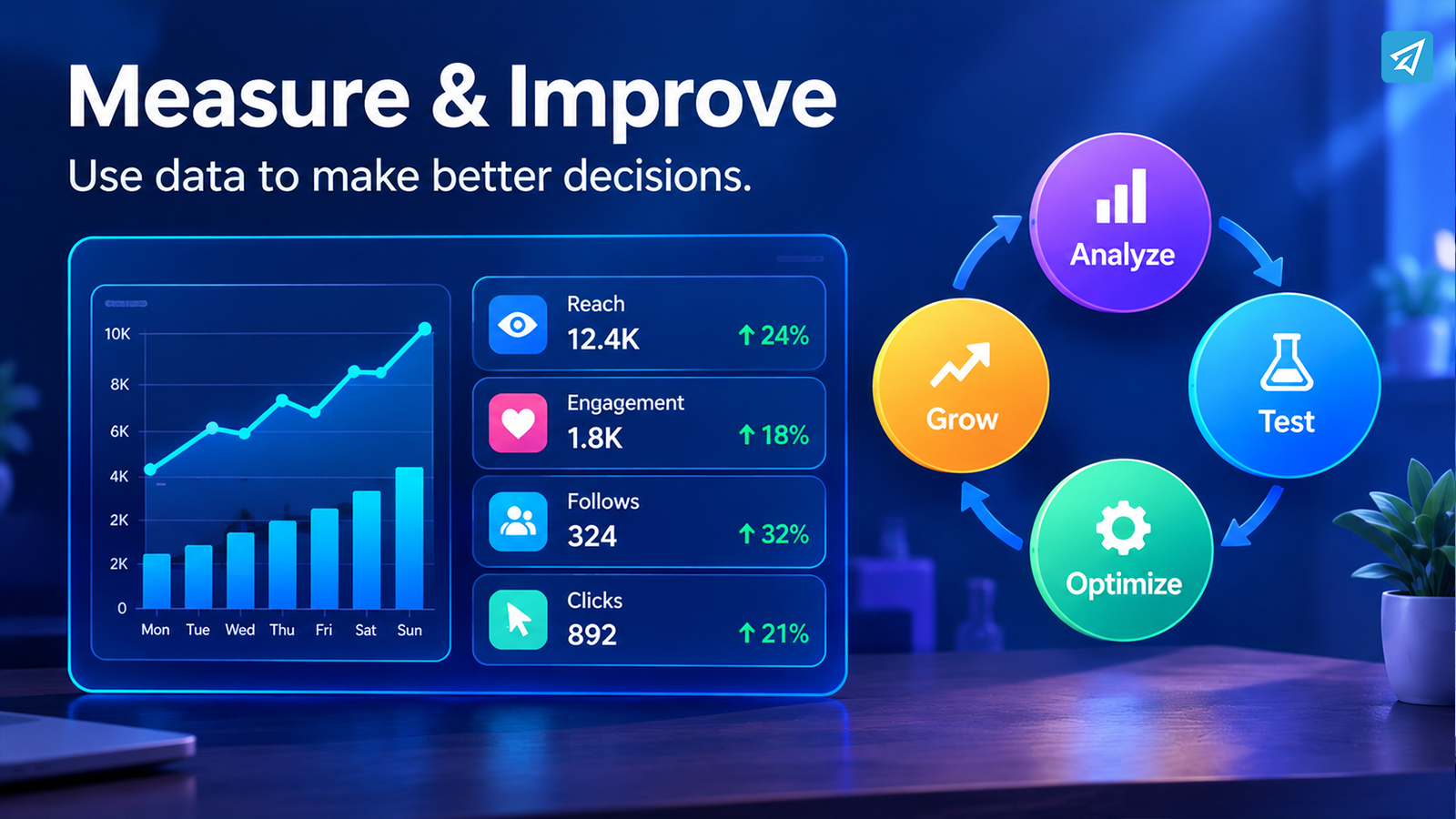
Create a simple review cycle: record the post’s objective, format, topic, and results; identify the strongest signal and weakest signal; then choose one change to test. For example, if educational videos retain viewers but attract few profile visits, test a clearer connection between the video topic and the value of following the account.
Give tests enough time and comparable conditions to produce useful evidence. Changing the topic, format, publishing frequency, and call to action simultaneously makes it difficult to understand which change mattered.
When Additional Execution Support Makes Sense
Content strategy, audience research, and performance analysis should remain the foundation of social media growth. Some campaigns, however, also involve repetitive execution tasks or specific metrics that require additional operational support.
An SMM Panel may support selected social media metrics and simplify certain execution tasks. OnlyTG SMM Panel lists services for Telegram, Instagram, TikTok, YouTube, Facebook, and X. Depending on the available service, users can review relevant details and select an option that matches a defined operational requirement.
This kind of tool should be treated as a supporting resource, not a replacement for content quality, audience relationships, analytics, or a coherent growth strategy. An increase in a selected metric does not automatically mean that a post is more relevant, that followers are genuinely interested, or that a campaign will generate sales.
Before using any service, identify the exact objective, review the service description and conditions, and consider whether the metric aligns with your broader goal. Continue evaluating audience responses and business outcomes independently.
How to Use OnlyTG SMM Panel as a Supporting Tool
If an SMM panel fits a specific operational need, OnlyTG keeps the ordering process relatively straightforward. You can use the Telegram bot or the OnlyTG Console. The official documentation describes selecting a platform and growth type, choosing a service, reviewing its available details, entering the target link and quantity, and confirming the order.
Option 1: Telegram Bot
Step 1 — Open the Bot
Find @SMMPonbot on Telegram and send /start.
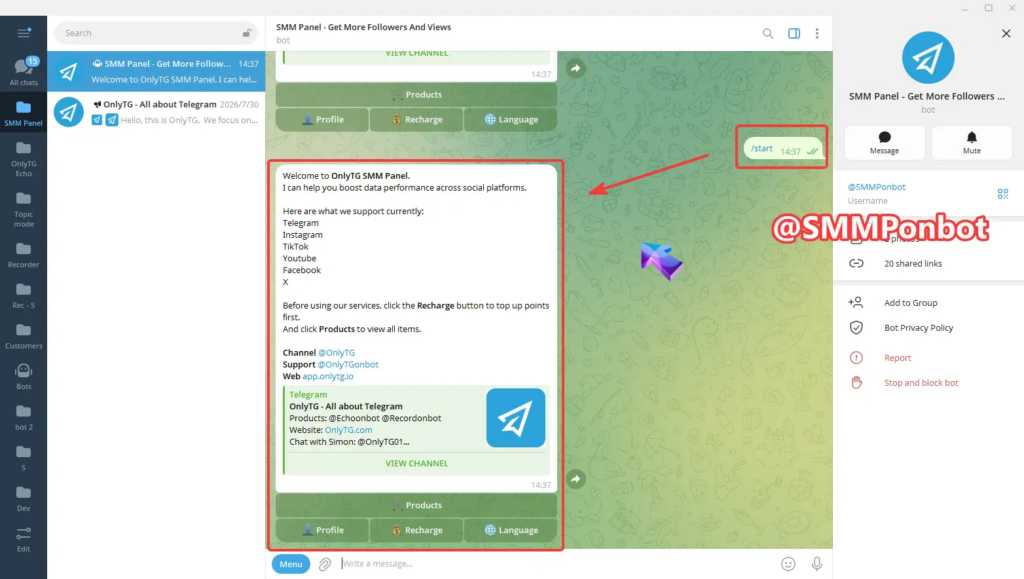
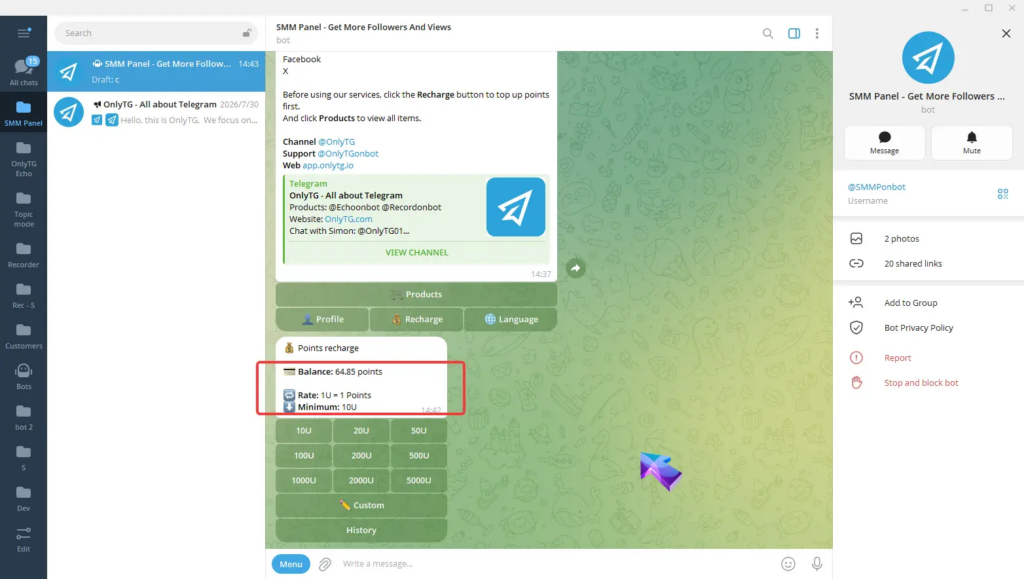
Step 2 — Add Balance
Use Recharge to fund the account. OnlyTG’s documentation currently lists 1 USDT = 1 point and a minimum recharge of 10 USDT.
Step 3 — Select the Platform and Growth Type
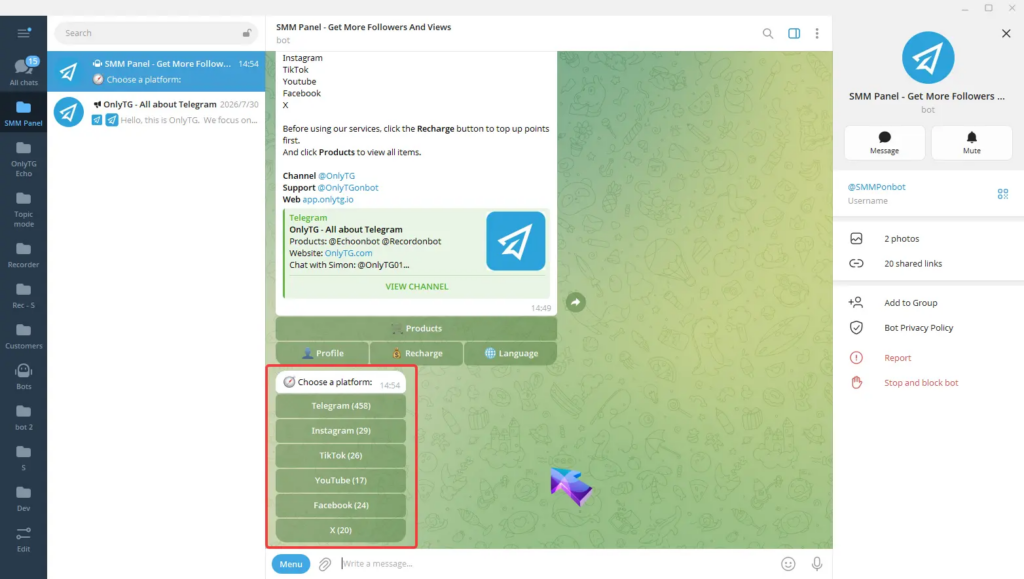
Open Products, choose the platform, then select the relevant growth category.
Step 4 — Review the Service
Check the service information, including price, quantity information, estimated waiting time, and notes.
Step 5 — Create the Order
Select Buy, enter the target link and quantity, review the details, and confirm.
Step 6 — Monitor the Order
Use Profile → Orders to review order records and status.
Option 2: OnlyTG Console
The Console provides a browser-based workflow.
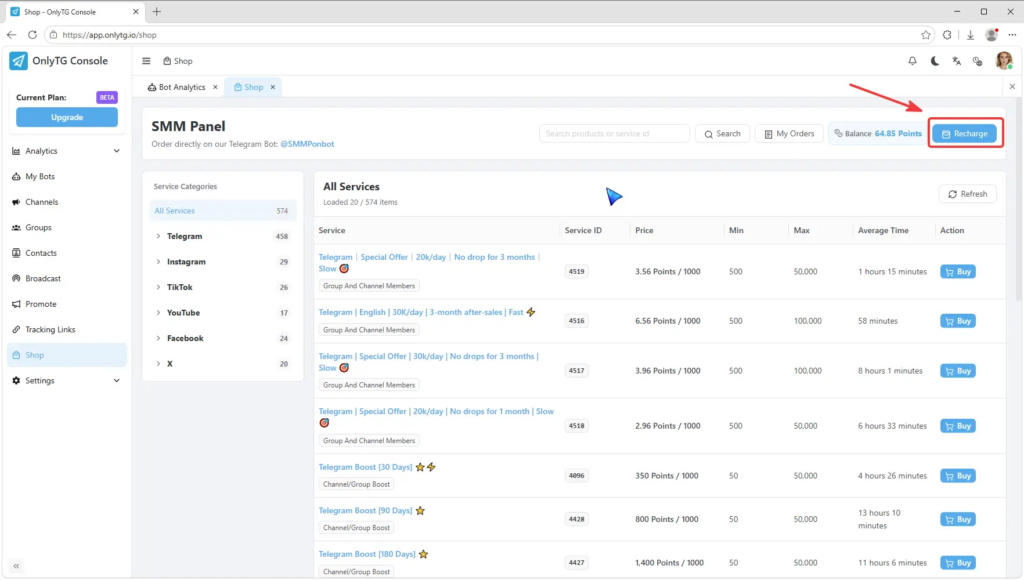
Open app.onlytg.io, log in, and select Shop. Choose a platform and growth category, review the available services, enter the target link and quantity, and create the order. The Console also provides service details and an My Orders area for reviewing order records and statuses.
Four Content Optimization Mistakes That Slow Growth
1. Treating every post as a sales opportunity. If every publication promotes an offer, audiences may have little reason to return. Provide useful information and community value alongside relevant promotional content.
2. Copying successful competitors without understanding their audience. A format that works for another creator may depend on their reputation, community, or subject expertise. Borrow useful principles, but develop content around your own audience’s needs.
3. Changing too many variables at once. If every new post uses a different topic, format, and publishing approach, you cannot identify what caused the result. Test one meaningful variable at a time when practical.
4. Confusing visible activity with meaningful progress. Views and reactions can help diagnose performance, but they do not independently demonstrate audience loyalty or business value. Connect each metric to the goal it is supposed to support.
Turn Optimization Into a Repeatable Growth Process
Knowing how to optimize social media content is less about finding one perfect format and more about making better decisions repeatedly. Define the result you want, identify the weakest part of the audience journey, improve the content that addresses it, and measure what changes.
Start with a manageable experiment: select one content pillar, publish a small group of related posts, and compare their performance using the same primary metric. Use what you learn to refine the next group rather than rebuilding your entire strategy after every result.
If you need additional execution support, explore OnlyTG SMM Panel as one optional part of your workflow. Keep the central priority where it belongs: creating relevant content, building audience trust, and using evidence to guide sustainable social media growth.
Frequently Asked Questions
1. How often should I optimize social media content?
Review performance regularly, but avoid changing your strategy after every post. A weekly or campaign-based review can help you identify patterns, while individual posts can provide early signals. The right frequency depends on how often you publish and how much comparable data you have.
2. How do I optimize social media content for different platforms?
Start with the audience and objective, then adapt the format, opening, length, and call to action to the platform. A short demonstration may work well as a vertical video, while a detailed explanation may need a longer video, structured visual post, or channel update. Measure performance separately on each platform.
3. Can an SMM Panel improve social media content performance?
An SMM Panel can support selected execution tasks and metrics, depending on the services available. It does not replace audience research, relevant content, community management, or performance analysis. Evaluate any service against a specific objective, and assess content quality and meaningful outcomes separately.