
A useful marketing video, product announcement, or educational post can take considerable time to produce, yet its exposure may remain limited to the audience of the account that originally published it. The problem is not always the content itself. Often, businesses have no clear process for distributing that content beyond its first destination. Learning how to amplify content across social media platforms means creating more opportunities for relevant audiences to discover, share, and interact with existing material. The key is to build a distribution system that adapts content to different platforms instead of simply publishing identical posts everywhere.
Why Publishing the Same Content Everywhere Rarely Works
Cross-platform distribution is often misunderstood as uploading one post to several social networks. Although this increases the number of places where content appears, it does not necessarily increase its effectiveness.
Each platform has a different content environment, audience behavior, and discovery mechanism. A detailed product explanation that works well as a YouTube video may be too slow for a short-form TikTok audience. A visually attractive Instagram post may need additional context before it becomes a useful Facebook discussion. A concise announcement might work in an X post but require a different presentation in a Telegram channel.
The distinction is between content duplication and content amplification.
Content duplication distributes the same material without considering how people consume it on each platform. Content amplification uses an original asset as the foundation for several relevant experiences, each designed for a particular audience and distribution environment.
For example, imagine a software company publishing a detailed tutorial about a new product feature. Instead of sharing the same tutorial link repeatedly, the marketing team could:
- Extract a short demonstration for TikTok.
- Create a visual feature summary for Instagram.
- Publish a more detailed walkthrough on YouTube.
- Share the tutorial and supporting discussion in its Facebook community.
- Post a concise product insight on X.
- Send a relevant announcement to its Telegram channel.
These formats serve different discovery opportunities while communicating the same underlying message.
The objective is not to maximize the number of platforms used. It is to increase the number of relevant opportunities through which people can discover and consume the original content.
Start With One Strong Content Asset, Not Six Separate Posts
Before distributing anything, identify the original content worth amplifying.
Not every post deserves additional promotional effort. A weak or unclear message can become more widely distributed without becoming more useful. Amplification should therefore begin with content selection rather than platform selection.
Evaluate whether the content has distribution potential
Review existing content against three practical questions.
1. Does it communicate a useful idea?
Content should provide something that an audience can understand, learn, discuss, or apply. This could be a product demonstration, a practical tutorial, a customer question, an industry explanation, or a solution to a common problem.
2. Can its central message survive different formats?
A strong content asset usually contains smaller ideas that can stand independently.
A 10-minute educational video, for example, may contain several individual tips, a demonstration, a common mistake, and a final recommendation. Each element could become a separate short-form content opportunity.
3. Does it have a clear audience?
A post about improving online store conversions may interest e-commerce operators but have little relevance to a general entertainment audience.
Knowing who should discover the content helps determine where and how to distribute it.
Prioritize assets that can support multiple distribution opportunities
A practical content selection process can look like this:
- Identify posts that already generate meaningful engagement or relevant traffic.
- Look for evergreen material that remains useful after its original publication date.
- Find content containing several distinct ideas or useful information points.
- Prioritize material connected to a product, campaign, educational objective, or business outcome.
- Remove content that depends heavily on outdated information or a time-sensitive announcement.
This approach helps marketing teams spend distribution resources on material with a clear purpose.
Adapt the Original Message to Each Platform
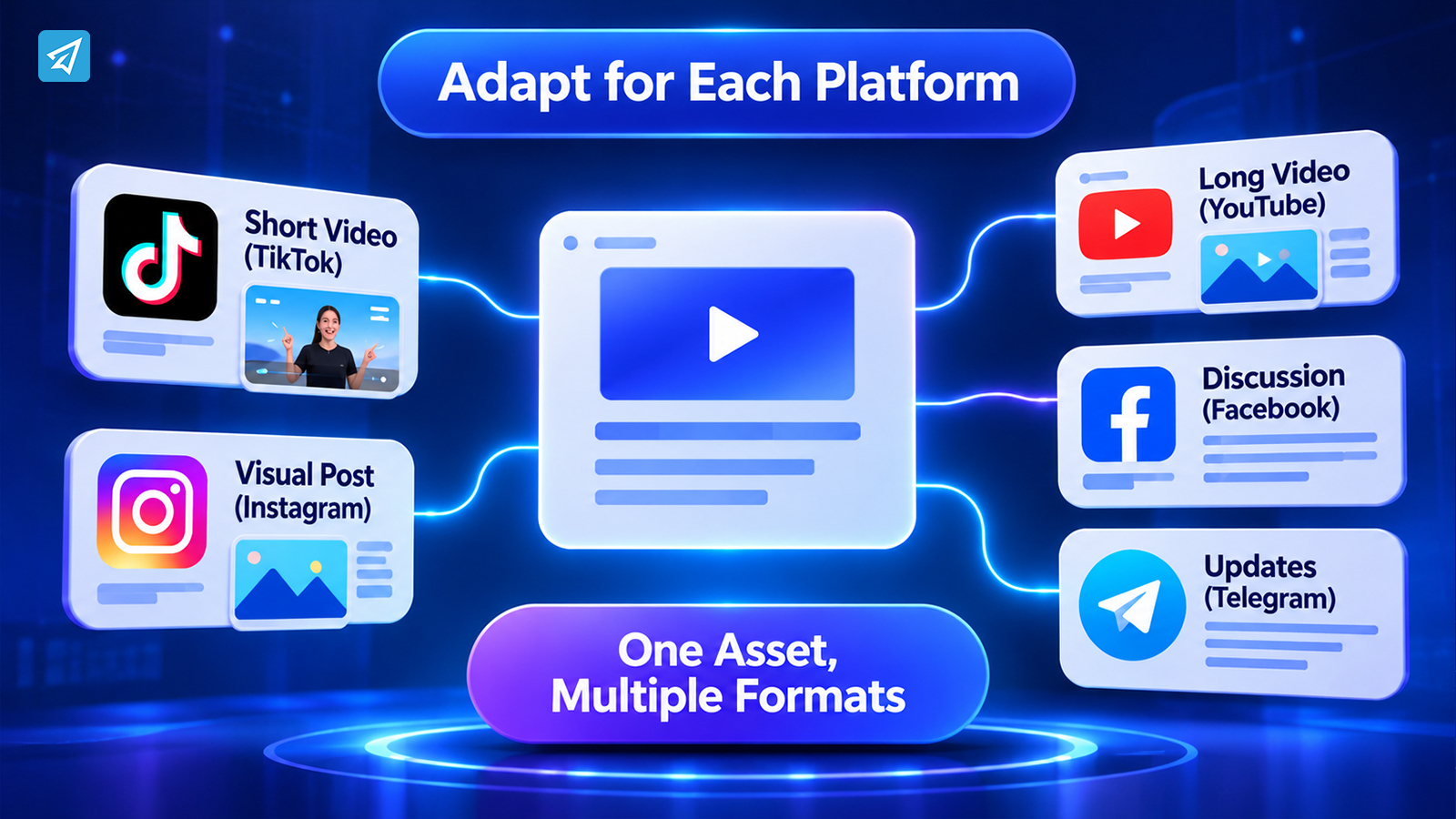
Once a suitable content asset has been selected, the next task is to create platform-specific versions.
The central message should remain consistent, but its presentation should change according to how users interact with each network.
Turn detailed content into short-form discoveries
Long-form content often contains information that can be separated into smaller, easier-to-consume pieces.
For example, a business publishing a detailed guide about website security could extract:
- A short video explaining one common security mistake.
- An Instagram carousel showing several practical precautions.
- A YouTube demonstration explaining a complete process.
- A Facebook post asking businesses about their security challenges.
- An X thread summarizing important recommendations.
- A Telegram announcement linking to the full guide.
Each version should communicate one understandable idea and give interested users a reason to explore the original material.
Avoid simply cutting a long video into random sections. A short-form asset needs its own opening, context, and takeaway.
Match the format to the platform’s content environment
Different networks offer different distribution opportunities.
Instagram: Use visual summaries, carousels, Reels, and concise captions to communicate the most immediately useful parts of a larger content asset.
TikTok: Extract focused demonstrations, quick explanations, or interesting moments. The opening should quickly establish why the video deserves attention.
YouTube: Use longer demonstrations, tutorials, explanations, and supporting Shorts to reach viewers with different content preferences.
Facebook: Adapt content into community-oriented posts, discussions, videos, or relevant promotional updates. Give people a reason to respond rather than relying exclusively on outbound links.
X: Convert important insights into concise posts or connected explanations. Focus on a clear argument, useful observation, or discussion-worthy question.
Telegram: Use channel posts to distribute announcements, summaries, educational material, and links to the complete resource. A clear message helps subscribers understand why the information is relevant.
The same topic can appear on all six platforms, but the format, opening, caption, and call to action should reflect each environment.
Build a content adaptation matrix
A simple matrix prevents teams from producing repetitive versions without a clear distribution purpose.
| Original asset | Platform adaptation | Primary purpose |
|---|---|---|
| Educational article | Instagram carousel | Make key information easy to discover |
| Product demonstration | TikTok short video | Introduce one practical benefit |
| Detailed tutorial | YouTube video | Explain the complete process |
| Industry insight | Facebook discussion | Encourage relevant conversations |
| Research finding | X post or thread | Share a concise, discussion-worthy insight |
| New resource | Telegram channel post | Inform existing subscribers |
This matrix is not a requirement to publish everything everywhere. It is a planning tool for identifying which adaptations are worth producing.
Extend Distribution Beyond Your Own Social Media Accounts

Platform adaptation creates more publishing opportunities, but the next challenge is getting the content in front of people who do not already follow the business.
An effective amplification strategy should consider distribution partners and additional promotional channels.
Work with people who already have audience trust
Influencer partnerships can help introduce content to communities that a business has not yet reached.
However, follower count alone is not a sufficient selection criterion.
A suitable partner should have:
- An audience relevant to the content topic.
- A communication style that fits the brand.
- Evidence of meaningful audience interaction.
- A reasonable connection between their usual content and the promoted material.
For example, a SaaS company releasing a tutorial for independent online retailers might approach creators who regularly discuss e-commerce operations. A relevant creator sharing the tutorial may generate more useful discovery opportunities than a much larger account with an unrelated audience.
Before starting a collaboration, agree on the content format, publication schedule, compensation if applicable, disclosure expectations, and tracking method.
Use separate campaign links or UTM parameters where possible to understand which partnership generates visits and other meaningful actions.
Encourage voluntary sharing from relevant communities
Employees, customers, professional contacts, and community members may help distribute useful content when they genuinely find it valuable.
The important distinction is that advocacy should be voluntary and relevant.
A business can make sharing easier by:
- Providing a short summary of the content.
- Preparing platform-appropriate sharing materials.
- Explaining who might benefit from the information.
- Giving participants the freedom to adapt their own message.
- Avoiding repetitive requests that make sharing feel compulsory.
This approach can extend distribution beyond brand-owned accounts while preserving a more natural communication style.
Use paid promotion selectively
Paid social promotion can provide additional exposure when a business has a clear reason to reach a specific audience.
However, not every published post deserves advertising expenditure.
Start with content that has a defined purpose, such as introducing a useful resource, supporting a product launch, or generating visits to a relevant landing page.
Before spending, establish:
- The audience the campaign should reach.
- The content or destination being promoted.
- The action users should take.
- The budget and campaign duration.
- The performance indicators that will guide decisions.
Do not assume that a post with the most likes is automatically the best candidate for paid promotion. A post generating relevant website visits or meaningful enquiries may be more valuable for a business objective.
Coordinate Amplification Around a Campaign, Not Random Publishing
When multiple platforms are involved, timing and message coordination become important.
Publishing unrelated adaptations whenever they are ready can make a campaign feel fragmented. A better approach is to organize distribution around one central message or promotional objective.
Consider a hypothetical online business introducing a new product feature.
Before launch: Prepare the main demonstration, short-form clips, visual summaries, and supporting explanations.
Launch day: Publish the main announcement, distribute platform-specific versions, and notify relevant existing communities.
Following days: Share additional demonstrations, answer questions, work with suitable creators, and publish supporting educational content.
After the initial campaign: Review traffic sources, audience responses, and meaningful actions. Reuse the most useful content in future communications.
The exact schedule should depend on the campaign, available resources, and audience behavior.
The objective is to create several connected discovery opportunities rather than expecting one announcement to generate all the desired exposure.
Maintain a consistent message across different formats
Adaptation should not change the meaning of the original content.
Before publishing each version, check:
- Does it communicate the same central message?
- Is the information accurate and current?
- Does the platform-specific format provide enough context?
- Does the call to action lead to the intended destination?
- Are campaign links correctly assigned?
- Does the content feel appropriate for the audience?
This is especially important when several people or agencies manage different social media accounts.
How to Measure Whether Cross-Platform Amplification Is Working
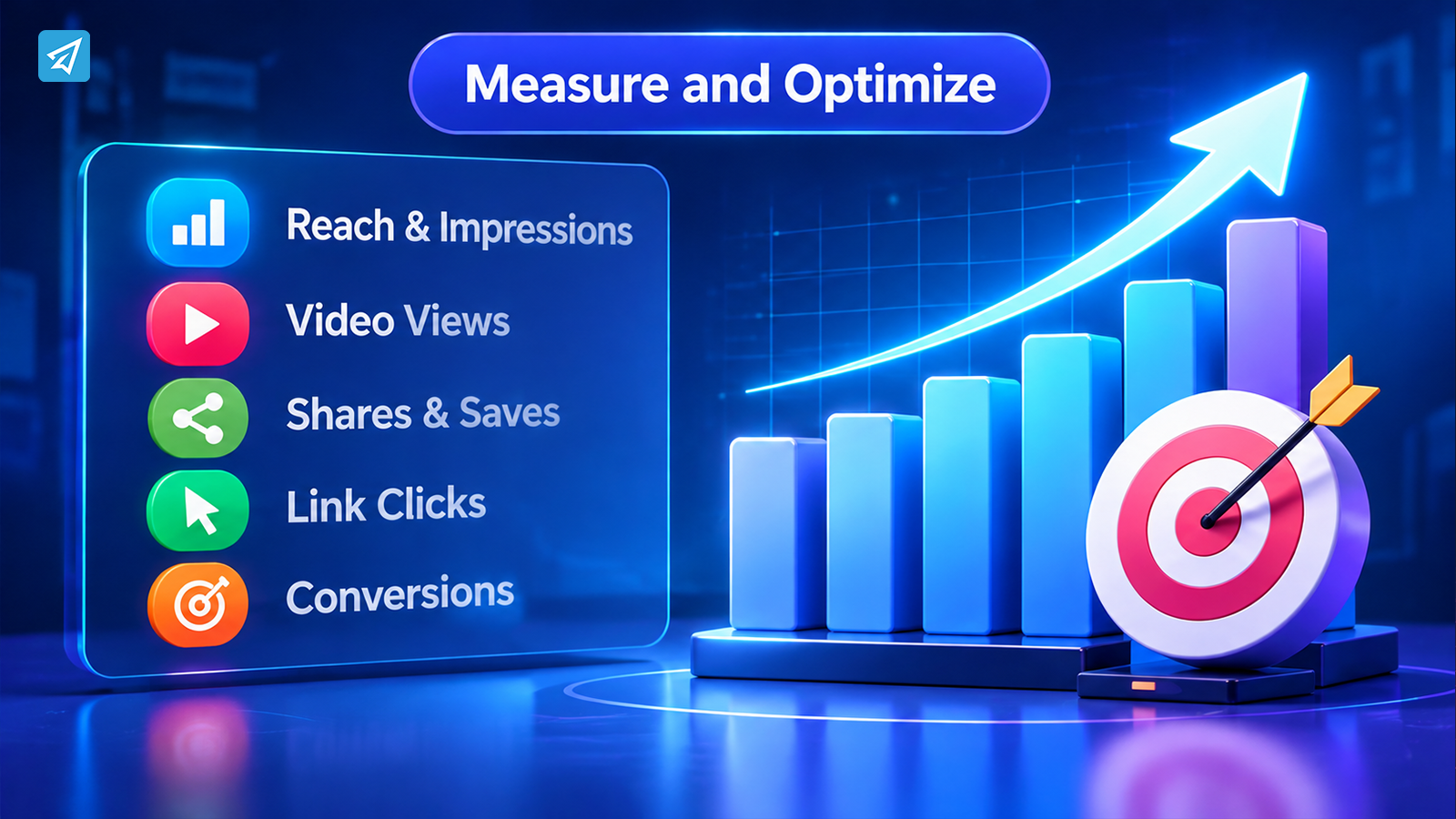
A campaign can generate activity on several networks without achieving its actual objective.
For this reason, measure distribution performance at both the platform and campaign levels.
Track discovery, engagement, and destination activity
Start with indicators that explain how people encounter and respond to the content.
Impressions and reach: These help evaluate the exposure generated by individual platform posts. Compare them across channels while remembering that platforms may define and report these metrics differently.
Video views: Useful when short-form or long-form video is a major part of the amplification strategy. Interpret views alongside available retention or watch-time information rather than treating every view as equal.
Shares and saves: These can help identify content that audiences consider worth revisiting or distributing to others.
Link clicks and referral traffic: These show whether social media distribution encourages people to visit the intended destination.
Conversions or meaningful actions: When relevant tracking is available, evaluate newsletter registrations, enquiries, product-page actions, or other outcomes connected to the campaign.
| Performance observation | Possible interpretation | Recommended action |
|---|---|---|
| High reach but few meaningful interactions | Content attracts exposure but may not connect with audience needs | Review relevance, message, and opening |
| Strong video views but limited destination visits | Viewers may not understand the next step | Improve context and call to action |
| Many link clicks but few conversions | The destination may not meet visitor expectations | Review landing-page relevance and experience |
| One platform consistently attracts relevant traffic | Its audience and content format may fit the campaign | Consider allocating more distribution resources there |
| Many shares but limited website activity | The content may be useful independently of the destination | Clarify the relationship between the post and the full resource |
Compare platforms without treating every metric as equivalent
A TikTok video view, an Instagram impression, and a Telegram channel post view do not necessarily represent the same type of audience exposure.
Instead of combining all platform metrics into one total, evaluate each platform according to its role.
For example:
- TikTok may introduce the topic to new viewers.
- Instagram may provide visual discovery and profile exploration.
- YouTube may support deeper content consumption.
- Facebook may encourage community discussion.
- X may generate interest through concise insights.
- Telegram may communicate updates to an existing subscriber base.
Then assess whether these different contributions support the same campaign objective.
Use tracking links to identify useful distribution sources
When a campaign is distributed through multiple channels, tracking links make performance analysis more informative.
UTM parameters can distinguish traffic from different sources, campaigns, and content placements.
For example, a business could use separate campaign URLs for its Instagram carousel, YouTube description, and Telegram announcement.
After publication, compare the resulting referral activity and destination behavior.
This helps answer a more useful question than simply asking which post received the most views:
Which distribution source brought the most relevant audience to the intended destination?
How to Use OnlyTG SMM Panel as a Supporting Tool
If an SMM panel fits a specific operational need, OnlyTG keeps the ordering process relatively straightforward. You can use the Telegram bot or the OnlyTG Console. The official documentation describes selecting a platform and growth type, choosing a service, reviewing its available details, entering the target link and quantity, and confirming the order.
Option 1: Telegram Bot
Step 1 — Open the Bot
Find @SMMPonbot on Telegram and send /start.
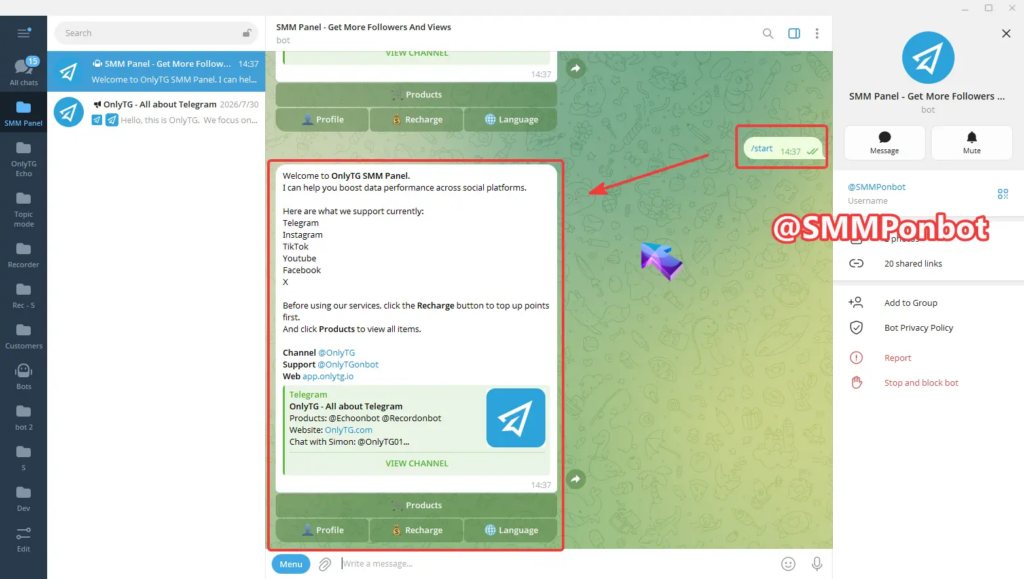
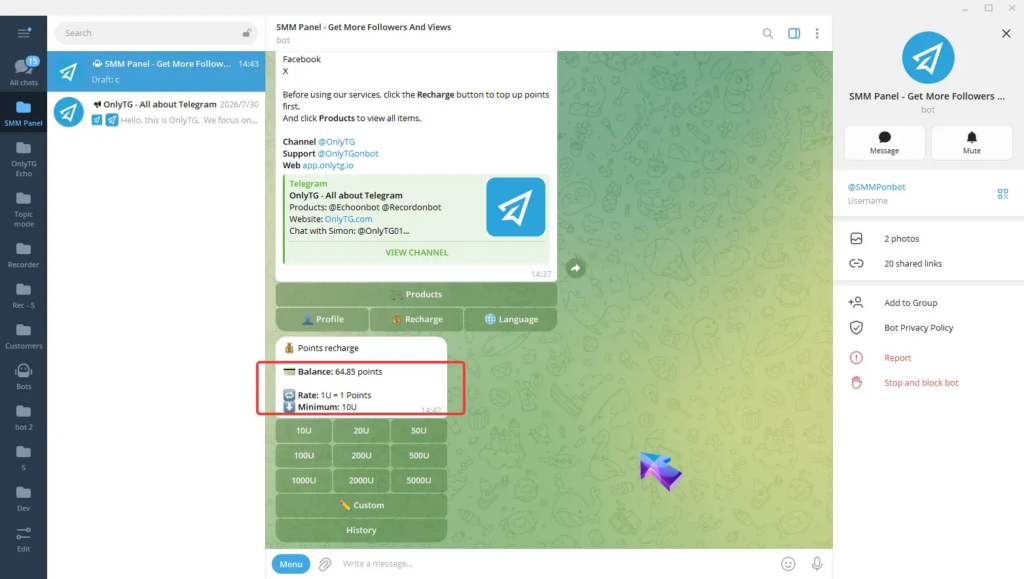
Step 2 — Add Balance
Use Recharge to fund the account. OnlyTG’s documentation currently lists 1 USDT = 1 point and a minimum recharge of 10 USDT.
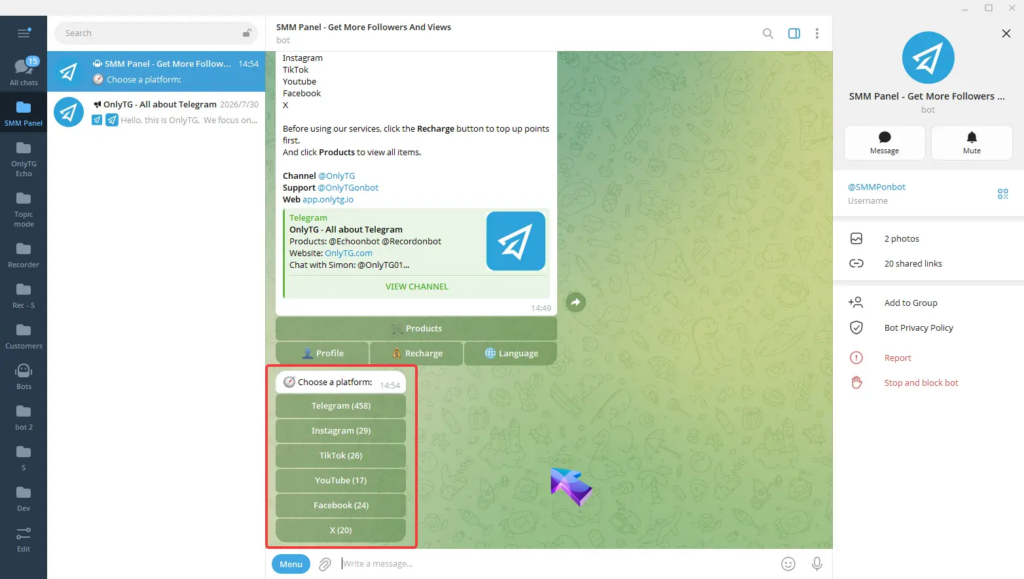
Step 3 — Select the Platform and Growth Type
Open Products, choose the platform, then select the relevant growth category.
Step 4 — Review the Service
Check the service information, including price, quantity information, estimated waiting time, and notes.
Step 5 — Create the Order
Select Buy, enter the target link and quantity, review the details, and confirm.
Step 6 — Monitor the Order
Use Profile → Orders to review order records and status.
Option 2: OnlyTG Console
The Console provides a browser-based workflow.
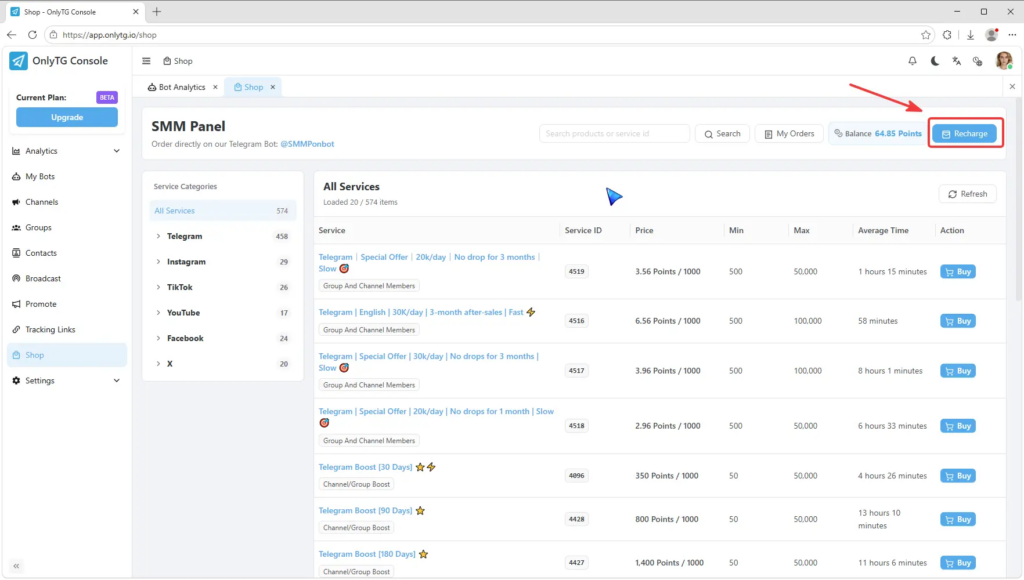
Open app.onlytg.io, log in, and select Shop. Choose a platform and growth category, review the available services, enter the target link and quantity, and create the order. The Console also provides service details and an My Orders area for reviewing order records and statuses.
Frequently Asked Questions
1. How can I amplify content across multiple social media platforms without creating new content for each one?
Start with one substantial content asset, such as an article, video, product demonstration, or research report. Identify its most useful ideas and adapt them into platform-specific formats. For example, a tutorial can become a short video, an Instagram carousel, an X thread, and a Telegram announcement. Each version should have its own context and presentation while preserving the original message.
2. Which social media platforms should I prioritize for content amplification?
Choose platforms according to your target audience, content format, and campaign objective. TikTok and Instagram can support short-form visual discovery, YouTube is suitable for more detailed video content, Facebook can support community-oriented distribution, X can communicate concise insights, and Telegram can distribute updates to subscribers. You do not need to use every platform. Prioritize those that provide relevant opportunities to reach your intended audience.
3. How do I know whether a content amplification strategy is successful?
Evaluate performance against the original campaign objective. Review platform reach, impressions, views, engagement, shares, referral traffic, and relevant conversions where tracking is available. Compare distribution sources rather than relying on total views alone. A successful strategy should create more relevant opportunities for people to discover, consume, and act on your content.
Conclusion: Make Every Strong Content Asset Work Harder
Amplifying content across social media platforms requires more than copying posts between accounts. It involves selecting useful original material, adapting its presentation to different platform environments, activating relevant distribution channels, and measuring what each source contributes.
The most effective approach is to treat every campaign as a connected distribution system. Start with a clear message, create platform-appropriate versions, use partnerships and paid promotion selectively, and evaluate the resulting audience activity.
With a repeatable process, businesses can extend the value of existing content while making more informed decisions about where their next distribution efforts should go.
Explore the OnlyTG SMM Panel if selected social media metric-support tasks are relevant to your campaign workflow, and keep content quality and audience relevance at the center of your amplification strategy.