
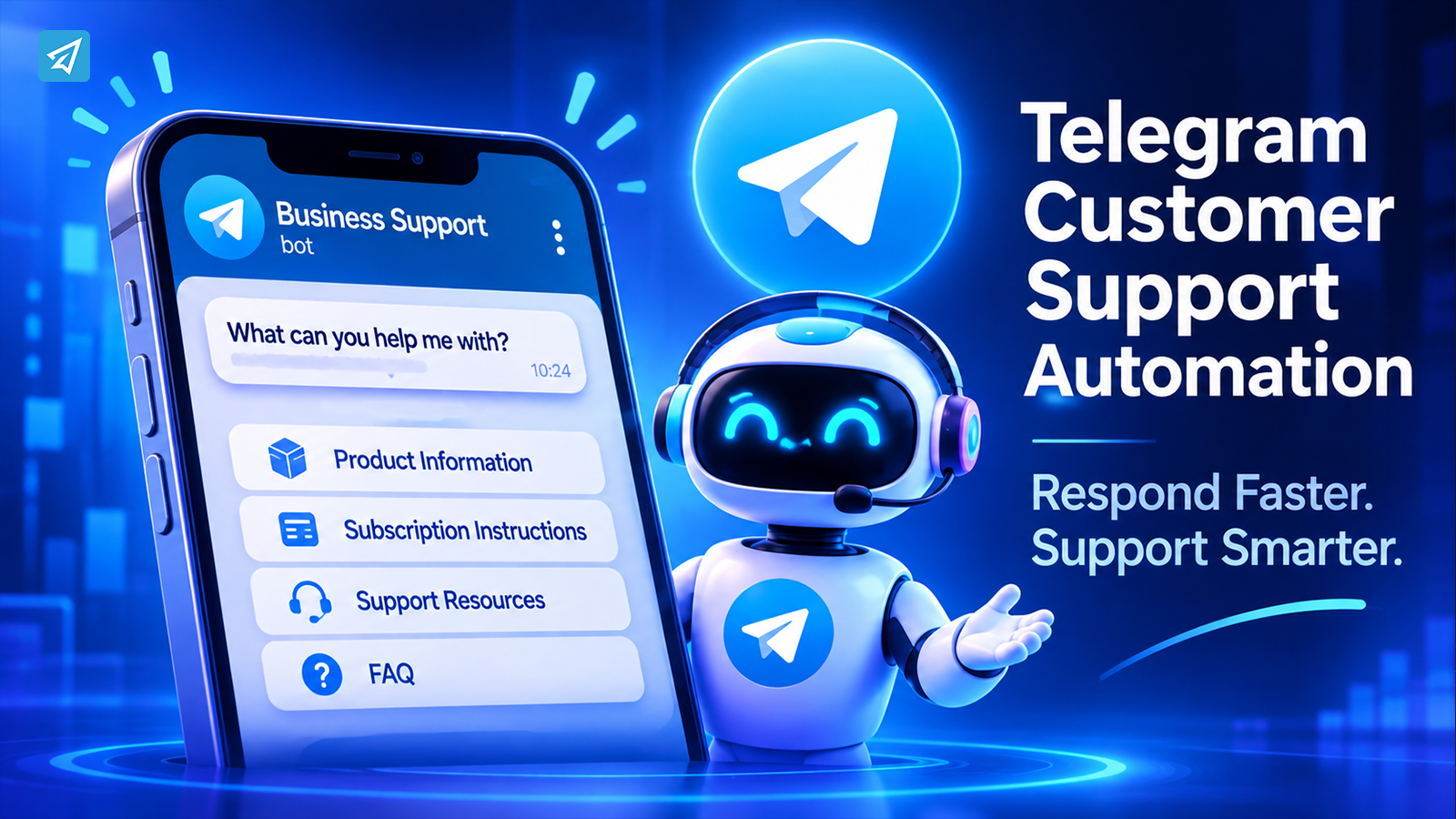
A customer visits a business’s Telegram channel, clicks its bot link, and asks about a product. Another wants to know how to place an order. Someone else asks the same question that three previous customers have already asked. When every inquiry requires a staff member to read, understand, and manually write a response, even a small support operation can become difficult to manage. The solution is not simply to reply faster. It is to organize Telegram customer support around a repeatable workflow that handles routine questions automatically while keeping business communication clear and consistent.
It Starts With One Simple User Action
Imagine an online business that uses Telegram as a customer communication channel. It publishes product updates through a channel, operates a Telegram group for its community, and provides a bot where customers can ask questions.
A potential customer discovers the business through a social media post and opens its Telegram bot.
The first interaction might be simple:
- A customer wants to know what the business offers.
- Another wants information about product availability.
- A returning customer needs instructions for using a service.
- A group member asks where to find an important announcement.
Each interaction represents an opportunity to help someone move forward.
However, the quality of that experience depends on what happens immediately after the customer sends a message.
If the bot provides no useful information, the customer may need to wait for an administrator. If the business has no organized response process, the customer might receive different answers depending on who handles the conversation.
This is where Telegram customer support needs a defined operating process.
Instead of treating every incoming message as an isolated task, businesses can identify common customer needs and prepare appropriate responses in advance.
The objective is straightforward: make the first interaction useful, provide relevant information quickly, and reduce unnecessary manual communication.
What Happens When the Process Is Manual?
Consider a business receiving 30 customer inquiries throughout the day. Many of those inquiries concern the same subjects:
- Product details
- Subscription instructions
- Service availability
- Payment procedures
- Frequently asked questions
- Links to important resources
Without automation, every inquiry enters a manual response cycle.
Customer sends a question → Staff member notices the message → Staff checks the relevant information → Staff writes a response → Customer waits.
The process appears manageable when message volume is low. As the business attracts more customers, however, the same routine becomes increasingly demanding.
Repetitive questions consume valuable time
A support employee might spend several minutes explaining the same subscription procedure to different customers.
The information does not change, but the employee must repeatedly locate and communicate it.
This leaves less time for complicated questions that genuinely require individual attention.
Response delays affect the customer experience
Customers do not necessarily send messages during business hours. Some inquiries arrive late at night, during weekends, or while administrators are occupied with other responsibilities.
When customers cannot immediately find basic information, they may leave before receiving an answer.
Different employees may provide different information
Without standardized responses, two employees might explain the same service using different instructions.
Even when both answers are correct, inconsistent wording can create confusion.
Growing communities create additional support work
Businesses that operate Telegram groups face another challenge.
Members ask questions publicly, repeat previous discussions, share links, or request information that administrators have already published.
The result is an operational problem: the team spends more time maintaining conversations and less time improving the customer experience.
Manual support is still important for complex situations. The problem is using manual effort for every interaction, including tasks that follow predictable patterns.
Now Add Automation to the Workflow
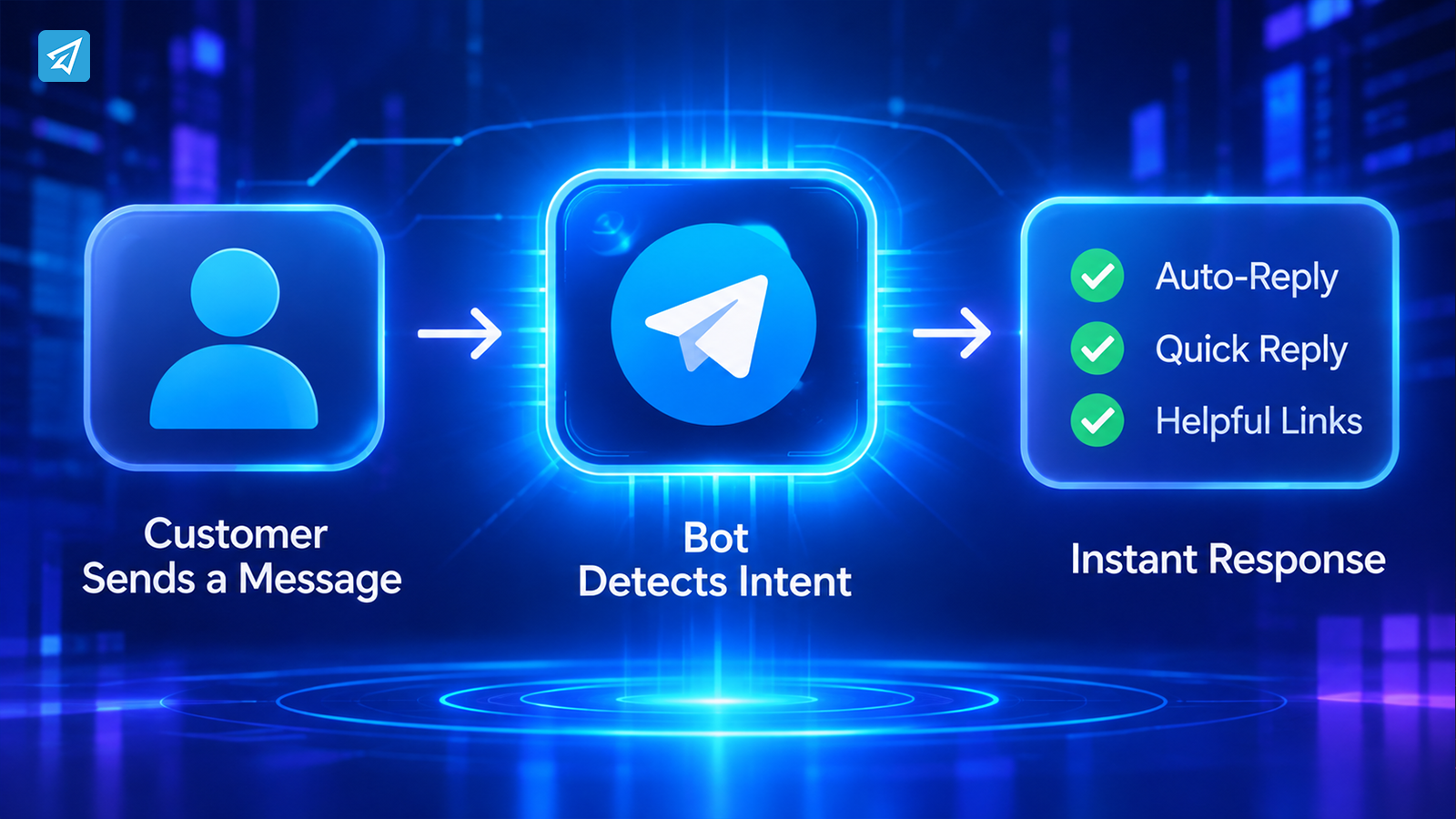
The most useful way to approach Telegram customer support automation is to separate routine communication from situations that require individual judgment.
Before: Manual communication
- Customer sends a message.
- Staff member reads and processes it.
- Staff manually prepares a response.
After: Automated communication
- Customer sends a message.
- Telegram chatbot receives the interaction.
- Automation rule identifies the configured trigger.
- Relevant preset response is delivered.
Conceptual workflow: Automated responses handle predefined interactions, while staff can continue managing situations that need personal attention.
Automation does not mean eliminating human support.
It means deciding which interactions can be standardized and preparing those responses before customers need them.
For example, a business can automate its welcome message, configure replies for common keywords, prepare reusable responses for its staff, and maintain a more organized Telegram community.
This creates a more predictable communication process.
Step 1: Handle the First Interaction
The first message matters because it establishes what customers can expect from the business.
When someone opens a Telegram bot for the first time, they should not have to guess what to do next.
A useful welcome message can introduce the business, explain the bot’s purpose, and direct customers toward the information they need.
For example:
Customer: Opens the Telegram bot.
Automated welcome message:
Welcome! Thanks for contacting our business.
What would you like to know?
- Product information
- Subscription instructions
- Service details
- Frequently asked questions
This small interaction provides an immediate starting point.
Instead of waiting for an administrator to explain the available options, customers receive basic guidance automatically.
With OnlyTG Echo, businesses can configure a Start Message that is delivered when a user activates the bot through the /start command or first opens it.
The message can contain text, media, and buttons, allowing businesses to organize introductory information into a more useful presentation.
The business should keep this message focused.
A long introduction containing every possible product detail can overwhelm new users. A short greeting with a few relevant directions is generally more practical.
The purpose is to help customers identify their next step.
Step 2: Recognize What the Customer Needs
After the initial interaction, the next challenge is understanding why someone has contacted the business.
Not every customer asks the same question, but many inquiries contain recognizable words or phrases.
For example:
Customer: “How can I subscribe?”
Customer: “What are your subscription options?”
Customer: “Where can I find the subscription instructions?”
These messages may contain the keyword “subscribe” or “subscription.”
A business can prepare a response explaining the subscription process and configure the bot to send that information when a matching keyword is detected.
This is the basic idea behind keyword-based automated replies.
With OnlyTG Echo, administrators can configure predefined keywords and associate them with prepared messages. When a customer’s message contains a configured keyword, the bot sends the corresponding response. Multiple keywords can be associated with a reply configuration.
A practical support setup might include:
| Customer inquiry | Example keyword | Prepared response |
|---|---|---|
| Subscription information | Subscribe | Subscription instructions |
| Product details | Product | Product information |
| Service availability | Available | Availability guidance |
| Payment instructions | Payment | Payment information |
| General assistance | Help | Support resources |
These examples are suggested business configurations, not predefined OnlyTG Echo templates.
The quality of this workflow depends on choosing keywords carefully.
A keyword that is too broad may trigger an irrelevant response. A keyword that is too specific may fail to recognize common variations.
Businesses should review actual customer questions and build their keyword rules around the language customers naturally use.
They should also test the responses before making the automation available.
Step 3: Move Beyond Simple Replies
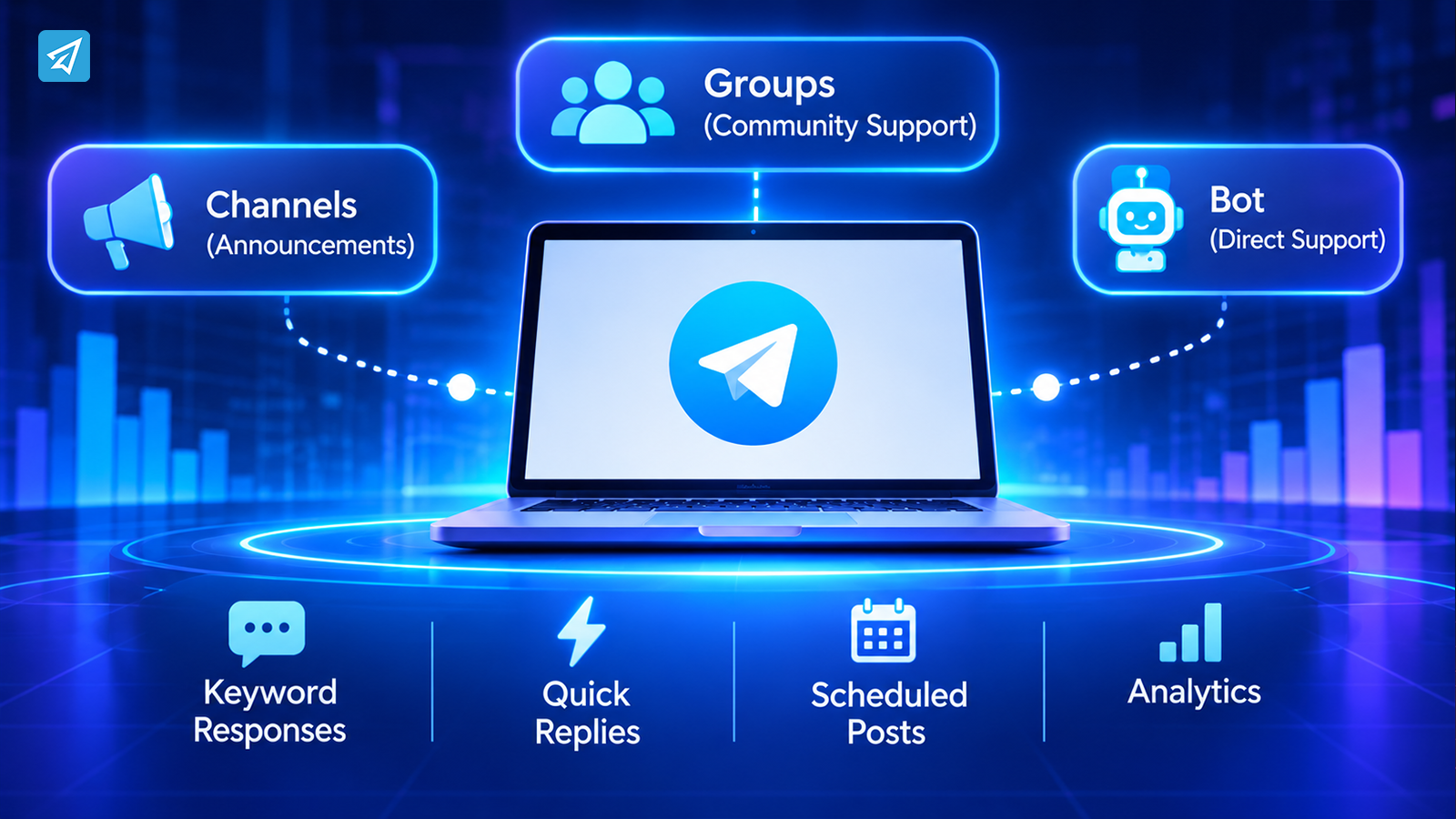
Automated customer support becomes more useful when businesses consider the entire communication environment rather than focusing exclusively on private bot conversations.
For many companies, Telegram consists of three connected operational areas:
- A bot for direct customer interaction.
- A group for community communication.
- A channel for announcements and important updates.
Each area serves a different purpose.
Use quick replies for recurring staff interactions
Not every response needs to be sent automatically.
Some customers ask questions that require an employee to review the situation first. In these cases, prepared messages can still reduce repetitive work.
For example, a staff member might regularly explain:
- How to find an order reference.
- Where to read the service instructions.
- Which information to provide when requesting assistance.
- Where to find the latest business announcements.
OnlyTG Echo provides Quick Reply functionality that allows administrators to prepare reusable messages and configure triggers for sending them during bot conversations. These messages can include text, media, and buttons.
This approach preserves human involvement while reducing the time needed to compose routine explanations.
Keep group conversations organized
A public Telegram group can become an important customer support environment, but it also creates moderation responsibilities.
New members may join without understanding the community rules. Some may publish promotional links or repeat prohibited content.
OnlyTG Echo provides several relevant group-management capabilities:
- Group CAPTCHA: Helps verify new members before they participate.
- Group Greeting: Sends a configured greeting when a new member joins and passes CAPTCHA verification when enabled.
- Group Rules: Allows administrators to configure community rules and penalties for violations.
- Group Keyword Reply: Sends preset messages when configured keywords are detected in group conversations.
For example, when a group member asks where to find product instructions, a configured keyword response can direct them toward the relevant resource.
This reduces the need for administrators to repeatedly interrupt their work to answer the same public question.
Keep important announcements accessible
Businesses can also use Telegram channels to publish service updates, instructions, and important customer notices.
Channel posts, scheduled posts, and loop posts help organize recurring communication.
The important distinction is that customer support does not end after the first question is answered.
Customers may need updated instructions, reminders, and access to information long after their initial interaction.
Step 4: Keep the Workflow Running Automatically
A customer support process should not depend entirely on administrators remembering when to publish every update.
Suppose an online business changes its subscription instructions.
Customers need to know about the change, but the information may also need to remain accessible to people who discover the business several days later.
A more organized communication process could look like this:
Updated information → Prepared Telegram content → Scheduled publication → Customer access → Ongoing communication
Businesses can use scheduled channel posts to prepare announcements in advance.
For information that needs to remain visible at recurring intervals, loop posts can help maintain regular publication.
OnlyTG Echo supports scheduled channel posts and loop posts for both channels and groups. Its documented capabilities also include broadcasts to bot contacts.
Broadcasts can be useful when a business needs to communicate an update to its bot contacts.
For example, a company might send information about a revised service procedure or a newly published set of instructions.
However, businesses should distinguish between helpful updates and excessive messaging.
A good communication schedule should be based on customer needs. Messages should be relevant, accurate, and appropriate for the audience.
The objective is not to send more messages. It is to make important information easier to receive and find.
Step 5: Measure What Is Happening

Once automation becomes part of the daily support process, businesses need to understand whether their communication setup is working as expected.
Without measurement, administrators may know that the bot is sending responses but have little understanding of how customers are interacting with it.
A useful review should consider several questions:
- Are people activating the bot?
- Which customer sources bring contacts to the bot?
- Are customers interacting with the available messages?
- Is the bot operating as expected?
- Which communication sources deserve more attention?
OnlyTG Echo provides bot statistics and contact information through its administration console, including information about contacts, bot messages, and recent operational activity.
Tracking Links provide another useful perspective.
Businesses can generate different tracking links for different promotional sources. When someone activates the bot through a corresponding link, the contact receives a source label. Administrators can then review the number of contacts associated with each source.
Consider a business promoting its Telegram bot through three channels:
- Its official website.
- An Instagram profile.
- A promotional campaign.
Using separate tracking links helps the business identify which sources are bringing people into its Telegram bot.
This information can guide future promotional decisions.
It is important to understand what these measurements represent. Bot statistics and source labels can help businesses understand bot activity and contact acquisition, but they should not automatically be treated as customer satisfaction scores, support resolution rates, or complete CRM performance reports.
Measurement is most useful when businesses connect each metric to a specific operational question.
One Workflow, Two Operating Models
The difference between manual and automated Telegram customer support becomes clearer when both approaches are compared across the same operational stages.
| Workflow Stage | Manual Process | Automated Process |
|---|---|---|
| First interaction | Staff manually welcomes customers | Configured Start Message |
| Common questions | Staff writes similar answers repeatedly | Keyword-based auto-replies |
| Reusable information | Staff searches for previous messages | Prepared Quick Replies |
| Group onboarding | Administrators handle each new member manually | CAPTCHA and Group Greeting |
| Group questions | Administrators repeatedly answer common questions | Group Keyword Reply |
| Customer announcements | Staff publishes each update manually | Scheduled channel posts |
| Recurring content | Staff remembers when to repost | Loop posts |
| Customer communication | Individual messages are prepared manually | Configured broadcasts |
| Performance review | Staff manually checks activity | Bot statistics and tracking links |
Automation does not remove the need for employees.
Instead, it reduces the number of predictable tasks that require their direct involvement.
This allows support teams to spend more time on unusual requests, product problems, and conversations that require individual judgment.
What This Workflow Looks Like in Practice
Consider a small online service business that receives customer inquiries through Telegram.
The company wants to provide basic information more consistently without requiring an administrator to answer every routine question.
Its support workflow could operate as follows:
- A customer discovers the Telegram bot. The business shares its bot link on its website and social media profiles.
- The customer activates the bot. A configured Start Message introduces the service and presents useful directions.
- The customer asks a question. For example: “How do I subscribe?”
- A configured keyword is recognized. The bot detects the relevant keyword and sends its prepared response.
- The customer receives useful information. The response provides subscription instructions and a relevant resource link.
- Staff handle requests requiring individual attention. Employees can use prepared Quick Replies for recurring explanations while reviewing more complicated inquiries separately.
- The business publishes ongoing updates. Scheduled channel posts and broadcasts communicate relevant information to the audience.
- Administrators review bot activity. Statistics and tracking links help the business understand contact activity and acquisition sources.
The important point is that each step has a defined purpose.
The welcome message introduces the business. Keyword replies provide relevant information. Quick Replies support staff communication. Scheduled publications keep customers informed. Analytics help administrators review the operation.
Not every customer inquiry will be resolved automatically. A complaint, unusual request, or account-specific problem may still require direct assistance.
The goal is to create a process where routine questions receive consistent information without preventing customers from receiving individual attention when necessary.
Where OnlyTG Echo Fits
Building a Telegram customer support workflow requires more than creating a bot and writing a welcome message.
Businesses need a way to configure responses, organize group interactions, prepare announcements, and review how their communication channel is performing.
This is where OnlyTG Echo can support the operational process.
OnlyTG Echo is a Telegram bot management and automation tool that allows users to configure bot interactions and community workflows without coding knowledge.
Its capabilities can support different parts of the customer communication process:
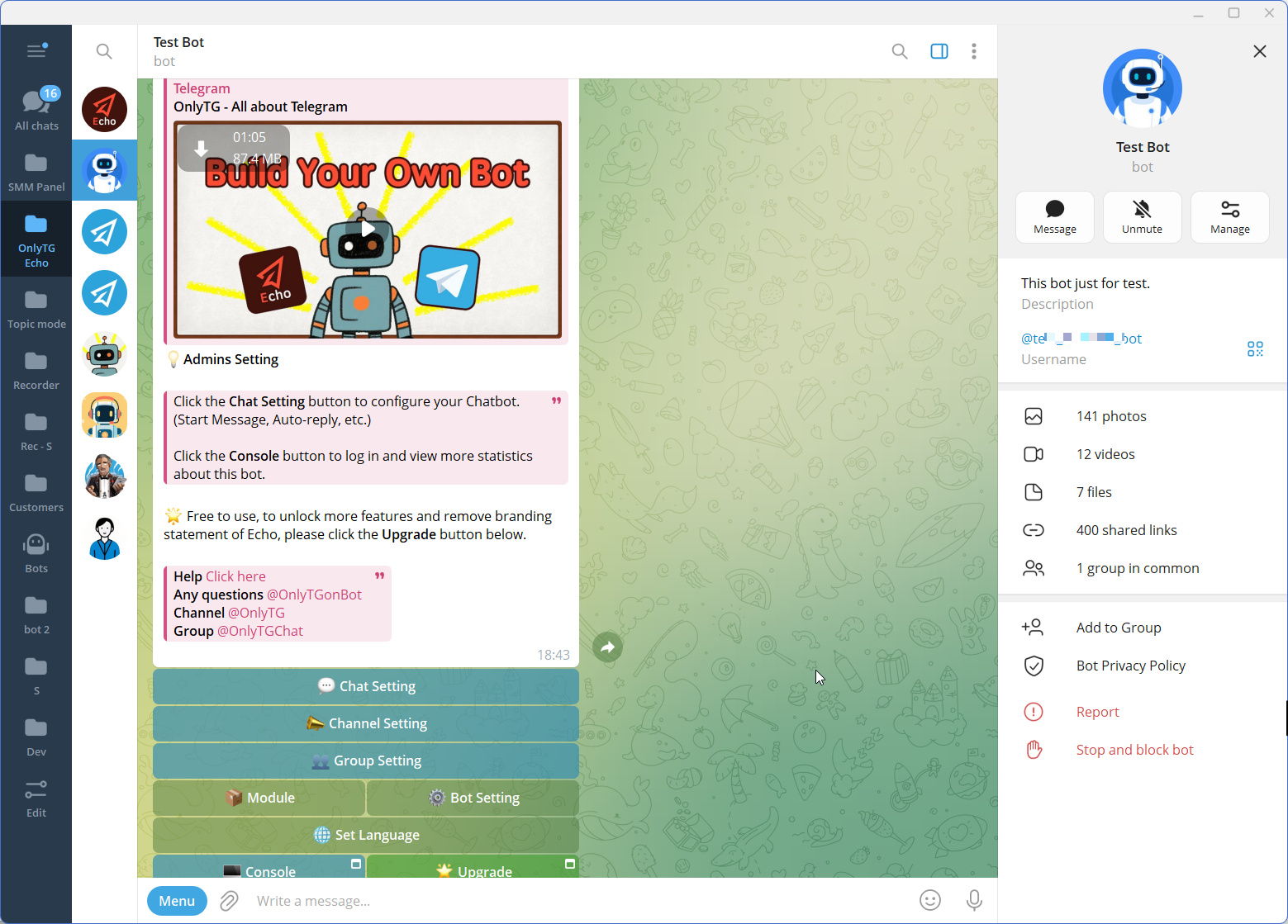
- Chatbot and Start Message: Establish the first interaction and provide introductory guidance.
- Auto-reply and Keyword Reply: Deliver predefined information when configured keywords are detected.
- Quick Reply: Help administrators send reusable messages during customer conversations.
- Multi-form Messages Builder: Organize text, media, and buttons into structured messages.
- Broadcast: Distribute updates to bot contacts.
- Group CAPTCHA and Group Greeting: Support new-member verification and onboarding.
- Group Rules and Group Keyword Reply: Help maintain more organized community conversations.
- Scheduled Posts and Loop Posts: Maintain recurring communication in Telegram channels and groups.
- Analytics and Tracking Links: Review bot activity and understand where contacts originate.
How to Use OnlyTG Echo
A practical implementation can be kept relatively simple.
Step 1 — Create a Telegram Bot
Use Telegram’s BotFather to create a bot and obtain its bot token. The bot becomes the communication interface that users interact with.
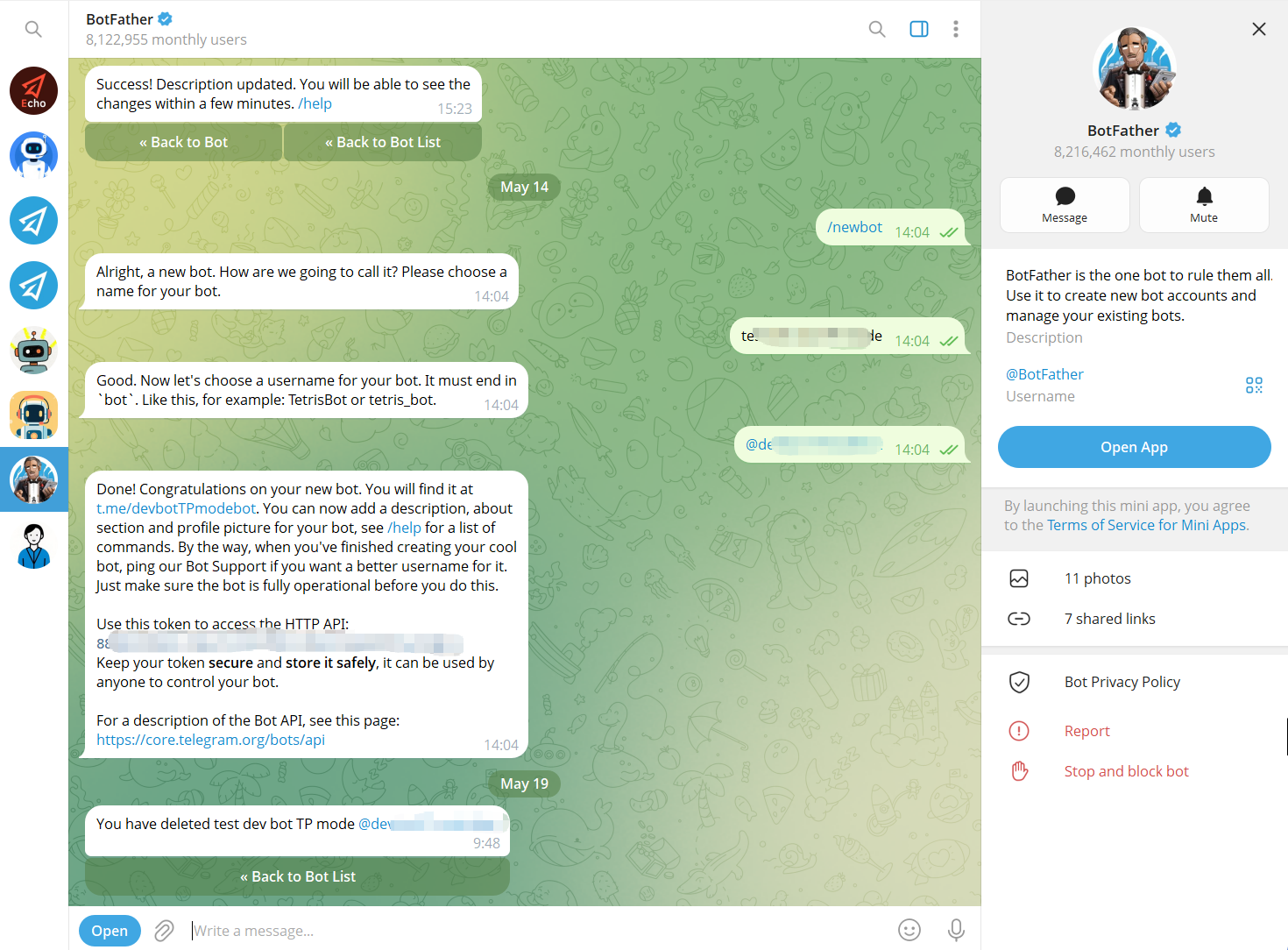
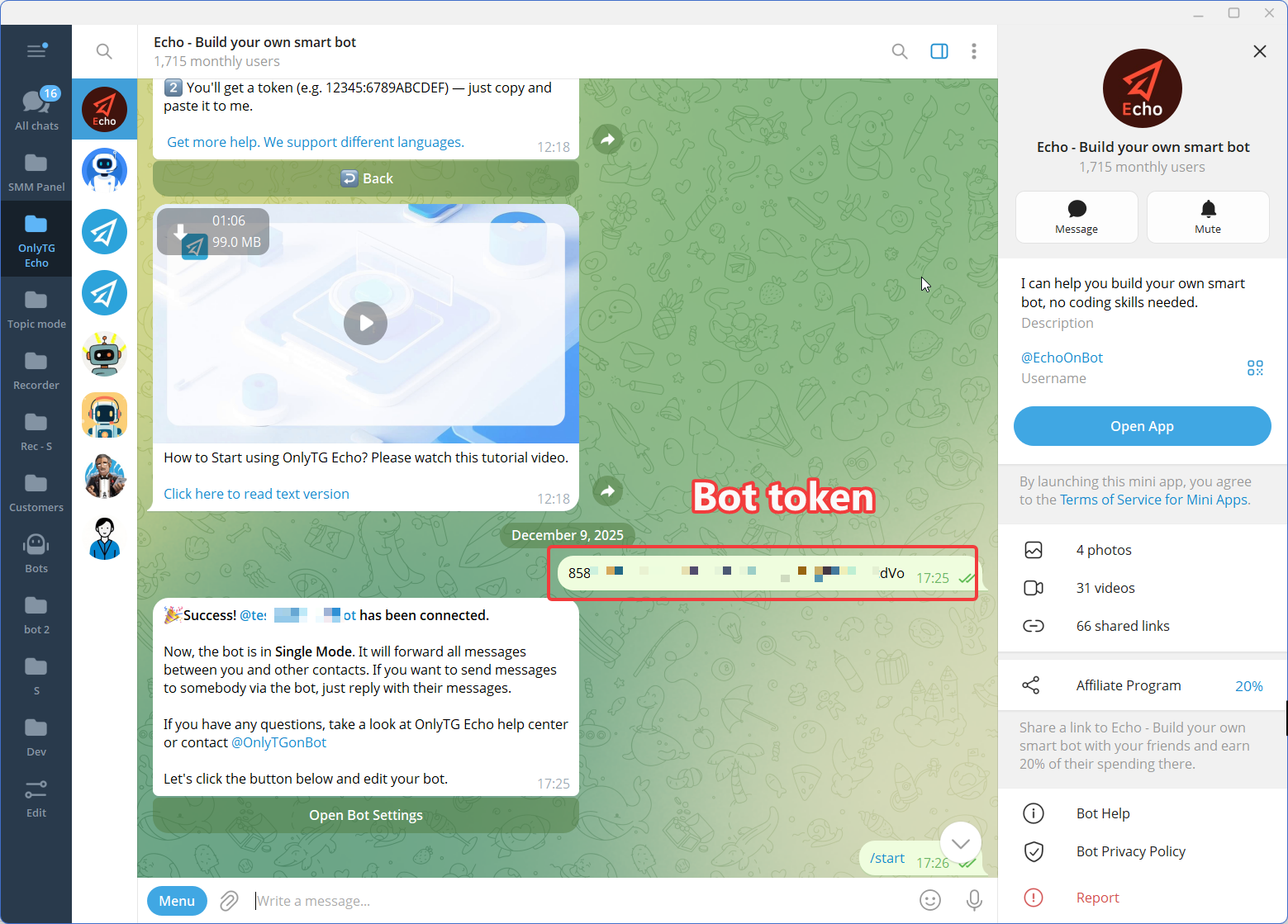
Step 2 — Connect the Bot to OnlyTG Echo
Connect the newly created Telegram bot to OnlyTG Echo using the bot token.
The purpose of this step is to give the business a no-code environment for configuring the bot’s communication behavior rather than requiring a custom automation workflow to be developed from scratch.
Step 3 — Configure the Features
FAQ
1. Can Telegram customer support be automated without coding?
Yes. Businesses can use no-code Telegram bot management tools to configure welcome messages, keyword-based responses, and reusable messages without developing a bot from scratch. OnlyTG Echo provides a no-code bot setup approach and configurable automation features.
2. Can a Telegram chatbot answer customer questions automatically?
A Telegram chatbot can answer predefined questions when its configured triggers are detected. For example, a business can associate keywords such as “subscription,” “payment,” or “product” with prepared responses. However, questions that require personal judgment or access to information not included in the configured replies still need individual attention.
3. When should a business start automating Telegram customer support?
A business should consider automation when staff repeatedly answer the same questions, customers experience unnecessary waiting, or administrators spend too much time maintaining Telegram groups and publishing routine updates. Starting with a few frequently asked questions is often more practical than attempting to automate every interaction at once.
Conclusion: Turn Repetitive Telegram Questions into a Managed Workflow
When a customer opens a Telegram bot and asks a simple question, they should not have to wait unnecessarily for information that the business already knows how to provide.
A well-organized Telegram customer support workflow makes that first interaction more useful. Welcome messages guide new users, keyword replies handle recurring questions, Quick Replies support staff, and scheduled content keeps customers informed.
The result is a more consistent communication process with less repetitive manual work.
OnlyTG Echo provides the tools businesses can use to configure and manage these Telegram automation workflows, from chatbot responses to group management and performance tracking.
Ready to improve your Telegram customer support process?
Explore OnlyTG Echo and start building a more organized Telegram communication workflow.