
Launching a new TikTok account is easy. Building an account that attracts the right audience is a different challenge. A creator may have a profile ready, several videos prepared, and a clear reason to join the platform, yet still struggle to decide what to publish first or how to get those initial videos discovered.
The first stage of TikTok growth is not about chasing a large follower count. It is about establishing a recognizable content direction, giving viewers a reason to watch, and learning which topics connect with the audience you want to reach. This guide explains how to launch a new TikTok account with a focused strategy, a manageable publishing plan, and a practical process for evaluating early results.
1. Define What Your New TikTok Account Should Become
Before publishing your first video, decide what the account is intended to offer.
A new account needs a recognizable reason for viewers to return. If one video is about cooking, the next is about gaming, and the third is an unrelated business promotion, viewers may find it difficult to understand what the account represents.
This does not mean every video must look identical. It means the account should have a consistent subject, audience, or point of view.
Start with three questions:
- Who do you want to reach?
- What problem, interest, or curiosity will your content address?
- Why would someone follow the account instead of watching one video and moving on?
For example, a small fitness creator could focus on practical workouts for people with limited time rather than general fitness content. A local bakery might share baking processes, product launches, and answers to common customer questions.
The more clearly the account communicates its value, the easier it becomes to plan relevant content.
Choose a content direction, not just a broad niche
A niche such as beauty, fitness, travel, or business is often too broad to guide daily content decisions.
Instead, narrow it into a useful content direction:
- Fitness → short home workouts for beginners.
- Travel → affordable weekend trips for working professionals.
- Beauty → skincare routines for people with sensitive skin.
- Business → practical marketing lessons for small online stores.
A focused direction gives you a starting point for video ideas and helps viewers recognize the type of content they can expect.
2. Set Up a TikTok Profile That Supports Discovery
Your profile should help a viewer understand the account after watching a video.
A new TikTok account does not need a complicated brand identity. It needs a profile that is clear, consistent, and relevant to the content being published.
Select an appropriate account type
TikTok offers different account options, including Personal and Business Accounts. The right choice depends on your goals, content needs, and the features available to you.
Creators who prioritize personal expression and content experimentation may prefer a Personal Account. Businesses that need commercial-focused tools may consider a Business Account.
Before switching, check TikTok’s current account features and restrictions. For example, music usage and commercial content requirements may differ.
Make your profile easy to understand
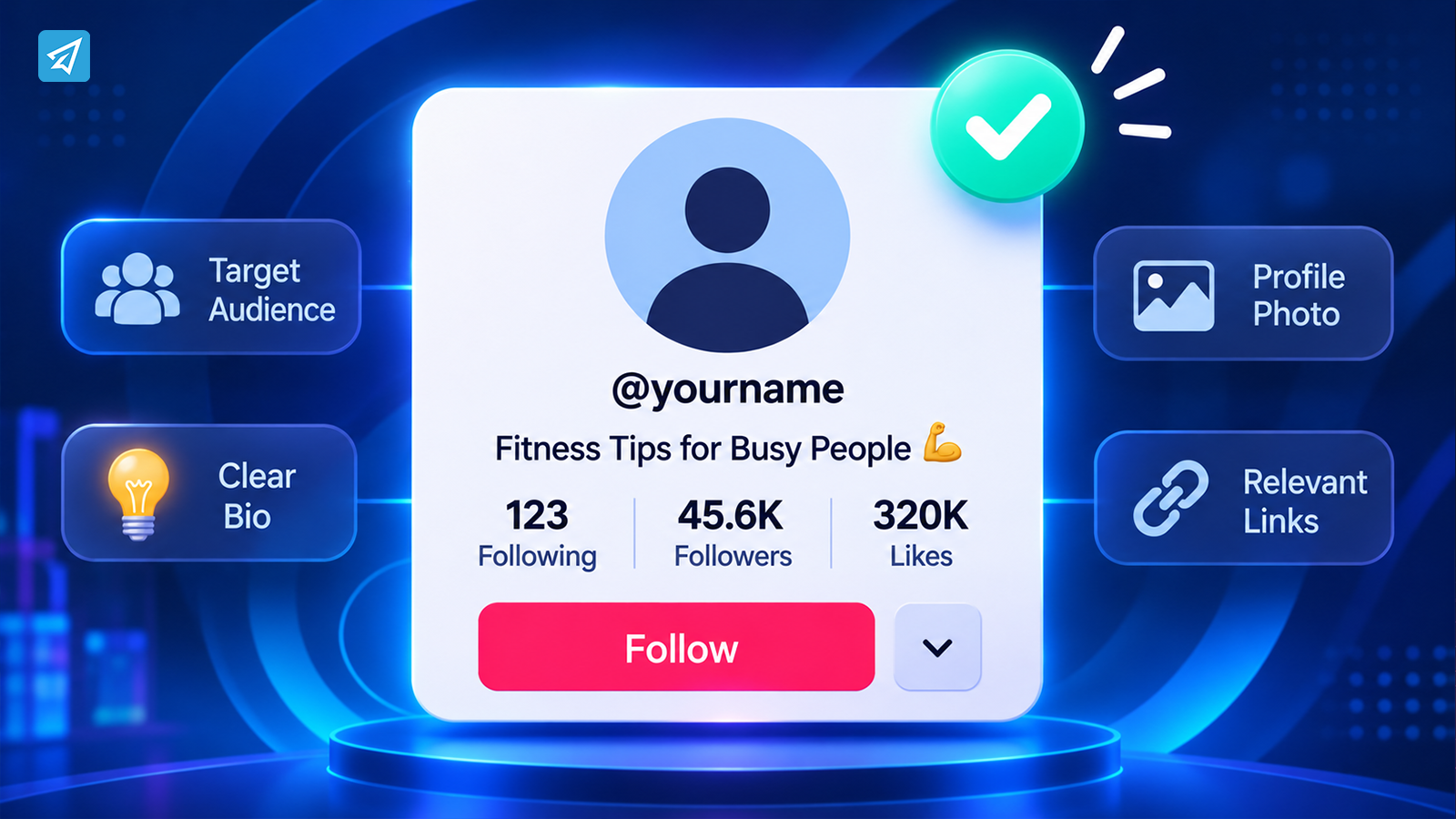
Prepare the following:
- Username: Choose a recognizable name that is easy to remember and relevant to your identity or brand.
- Profile photo: Use a clear image that helps viewers recognize the account.
- Bio: Explain what viewers can expect from your content.
- Profile links: Add relevant links when the account is eligible and the feature is available.
A useful bio answers a simple question: What will I get if I follow this account?
For example:
“Simple home workouts and practical fitness tips for busy beginners.”
This is more informative than a bio that only says “Fitness lover.”
3. Build a Launch Content Plan Around Three Repeatable Themes
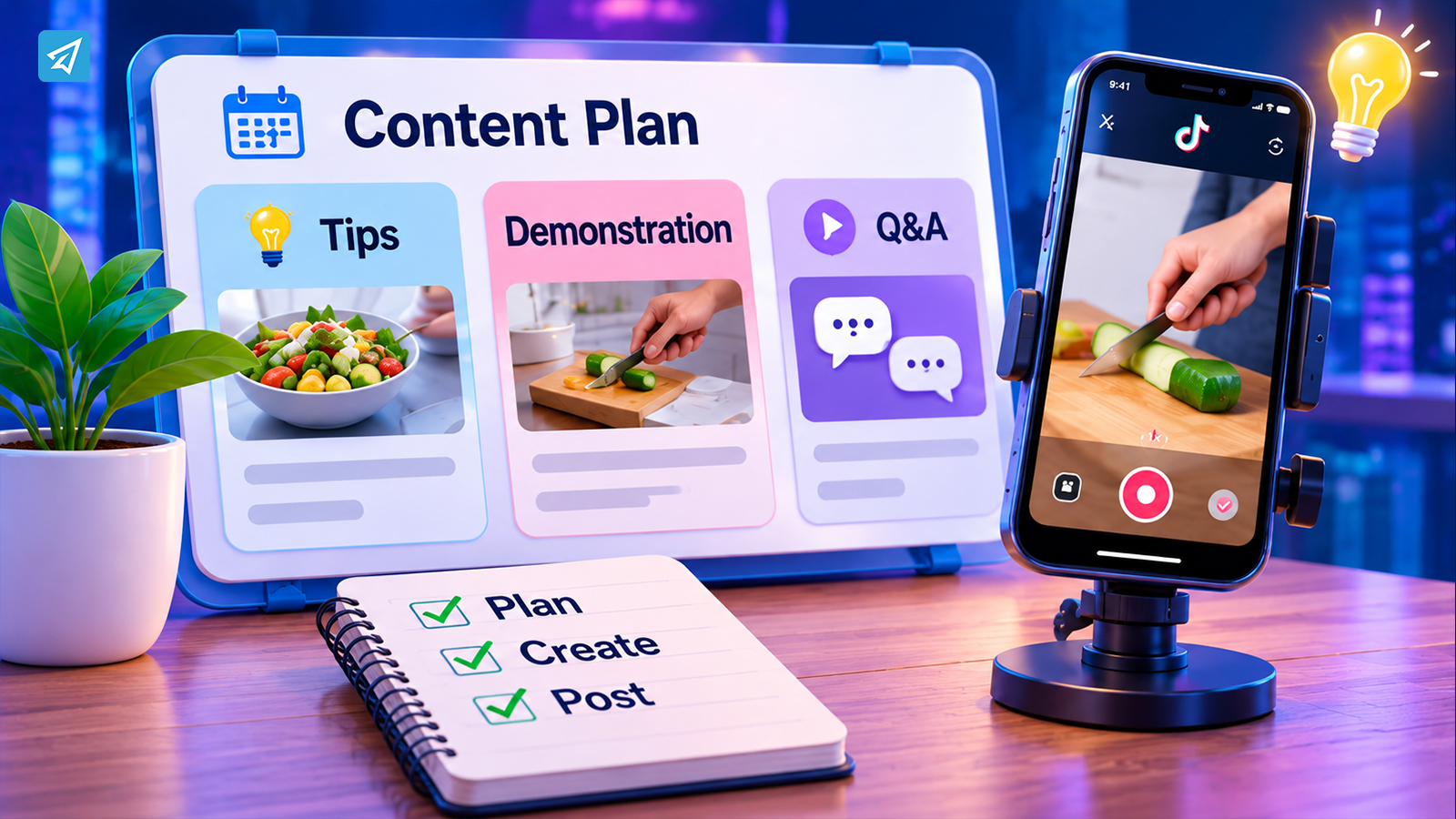
A new TikTok account needs enough content to test its direction. However, creating unrelated videos without a plan makes it difficult to understand what is attracting viewers.
Instead of starting with a large list of random ideas, define three repeatable content themes.
For a small online store selling reusable kitchen products, the themes might be:
- Practical tips: Show ways to reduce food waste or organize a kitchen.
- Product demonstrations: Explain how a product works in a real situation.
- Customer questions: Answer common questions about materials, cleaning, or use.
These themes support the same audience while allowing different video formats.
Turn each theme into specific video ideas
A content theme is not yet a video.
“Practical tips” could become:
- Three ways to keep vegetables fresh for longer.
- A common kitchen storage mistake.
- How to organize a small refrigerator.
“Product demonstrations” could become:
- What happens when you use the product for a week?
- How to clean it after everyday use.
- Which kitchen task does it make easier?
Each idea should be specific enough to communicate in one video.
The purpose of this plan is not to predict which video will become popular. It is to give the account a coherent set of content experiments.
4. Make the First Videos Easy to Understand
A new TikTok account has no established relationship with its audience. Each video needs to communicate its value quickly.
The opening should make the subject clear, create curiosity, or introduce a recognizable problem.
For example, instead of starting a video with:
“Hi everyone, welcome to my new account…”
Try opening with:
“Here is the kitchen storage mistake that makes vegetables spoil faster.”
The second opening gives viewers a reason to continue watching.
Use a simple video structure
A practical structure for a new creator is:
- Opening: Introduce a question, problem, result, or interesting observation.
- Main content: Show the explanation, demonstration, or steps.
- Payoff: Give the viewer a useful answer or clear takeaway.
- Next action: Invite a relevant comment, follow, or profile visit when appropriate.
Not every video needs an explicit call to action. The content itself should make the account worth following.
TikTok’s creator guidance highlights storytelling, relevant captions, appropriate sounds, and experimentation. It also notes that video views can vary and that simply posting more videos does not automatically increase recommendation.
Keep the format manageable
For a new account, it is usually more useful to create a repeatable video format than to spend excessive time producing one highly polished video.
Possible formats include:
- A short tutorial.
- A before-and-after demonstration.
- A common mistake and its correction.
- A question-and-answer video.
- A quick product or process explanation.
The best format depends on the topic and the creator’s ability to produce it consistently.
5. Launch With a Small, Consistent Publishing Schedule
A launch plan should be realistic enough to maintain.
If a creator can produce three useful videos per week, a consistent three-video schedule is more valuable than planning daily uploads and abandoning the plan after a few days.
Before launching, prepare a small content batch:
- A few videos addressing common audience questions.
- A few videos demonstrating the account’s main subject.
- A few videos testing different openings or formats.
The initial goal is to create enough content to begin learning.
Avoid judging the account based on one video. A single post may receive limited exposure for reasons that do not clearly indicate whether the overall content direction is suitable.
A short launch period should be treated as an early testing phase, not a final verdict on the account’s potential.
6. Help the Right Viewers Discover Your TikTok Videos
Publishing is only one part of launching a new TikTok account. The next challenge is helping relevant viewers find the content.
TikTok’s recommendation systems consider several types of signals, including user interactions, content information, and user information. Interactions such as watching, liking, sharing, commenting, or skipping can influence recommendations. Content information can include sounds, hashtags, and other details.
For a new creator, this means making the content easy to understand and relevant to the intended audience.
Use captions and hashtags to clarify the subject
Write captions that describe the video rather than adding unrelated keywords.
For example:
“Three beginner-friendly exercises you can do at home without equipment.”
Relevant hashtags can provide additional context, but they should not replace a clear video topic.
Avoid using a large number of unrelated trending hashtags simply because they appear popular. A hashtag should reflect the actual content or audience.
Explore relevant communities
Before and after publishing, spend time understanding what your intended audience is discussing.
Look at:
- Questions people repeatedly ask.
- Common misunderstandings.
- Video formats used by creators in the same topic area.
- Comments that suggest an unmet need.
- Content that viewers save, share, or discuss.
This research can help you identify new content ideas and create videos that respond to genuine audience interests.
7. Promote the New Account Without Losing Its Focus
A new TikTok account does not have to rely exclusively on TikTok discovery.
If you already have an audience on another platform, you can introduce your TikTok profile through relevant posts, newsletters, websites, or community channels.
For a business, this might mean sharing a TikTok video that answers a common customer question in an existing customer community.
For a creator, it could mean announcing the new account to an audience that already follows related work.
The key is audience relevance.
Do not promote the account indiscriminately to people who have little interest in its content. A large number of profile visits is not useful if the visitors are unlikely to watch future videos or follow the account.
Cross-promotion should introduce the account to people who have a reason to care about its subject.
8. Measure the Early Results That Help You Make Decisions

A new account needs a simple way to evaluate whether its content direction is working.
Avoid treating follower count as the only meaningful measure. Early results should help you understand what is happening at different stages of the audience journey.
| Metric or observation | What it may indicate | Recommended action |
|---|---|---|
| Low video views | Limited discovery or a topic that is not attracting attention | Test a clearer topic, opening, or relevant distribution method |
| Views but few profile visits | The video may be useful without communicating the account’s broader value | Connect the video topic more clearly to the account’s content direction |
| Profile visits but few follows | The profile may not explain why viewers should return | Improve the bio, profile identity, and consistency of content themes |
| Some videos attract meaningful comments | A topic may be prompting audience interest | Develop related videos and answer audience questions |
| Views and follows increase, but audience relevance is weak | Content or promotion may be attracting the wrong people | Narrow the topic and review where the account is being promoted |
These are diagnostic possibilities, not guaranteed explanations. Different videos and audiences behave differently.
Compare content by theme
After publishing several videos, review which themes appear to attract the most relevant attention.
Ask:
- Which videos attracted viewers who visited the profile?
- Which topics generated useful questions?
- Which formats were easiest to produce consistently?
- Which videos attracted an audience aligned with the account’s purpose?
Do not change every aspect of the strategy at once.
If one theme appears promising, create a few more videos around it. If the opening seems weak, test a different opening while keeping the topic similar.
This makes the learning process more useful.
9. How to Use OnlyTG SMM Panel as a Supporting Tool
If an SMM panel fits a specific operational need, OnlyTG keeps the ordering process relatively straightforward. You can use the Telegram bot or the OnlyTG Console. The official documentation describes selecting a platform and growth type, choosing a service, reviewing its available details, entering the target link and quantity, and confirming the order.
Option 1: Telegram Bot
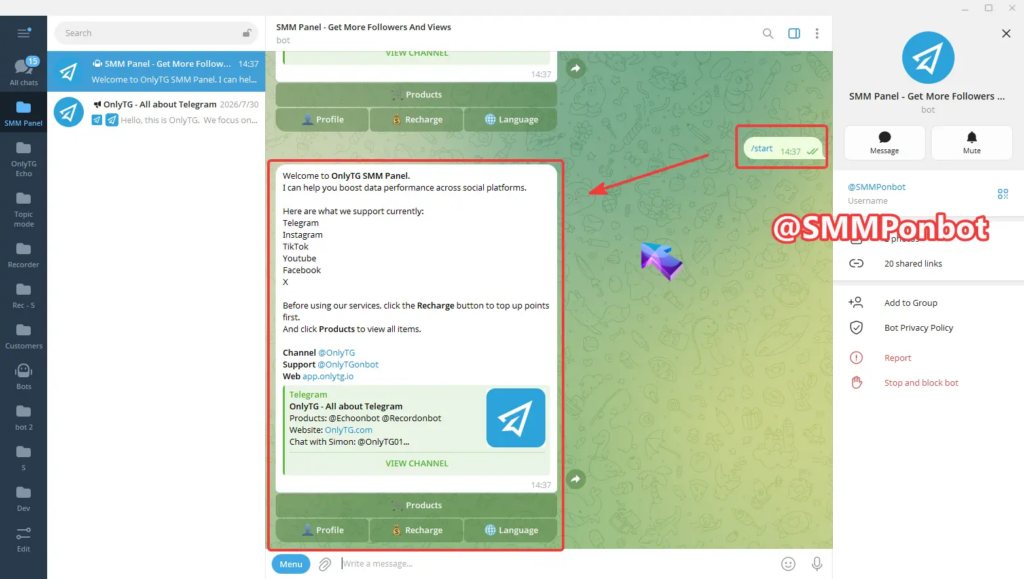
Step 1 — Open the Bot
Find @SMMPonbot on Telegram and send /start.
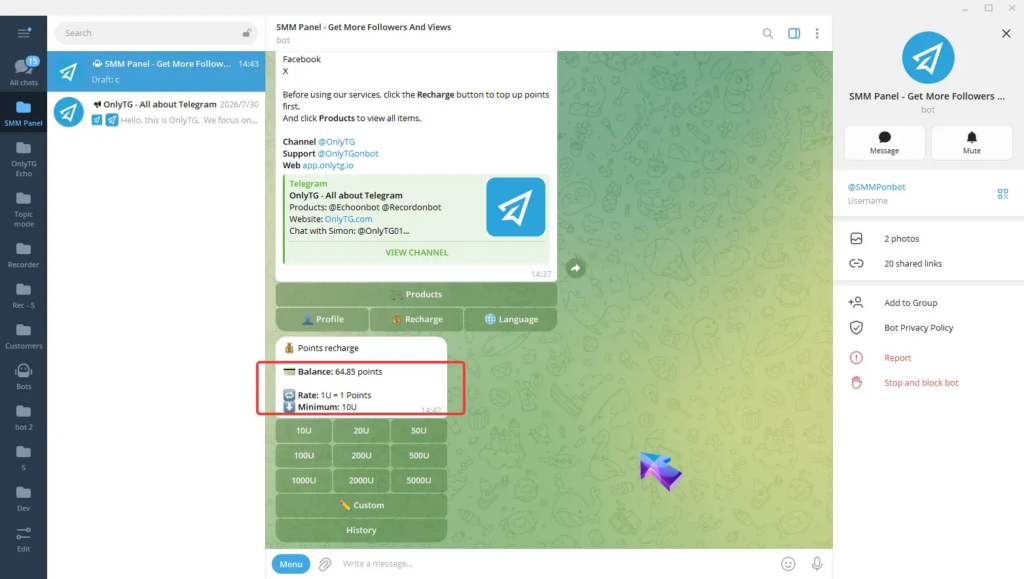
Step 2 — Add Balance
Use Recharge to fund the account. OnlyTG’s documentation currently lists 1 USDT = 1 point and a minimum recharge of 10 USDT.
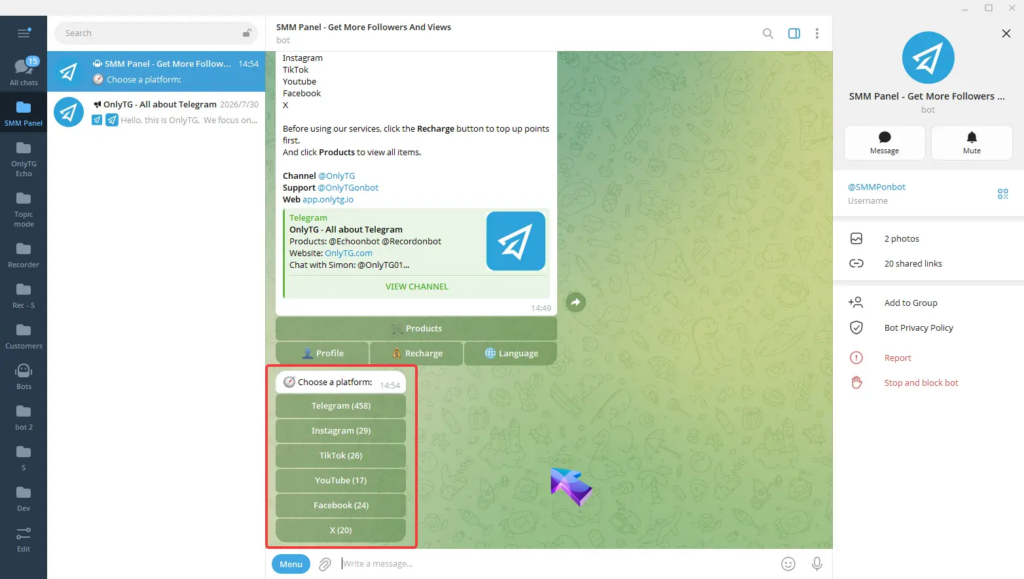
Step 3 — Select the Platform and Growth Type
Open Products, choose the platform, then select the relevant growth category.
Step 4 — Review the Service
Check the service information, including price, quantity information, estimated waiting time, and notes.
Step 5 — Create the Order
Select Buy, enter the target link and quantity, review the details, and confirm.
Step 6 — Monitor the Order
Use Profile → Orders to review order records and status.
Option 2: OnlyTG Console
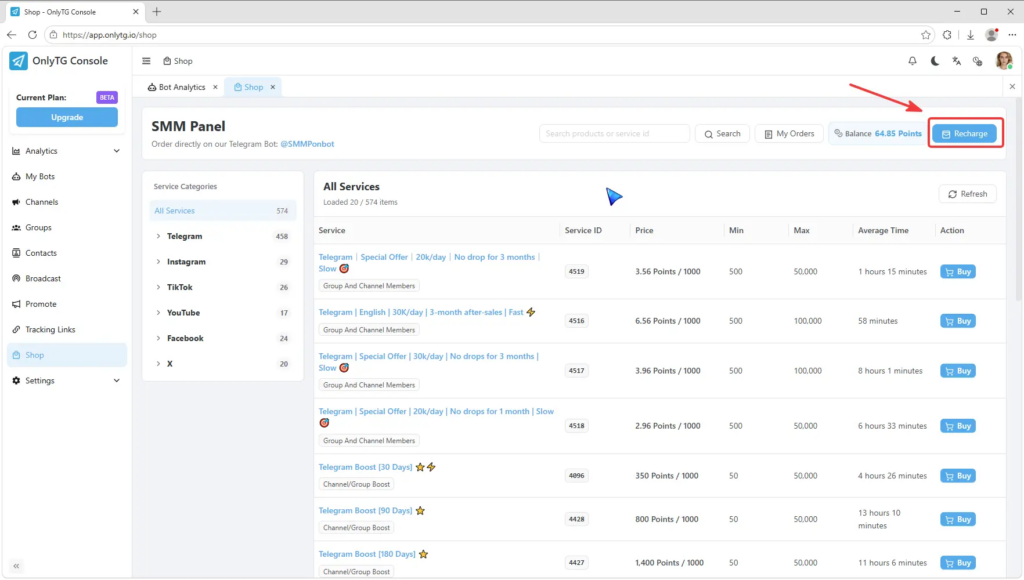
The Console provides a browser-based workflow.
Open app.onlytg.io, log in, and select Shop. Choose a platform and growth category, review the available services, enter the target link and quantity, and create the order. The Console also provides service details and an My Orders area for reviewing order records and statuses.
10. Give the Account a Clear Next Step After Launch
Launching a new TikTok account is not a one-time event. The first videos provide the material needed to decide what the account should do next.
Once the initial content has been published, use the results to choose a practical next step:
- Continue a content theme that attracts the intended audience.
- Refine a video format that is difficult to produce.
- Improve a profile that does not communicate the account’s value.
- Create follow-up videos based on comments and questions.
- Reconsider the account’s topic if the content consistently attracts an unrelated audience.
The aim is not to make the first launch perfect. It is to create a clear starting point and a repeatable learning process.
A new TikTok account becomes easier to grow when each video serves a purpose: introducing a topic, answering a question, testing an idea, or helping the intended audience discover the account.
Start with a clear direction, publish content that delivers a specific value, and use early audience responses to decide what to make next. That is a more sustainable foundation for TikTok growth than focusing on follower numbers before the account has established what it offers.
FAQs
1. How many videos should I post when launching a new TikTok account?
There is no universal number that guarantees a successful launch. Prepare enough videos to test a few relevant content themes and maintain a schedule you can sustain. Focus on learning from audience responses rather than meeting an arbitrary upload target.
2. How do I get my first followers on a new TikTok account?
Create videos for a clearly defined audience, make the profile explain what viewers can expect, and publish content that gives people a reason to return. Relevant cross-promotion can also introduce the account to people who already have an interest in its topic.
3. Should I use an SMM Panel when launching a new TikTok account?
An SMM Panel may support a specific execution task, depending on the available service and its conditions. It should not replace content planning, audience research, organic discovery, or performance analysis. Metrics supported by a service should not be treated as proof of genuine audience interest or business results.