
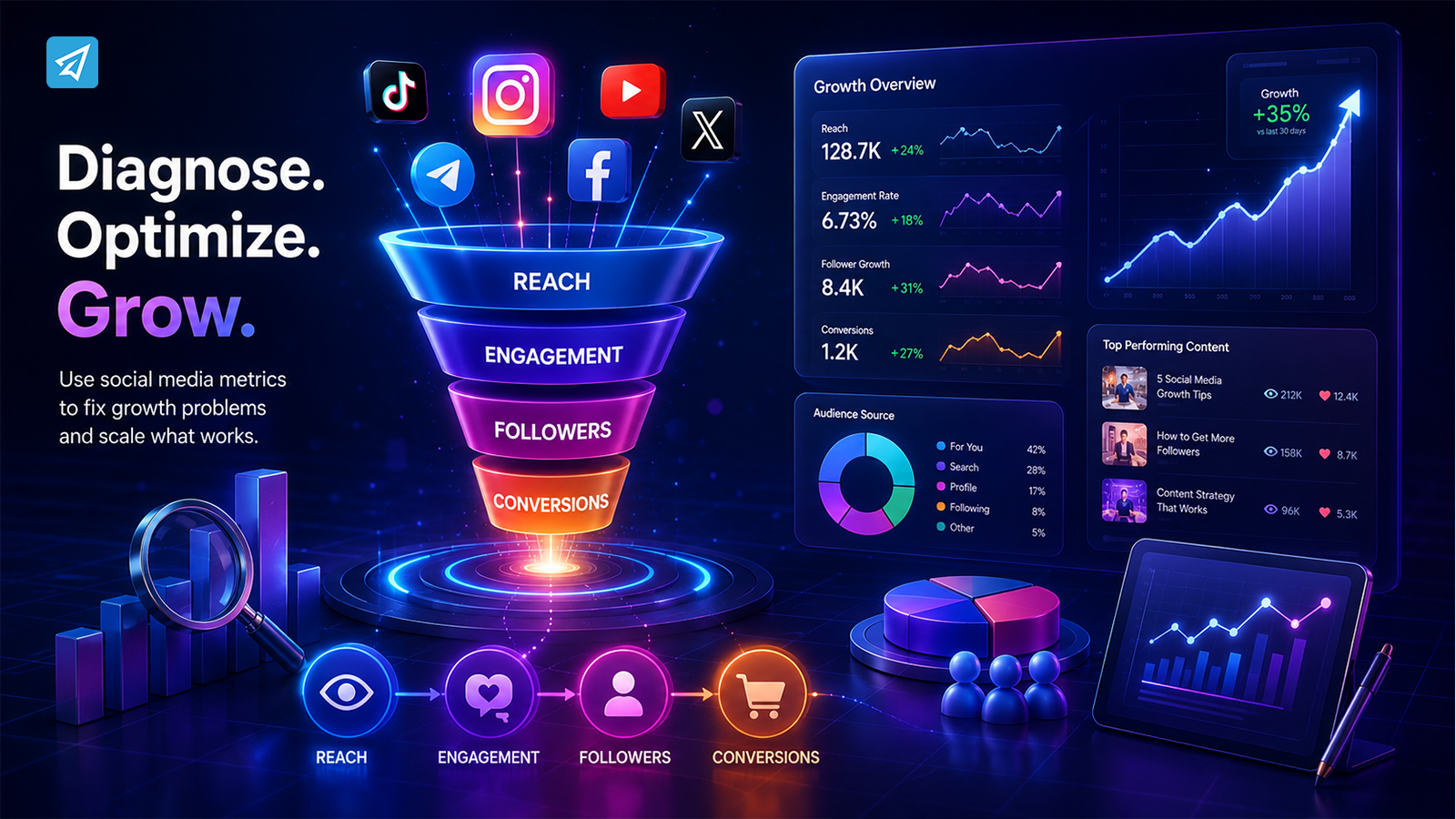
Social media growth rarely stops for just one reason. You may be publishing consistently but reaching too few people, gaining views without followers, or attracting followers who rarely interact with your content. When that happens, posting more is not necessarily the answer.
The better approach is to use social media metrics to identify where the growth process is breaking down. The right numbers can tell you whether the problem is visibility, content relevance, audience conversion, engagement, or business impact. Once you know the bottleneck, you can stop changing everything at once and focus your effort on the part of the strategy that actually needs improvement.
Start With the Growth Problem, Not the Metric
One of the easiest mistakes in social media marketing is opening an analytics dashboard and immediately looking for the biggest number.
A large follower count may look impressive, but it does not automatically mean the account is growing effectively. Similarly, a post with thousands of views may generate very little audience growth or meaningful action.
A better starting point is:
What outcome are you trying to improve?
If you want more people to discover your content, visibility metrics matter. If you want more followers, you need to understand how exposure turns into profile visits and follows. If your priority is engagement, you need to examine whether people are doing more than simply viewing your posts.
Social media metrics become useful when they answer a decision-making question.
A practical diagnostic framework
| Growth Problem | Recommended Focus | Useful Metrics |
|---|---|---|
| Too few people discover your content | Distribution and reach | Reach, impressions, views |
| People see content but do not follow | Content-to-profile conversion | Profile visits, follower growth |
| Views are high but interaction is weak | Relevance and content quality | Engagement rate, comments, shares |
| Followers increase but activity declines | Audience quality and retention | Engagement, returning viewers, retention |
| Social activity does not create business value | Conversion path | Clicks, leads, conversions |
When Reach Is the Real Growth Bottleneck

Suppose your content is well-produced, but only a small number of people see it.
In this situation, creating even more content may not solve the problem. The issue could be distribution.
Look at reach, impressions, and views together. Reach indicates how many individual accounts were exposed to content, while impressions can reflect repeated exposure. Video views can reveal whether content is attracting initial attention.
If these numbers remain low, examine the factors controlling distribution:
- Is the content designed for the platform?
- Are you using formats the audience already consumes?
- Are your topics relevant to current audience interests?
- Are titles, hooks, thumbnails, or opening seconds strong enough?
- Are you publishing consistently enough to generate useful performance data?
- Are you relying on one distribution source?
The strategic response should be to improve discoverability and distribution, not simply increase publishing volume.
For example, a creator whose short videos consistently receive very low exposure might test different opening hooks and formats before producing twice as many videos. A Telegram channel with useful posts but limited discovery might need stronger cross-promotion or a clearer positioning strategy.
The metric tells you there is a visibility problem. Your job is to identify the operational reason behind it.
When People See Your Content but Do Not Follow
A different pattern appears when reach and views are healthy but follower growth remains weak.
This usually points to a conversion problem rather than a visibility problem.
Imagine that 50,000 people discover your content during a month, but your follower count barely changes. More exposure alone may not produce the result you want.
Investigate the journey between content discovery and audience commitment.
Ask:
- Does the profile immediately explain what the account offers?
- Does the content give users a reason to see future posts?
- Is there a recognizable topic or content promise?
- Are calls to action appropriate and specific?
- Are your most successful posts attracting the right audience?
This is where follower growth should be interpreted alongside content performance.
A post can be successful because it answers a one-time question, while another may be successful because it makes people want to follow the creator for future information. Those are different forms of value.
If views are rising but followers are not, optimize the conversion layer before chasing additional reach.
When Engagement Is the Weak Point
High visibility does not automatically mean high audience interest.
If people are seeing your content but rarely commenting, sharing, saving, reacting, or otherwise interacting, your next priority should probably be relevance rather than distribution.
The engagement rate can help you compare how strongly different pieces of content resonate, although the exact calculation can vary by platform and measurement method.
Instead of asking only, “How many likes did this post get?”, ask:
What did people do after seeing it?
Shares can indicate that content has enough value to pass to another person. Comments can reveal discussion potential. Saves may indicate practical usefulness. Reactions can provide a lighter signal of immediate response.
This changes how you develop content.
If educational posts consistently receive stronger engagement than promotional posts, your strategy may need more educational material. If opinion-based posts generate discussion but tutorials generate saves, each format may serve a different role.
The goal is not to maximize every engagement metric simultaneously. It is to understand which content behaviors support your growth objective.
If Followers Are Growing but the Account Feels Inactive
Follower growth can sometimes hide a retention or audience-quality problem.
An account may gain followers while average engagement, views, or returning audience activity remains flat. This means the top-line audience number is increasing without a corresponding increase in active participation.
Look beyond total followers.
Compare follower growth with:
- Engagement trends
- Content reach
- Returning viewers
- Watch time or retention for video
- Comments and shares
- Click activity where relevant
A growing audience should eventually create more opportunities for meaningful interaction.
If that is not happening, investigate whether your recent content is still aligned with why people followed you in the first place.
This is especially important when your content mix changes. An account known for educational content may lose engagement if it suddenly becomes dominated by promotions. A creator who attracts an audience through short-form entertainment may struggle when switching entirely to long-form content without adjusting expectations.
Growth is not only about adding people. It is about keeping the relationship useful.
Match Content Strategy to the Data
Once you identify the bottleneck, use the data to decide what type of content deserves more attention.
A strong content strategy usually contains several roles rather than one repeated format.
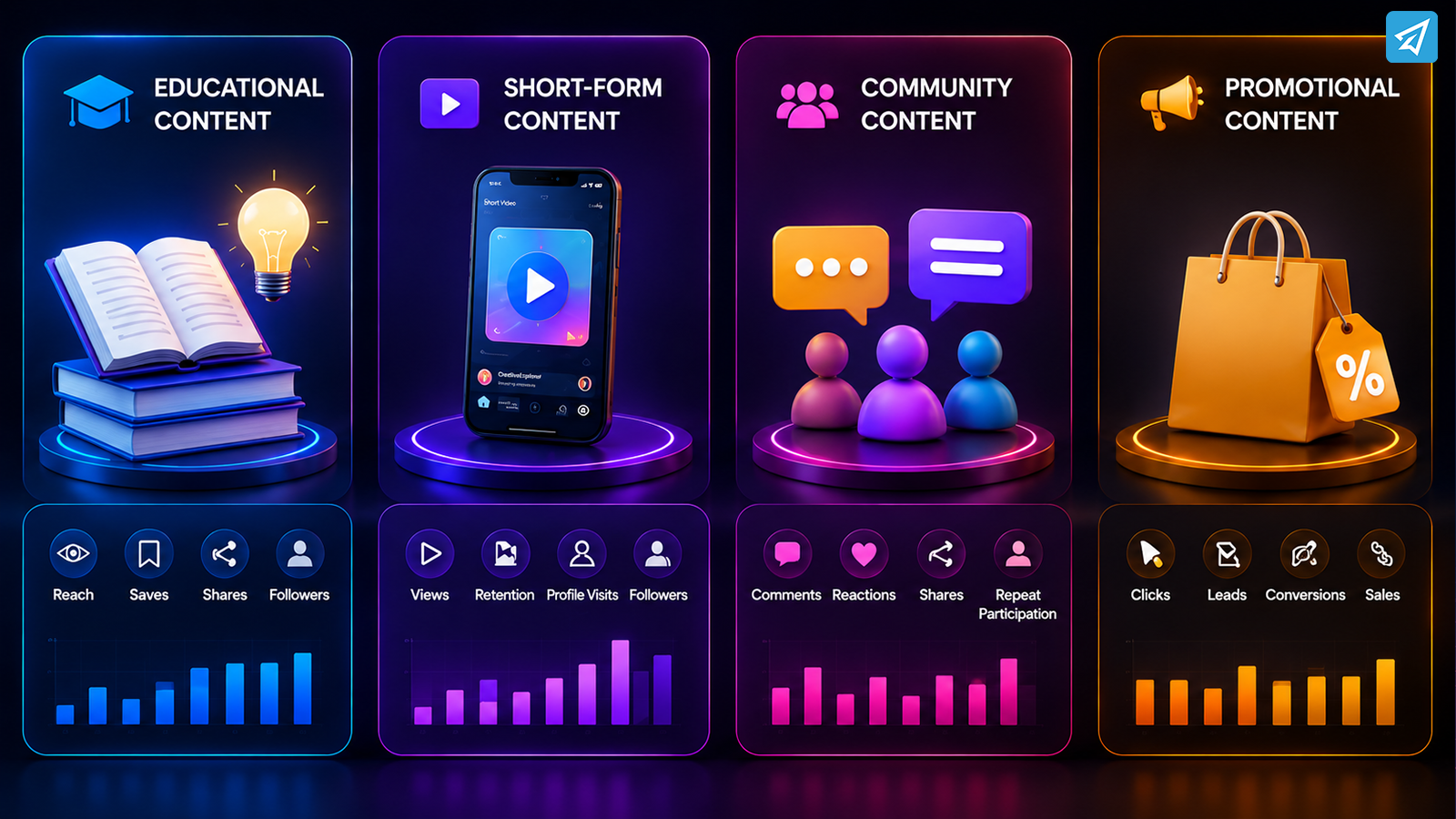
Educational content
Educational posts can attract people searching for solutions and establish expertise.
Track reach, saves, shares, and follower growth to determine whether useful information is helping you attract and retain an audience.
Short-form content
Short videos can be useful for discovery, but views alone should not determine success.
Look at views alongside retention, engagement, profile activity, and follower growth. A video with fewer views but stronger audience conversion may be more valuable than a viral clip that produces no lasting audience.
Community content
Questions, discussions, polls, replies, and audience-led topics can create opportunities for interaction.
Here, comments, reactions, shares, and repeat participation may be more informative than raw reach.
Promotional content
Promotional posts have a different job. Their effectiveness should be evaluated through clicks, leads, conversions, or other relevant business actions rather than engagement alone.
This is why a social media content calendar should not be judged as one giant number. Different content types perform different jobs inside the growth system.
Turn Metrics Into Decisions
Analytics become valuable when they change what you do next.
A simple weekly review can ask four questions:
1. What improved?
Identify content, topics, formats, or platforms showing positive movement.
2. What declined?
Look for meaningful changes rather than reacting to one unusually weak post.
3. Why might the change have happened?
Consider content format, audience relevance, publishing consistency, platform differences, and distribution.
4. What will we test next?
Choose one or two variables instead of changing the entire strategy.
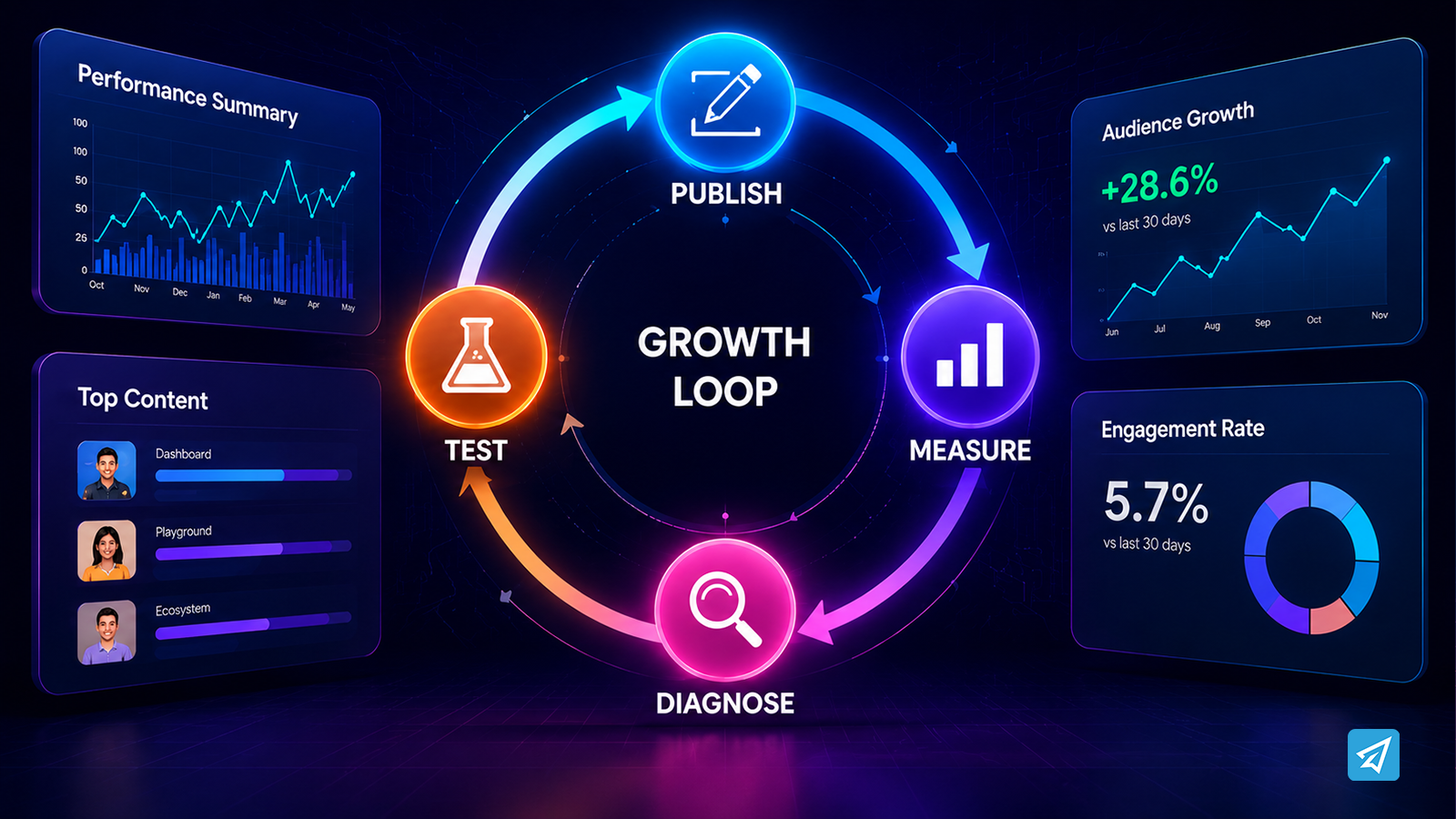
This creates a feedback loop:
Publish → Measure → Diagnose → Test → Publish Again
The goal is not to create a perfect dashboard. It is to build a repeatable process where every reporting cycle produces a useful decision.
Where an SMM Panel Fits Into Social Media Growth
An SMM Panel can be part of that operational layer. For example, OnlyTG SMM Panel provides social media growth services for Telegram, Instagram, TikTok, YouTube, Facebook, and X, with services that can support metrics such as followers, views, reactions, and other listed growth types.
That can be useful when a marketer needs additional operational support around selected growth activities.
How to Use OnlyTG SMM Panel
Option 1: Telegram Bot
Find @SMMPonbot on Telegram and send
/start.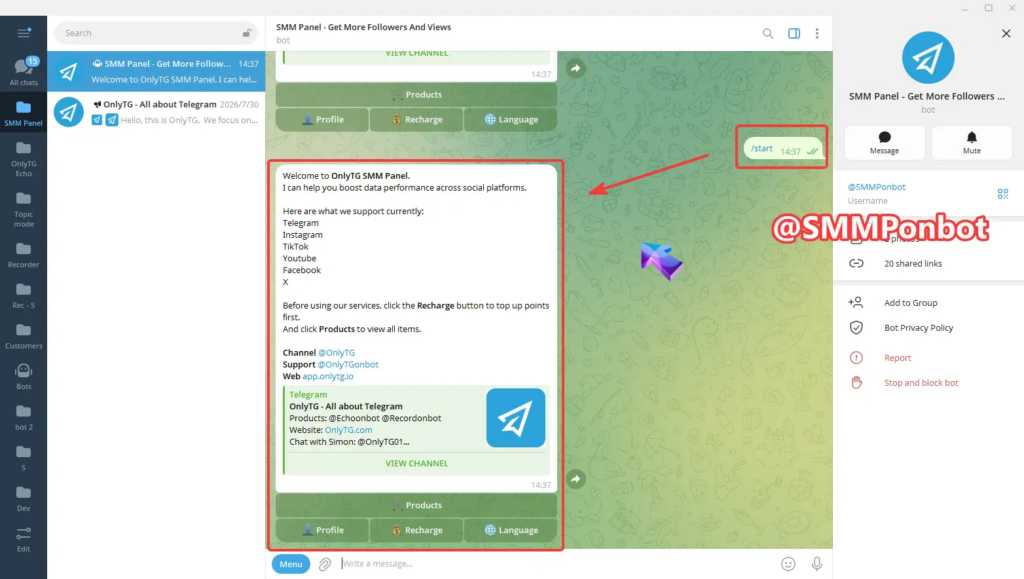
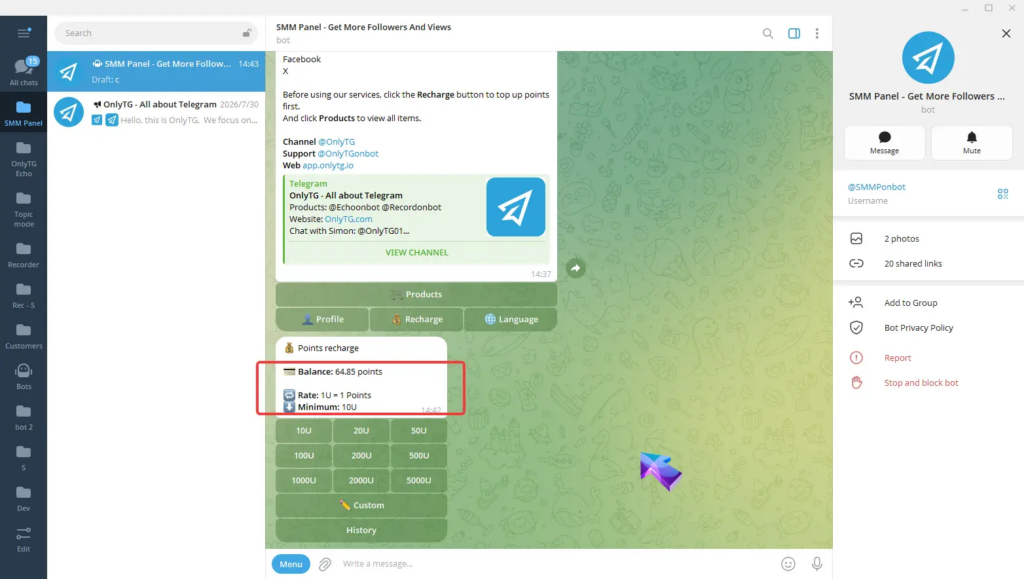
Use Recharge to fund the account. OnlyTG’s documentation currently lists 1 USDT = 1 point and a minimum recharge of 10 USDT.
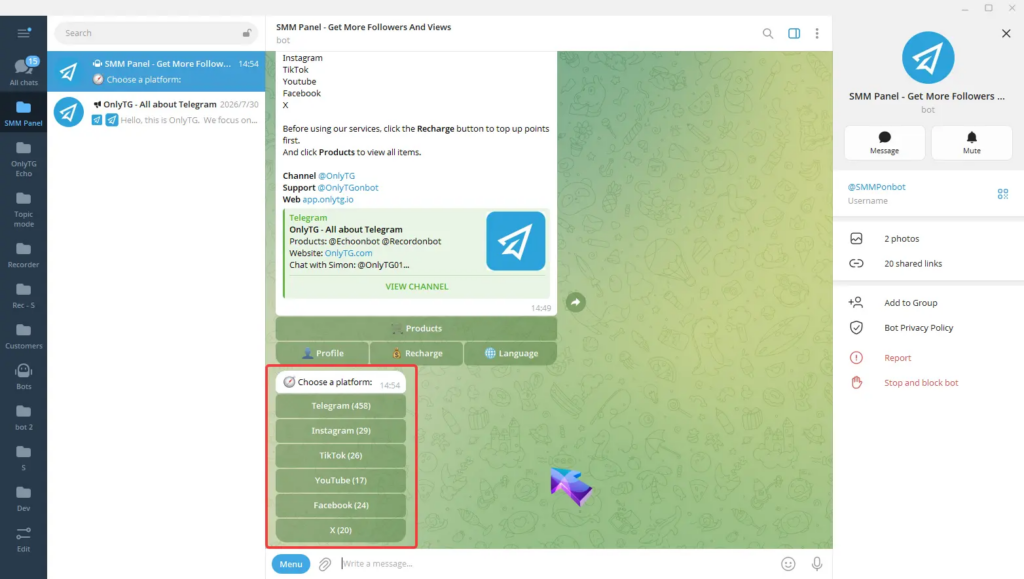
Open Products, choose the platform, then select the relevant growth category.
Check the service information, including price, quantity information, estimated waiting time, and notes.
Use Profile → Orders to review order records and status.
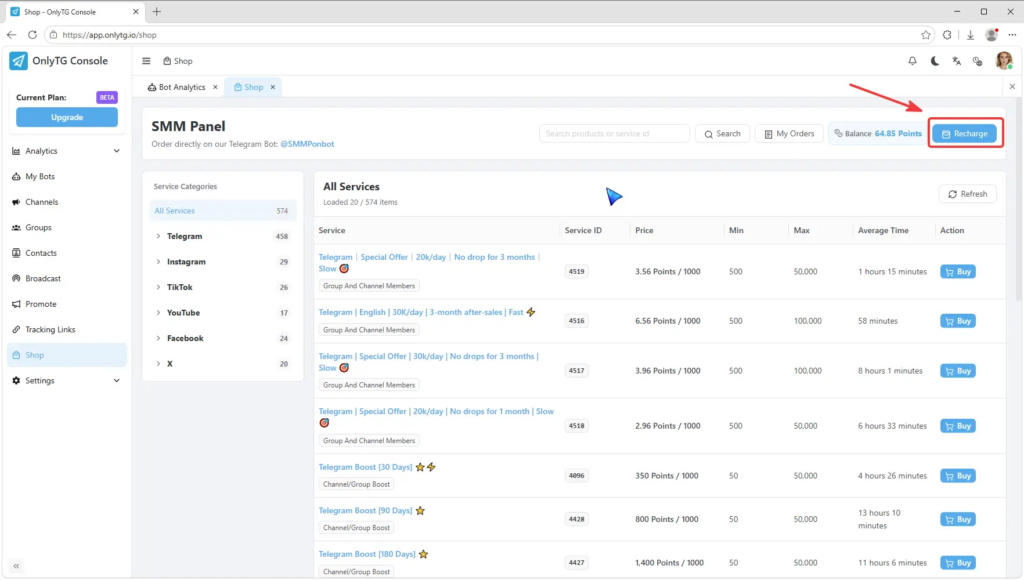
Option 2: OnlyTG Console
FAQ
1. Which social media metrics should I track first?
Start with the metrics most closely connected to your current growth goal. For awareness, reach and impressions can help diagnose visibility. For audience growth, follower growth and content-to-profile behavior are useful. For engagement, engagement rate, comments, shares, or saves can reveal how strongly content resonates. If your goal is business growth, add clicks, leads, or conversions.
2. How do I know which social media metric is causing slow growth?
Look for the stage where the numbers drop most sharply. Low reach suggests a distribution problem. Strong reach but weak follower growth suggests a conversion problem. Strong views but weak interaction suggests a relevance or engagement problem. Strong audience growth but weak activity suggests a retention or audience-quality issue. Use several related metrics rather than relying on one number.
3. Can an SMM Panel replace a social media growth strategy?
No. An SMM Panel can support selected execution activities, but it does not replace audience research, content planning, analytics, community management, positioning, or optimization.