

To grow a new social media account, focus on three things first: make the account easy to understand, publish content that gives people a reason to follow, and create enough early activity to generate visibility and engagement. A new account rarely grows simply because it exists. You need a clear audience, consistent content, active interaction, and a deliberate approach to reaching people outside your existing network.
The challenge is that a new account has little history, few followers, and limited initial engagement. That makes the first stage less about “going viral” and more about creating enough useful signals to discover what works.
Why Is Growing a New Social Media Account Difficult?
Starting from zero creates a visibility problem.
An established account already has followers who can see new posts, interact with them, and potentially share them. A new account has none of that initial momentum.
This creates a cycle:
Few followers → limited initial exposure → little engagement → fewer opportunities to reach new people.
Breaking this cycle requires more than simply posting more frequently.
Your account needs to communicate a clear value proposition, while your content needs to attract the type of people you actually want as followers.
That is why audience definition, content quality, engagement, and distribution should be treated as connected parts of the same growth strategy.
1. Start With a Clear Audience and Account Position

Before trying to get followers, determine who should follow you and why.
A vague account such as “business tips” is difficult to differentiate. A more specific position gives potential followers an immediate reason to care.
For example, instead of:
Business advice
you could focus on:
Practical marketing tips for small online businesses.
The second version tells visitors what they can expect.
Your profile should answer three questions quickly:
- What is this account about?
- Who is it for?
- What will followers get from it?
This applies across Instagram, TikTok, YouTube, Telegram, Facebook, X, and other platforms, even though each platform has different content formats and audience behaviors.
A clear position also makes content creation easier because you can build recurring topics instead of producing unrelated posts.
2. Build Content That Gives People a Reason to Follow
Once the account has a clear direction, content becomes the main engine of organic growth.
The objective is not to make every post viral. Instead, create content that repeatedly delivers one or more forms of value:
- Education
- Entertainment
- Inspiration
- Useful information
- Problem solving
- Community participation
For a new account, repeatable content formats are particularly useful.
Suppose you launch a social media marketing account. Instead of publishing random marketing posts, you might create recurring formats such as:
- One-minute marketing tips
- Common social media mistakes
- Weekly content ideas
- Before-and-after examples
- Quick platform comparisons
This gives visitors a reason to recognize the account and return.
Shareable content is also important because followers are not the only source of distribution. A useful post can reach people who have never encountered your account if existing users share, repost, comment on, or otherwise interact with it.
3. Choose the Right Platform Instead of Trying Everything at Once

A new account does not necessarily need to be active on every social network.
Different platforms support different content styles and audience behaviors. Short-form video may be central to discovery on TikTok and YouTube Shorts, while Instagram can combine Reels, carousels, Stories, and other formats. Telegram has a different structure because channels and groups are built around direct community distribution.
The better question is not:
“Which platform is the biggest?”
It is:
“Where does my target audience already spend time?”
Starting with one primary platform can also make experimentation easier.
You can learn:
- Which topics receive attention
- Which formats generate reactions
- Which posts attract profile visits
- Which content produces followers
- Which audience segments respond most strongly
Once you have a repeatable content process, expanding to another platform becomes easier.
4. Turn Early Engagement Into a Growth Loop
Followers are only one part of social media growth.
A healthier growth loop looks like this:
Content → Initial Exposure → Engagement → Wider Exposure → Profile Visits → New Followers → More Initial Engagement
Your job is to improve the different stages of this loop.
For example, if a post receives views but almost nobody visits the profile, the content may attract attention without communicating enough about the account.
If people visit the profile but do not follow, the profile positioning may need improvement.
If followers rarely interact with new posts, the content may not be relevant enough to the audience.
This is why simply watching follower count can be misleading. Reach, views, reactions, comments, shares, profile visits, and follower growth can tell you different parts of the story.
The key is to identify where the growth loop is breaking.
5. Use Community Interaction to Find Your First Followers
New accounts should not depend entirely on people discovering them passively.
Active participation can help put your account in front of relevant audiences.
Depending on the platform, this can include:
- Responding to comments
- Joining conversations in your niche
- Answering relevant questions
- Participating in communities
- Collaborating with creators
- Encouraging discussions around your posts
- Responding to direct messages
The important distinction is between genuine participation and spam.
If you operate a fitness account, for example, commenting “Nice post!” on hundreds of unrelated accounts is unlikely to create meaningful relationships.
A thoughtful comment on a relevant creator’s post can start a much more useful interaction.
The goal is not simply to make your username appear everywhere. It is to become visible where your potential audience is already paying attention.
6. Give a New Account Enough Data to Learn From
One common mistake is changing the strategy too quickly.
A new account might publish three posts, see limited results, and conclude that the entire strategy does not work.
Instead, treat the first stage as an experimentation period.
Test variables such as:
- Topic
- Hook
- Content format
- Video length
- Posting time
- Caption style
- Call to action
- Visual presentation
- Audience segment
Then compare the results.
Suppose a new business account publishes two types of content. Educational posts generate more saves and profile visits, while promotional posts generate very little interaction.
That gives the account a useful signal: its audience may currently respond better to educational content.
The strategy can then shift toward what the audience demonstrates it wants.
7. When Should You Use Paid or External Growth Support?
Organic content should remain the foundation, but some accounts also need additional distribution support.
This is particularly relevant when you are trying to create initial visibility around a new account, a campaign, a launch, or a specific piece of content.
The important point is that external growth should support a strategy rather than replace one.
For example, buying visibility for an account with unclear positioning and poor content does not solve the underlying problem.
Before using a growth service, check:
- Which platform is supported
- What type of metric is being provided
- Minimum and maximum quantity
- Price
- Expected processing time
- Target requirements
- Whether the service matches your objective
Different goals require different services.
Someone trying to increase video exposure has a different requirement from someone trying to increase followers. A Telegram channel also has different needs from an Instagram account.
This is where an SMM panel can become an execution tool within a broader social media growth strategy.

Using OnlyTG SMM Panel as Part of a Growth Strategy
OnlyTG SMM Panel supports growth-related services for platforms including Telegram, Instagram, TikTok, YouTube, Facebook, and X. Its available services can include followers, views, reactions, and other social media metrics.
For a new account, the practical use case is straightforward: after deciding what you want to improve, you can select a relevant service and place an order instead of treating the panel itself as the entire growth strategy.
How to Use OnlyTG SMM Panel as a Supporting Tool
If an SMM panel fits a specific operational need, OnlyTG keeps the ordering process relatively straightforward. You can use the Telegram bot or the OnlyTG Console. The official documentation describes selecting a platform and growth type, choosing a service, reviewing its available details, entering the target link and quantity, and confirming the order.
Option 1: Telegram Bot
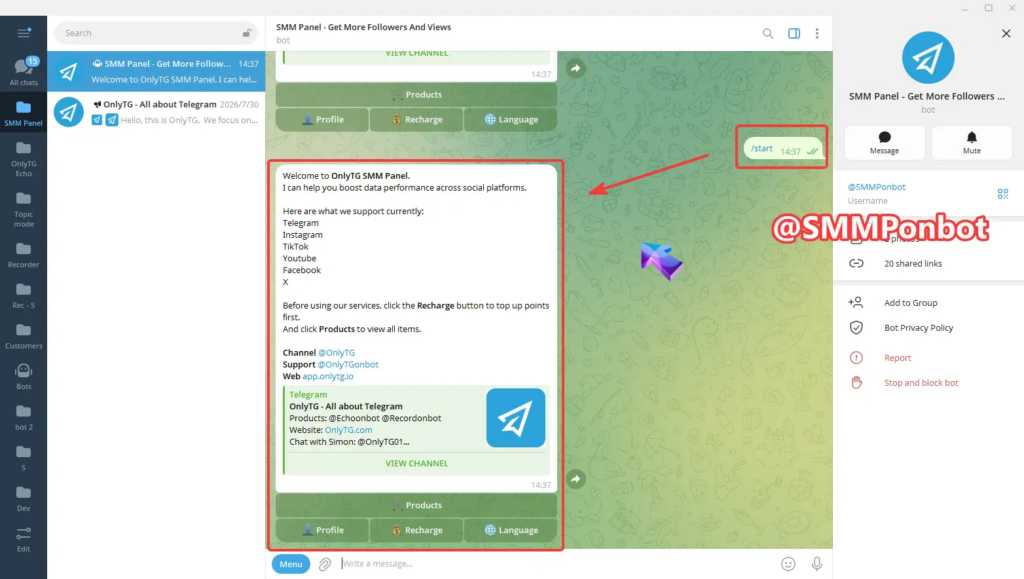
Step 1 — Open the Bot
Find @SMMPonbot on Telegram and send /start.
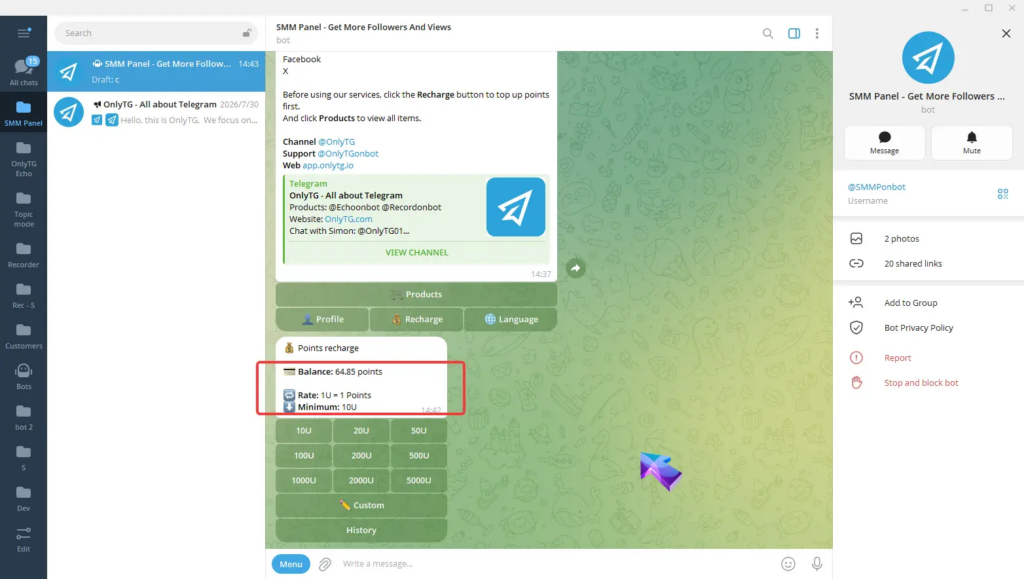
Step 2 — Add Balance
Use Recharge to fund the account. OnlyTG’s documentation currently lists 1 USDT = 1 point and a minimum recharge of 10 USDT.
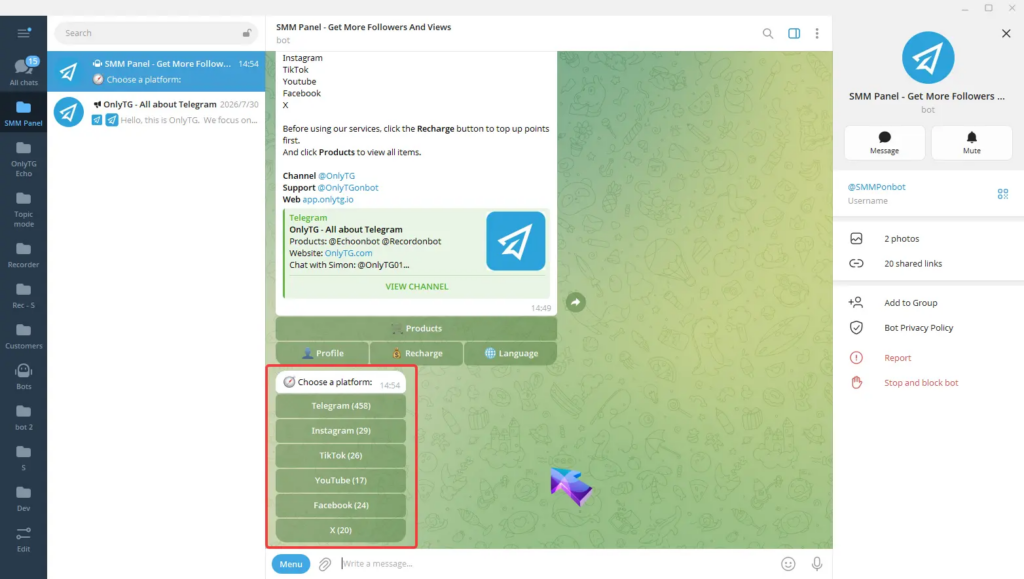
Step 3 — Select the Platform and Growth Type
Open Products, choose the platform, then select the relevant growth category.
Step 4 — Review the Service
Check the service information, including price, quantity information, estimated waiting time, and notes.
Step 5 — Create the Order
Select Buy, enter the target link and quantity, review the details, and confirm.
Step 6 — Monitor the Order
Use Profile → Orders to review order records and status.
Option 2: OnlyTG Console
The Console provides a browser-based workflow.
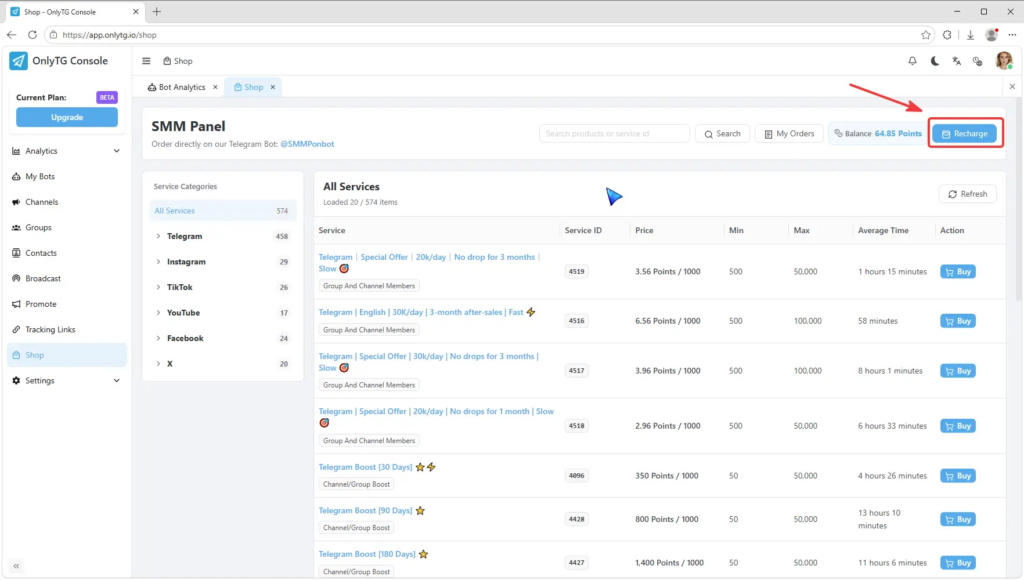
Open app.onlytg.io, log in, and select Shop. Choose a platform and growth category, review the available services, enter the target link and quantity, and create the order. The Console also provides service details and an My Orders area for reviewing order records and statuses.
A Practical Example: Starting a New Telegram Channel
Suppose you are launching a Telegram channel about productivity for freelancers.
Instead of immediately trying to maximize the member count, you could build the growth process in stages.
First, define the channel around a specific audience: freelancers who want practical productivity systems.
Next, publish several useful posts covering topics such as time management, project planning, and workflow templates.
Then, observe which subjects generate the most views and reactions.
After establishing a content direction, you can promote the channel through relevant communities, partnerships, social media posts, or other acquisition channels.
If you also need additional distribution support, an SMM panel can be considered as one execution option. You would select a suitable Telegram service, review its requirements and limits, enter the channel target, and track the order.
The important distinction is that the panel supports the distribution stage. The content and audience strategy still determine whether new visitors have a reason to stay.
What Should You Avoid When Growing a New Account?
Don’t Optimize Only for Follower Count
A large number of followers does not automatically mean that an account has a valuable audience.
Look at the relationship between followers, views, reactions, comments, shares, profile visits, and business outcomes.
Don’t Publish Without a Clear Topic
If every post targets a different audience, your account becomes difficult to understand.
Consistency does not mean repeating the same post. It means maintaining a recognizable subject, audience, and value proposition.
Don’t Expect One Tactic to Work Everywhere
A strategy that works for Instagram may not translate directly to TikTok, YouTube, Telegram, or LinkedIn.
Platform differences matter.
Don’t Use Growth Services Without Checking the Details
Before ordering a service, review the actual service description, target requirements, quantity limits, and processing information.
Growth should be intentional rather than based on purchasing the largest available number.
A Simple Framework for Growing From Zero
Define → Publish → Engage → Measure → Improve → Amplify
Define: Decide who the account is for and what it offers.
Publish: Create useful, recognizable content consistently.
Engage: Participate in conversations where your target audience already exists.
Measure: Track views, engagement, profile activity, and follower growth.
Improve: Repeat the topics and formats that produce useful signals.
Amplify: When appropriate, use collaborations, advertising, or growth services such as an SMM panel to support specific objectives.
This approach is more sustainable than treating follower acquisition as a single transaction.
Frequently Asked Questions
1. How long does it take to grow a new social media account?
There is no universal timeline. Growth depends on the platform, niche, content quality, audience demand, consistency, distribution, and level of competition. A new account should focus first on identifying repeatable growth patterns rather than setting an arbitrary follower deadline.
2. Should I focus on followers, views, or engagement first?
It depends on the account’s objective. Views can help measure exposure, followers indicate audience acquisition, and reactions or comments provide signals about audience interaction. For most new accounts, looking at several metrics together provides more useful information than optimizing for one number alone.
3. Can an SMM panel replace organic social media growth?
No. An SMM panel can be used as an execution tool for selected growth objectives, but it does not replace audience research, useful content, community building, or performance analysis. The strongest approach is to use distribution support alongside a broader social media marketing strategy.
Conclusion
Learning how to grow a new social media account is less about finding one secret growth hack and more about building a repeatable system.
Start with a clear audience and position. Publish content that gives people a reason to follow. Choose the platforms that fit your audience. Engage with relevant communities, measure what happens, and improve based on actual results.