

Getting attention on social media is only the first step. The harder challenge is turning that attention into meaningful interaction.
If your posts receive views but few comments, reactions, shares, or follows, the problem may not simply be a lack of reach. Your content may be reaching the wrong people, giving viewers little reason to respond, or failing to create a consistent path from discovery to community.
Learning how to increase social media engagement therefore requires more than publishing more often. You need a system that connects audience research, useful content, platform selection, distribution, interaction, and measurement. Once those pieces work together, engagement becomes something you can improve deliberately rather than something you simply hope for.
Start With the Audience, Not the Engagement Metric
One of the most common mistakes in social media marketing is treating engagement as the starting point.
A better approach is to begin with the audience.
Before creating content, identify:
- Who are you trying to reach?
- What problems do they want to solve?
- What information are they actively looking for?
- Which content formats do they already consume?
- What would make them stop scrolling?
- What would make them comment, share, save, or follow?
This distinction matters because engagement is usually a response to relevance.
A business selling productivity software, for example, should not simply publish posts asking people to “like and follow.” It can create practical content around workflow problems, productivity mistakes, templates, comparisons, or time-saving techniques. The audience then has a concrete reason to interact.
Turn Audience Insights Into Content Questions
Instead of asking, “What should we post today?”, build a list of recurring audience questions.
| Goal | Metrics | Recommended Focus |
|---|---|---|
| Visibility | Reach / Views | Distribution and discoverability |
| Audience Growth | Followers | Content relevance and profile conversion |
| Engagement | Reactions / Comments / Shares | Conversation and community |
| Content Performance | Watch Time / Retention | Format and content optimization |
The goal is not to maximize every metric simultaneously. Each metric should answer a different business question.
If visibility is weak, improve distribution and discoverability. If people see your content but do not follow, examine your profile and the value proposition behind your content. If followers rarely interact, focus on relevance, conversation, and community.
Build Content That Gives People a Reason to Respond
Publishing consistently is useful, but consistency alone does not create engagement.
Strong social media content usually gives the audience something to do mentally or emotionally. It can teach, challenge, entertain, solve a problem, invite an opinion, or provide something worth sharing.
A practical content system can combine several categories:
Educational Content
Teach something useful in a format that is easy to consume.
Examples include:
- Short tutorials
- Checklists
- Industry tips
- Mistake breakdowns
- How-to posts
- Explanations of complicated topics
Educational content can encourage saves and shares because its value extends beyond the moment someone sees it.
Conversation Content
Ask questions that are genuinely connected to your audience.
Instead of generic questions such as “What do you think?”, create specific prompts:
Which part of your content workflow takes the most time?
Specific questions are easier to answer because the audience knows exactly what you are asking.
Community Content
Give existing followers a reason to participate.
You can highlight customer questions, respond to recurring discussions, collect opinions, or turn community feedback into future content. This creates an engagement loop where interaction becomes a source of new content.
Repurposed Content
A successful idea does not need to disappear after one post.
A long-form article can become a short video, a carousel, a discussion post, several short tips, or a community question. Repurposing allows you to test the same core idea across different formats without constantly starting from zero.
Match Your Content to the Platform
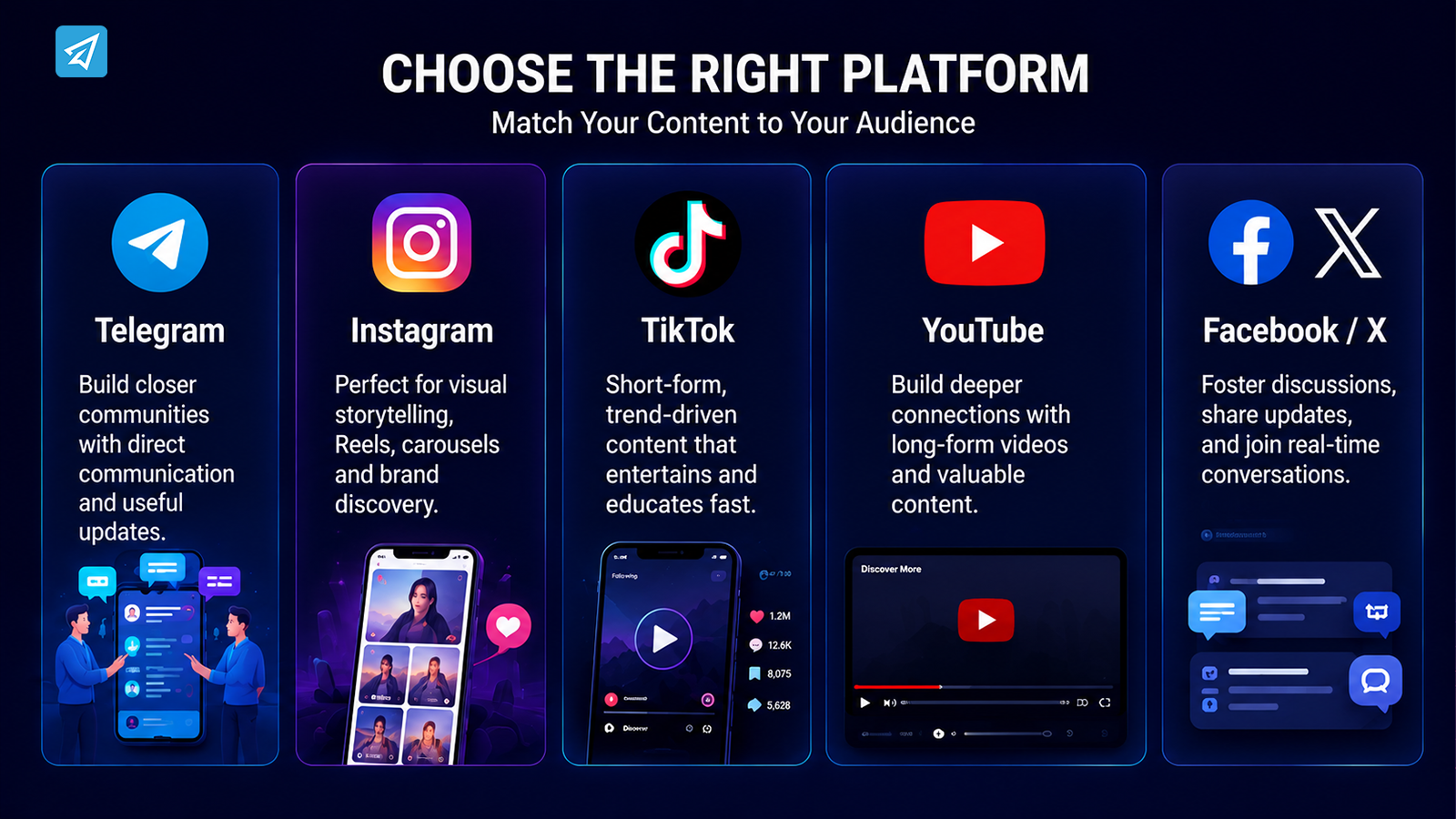
There is no universal social media growth strategy.
Different platforms encourage different behaviors, formats, and discovery patterns. The right choice depends on where your target audience spends time and what type of content you can consistently produce.
Telegram
Telegram can be particularly useful for brands, creators, publishers, and communities that want a more direct relationship with their audience.
A growth strategy can combine public content, community discussions, useful updates, recurring posts, and interactive formats. The emphasis should be on giving subscribers a reason to remain active rather than treating subscriber count as the only objective.
Instagram can work well for visual storytelling, short-form video, educational carousels, creator content, and brand discovery.
For engagement, consider how the first few seconds of a Reel or the first slide of a carousel communicates value. Strong visual hooks can improve the chance that people continue consuming the content.
TikTok
TikTok is highly compatible with short-form, personality-driven, educational, entertaining, and trend-aware content.
Instead of simply copying trends, connect the format to your niche. A trend is more useful when it helps communicate an idea your target audience actually cares about.
YouTube
YouTube provides opportunities for both discovery and deeper audience development.
Views alone do not explain whether a video is working. Watch time, retention, click-through behavior, comments, returning viewers, and subscriber growth can provide a more complete picture.
Facebook and X
Facebook can support communities, discussions, pages, groups, and shareable content, while X can be useful for real-time conversations, commentary, expertise, and network-driven distribution.
The important principle is simple: choose platforms based on audience-platform fit rather than trying to be everywhere.
Create an Engagement Loop Instead of Chasing Individual Posts
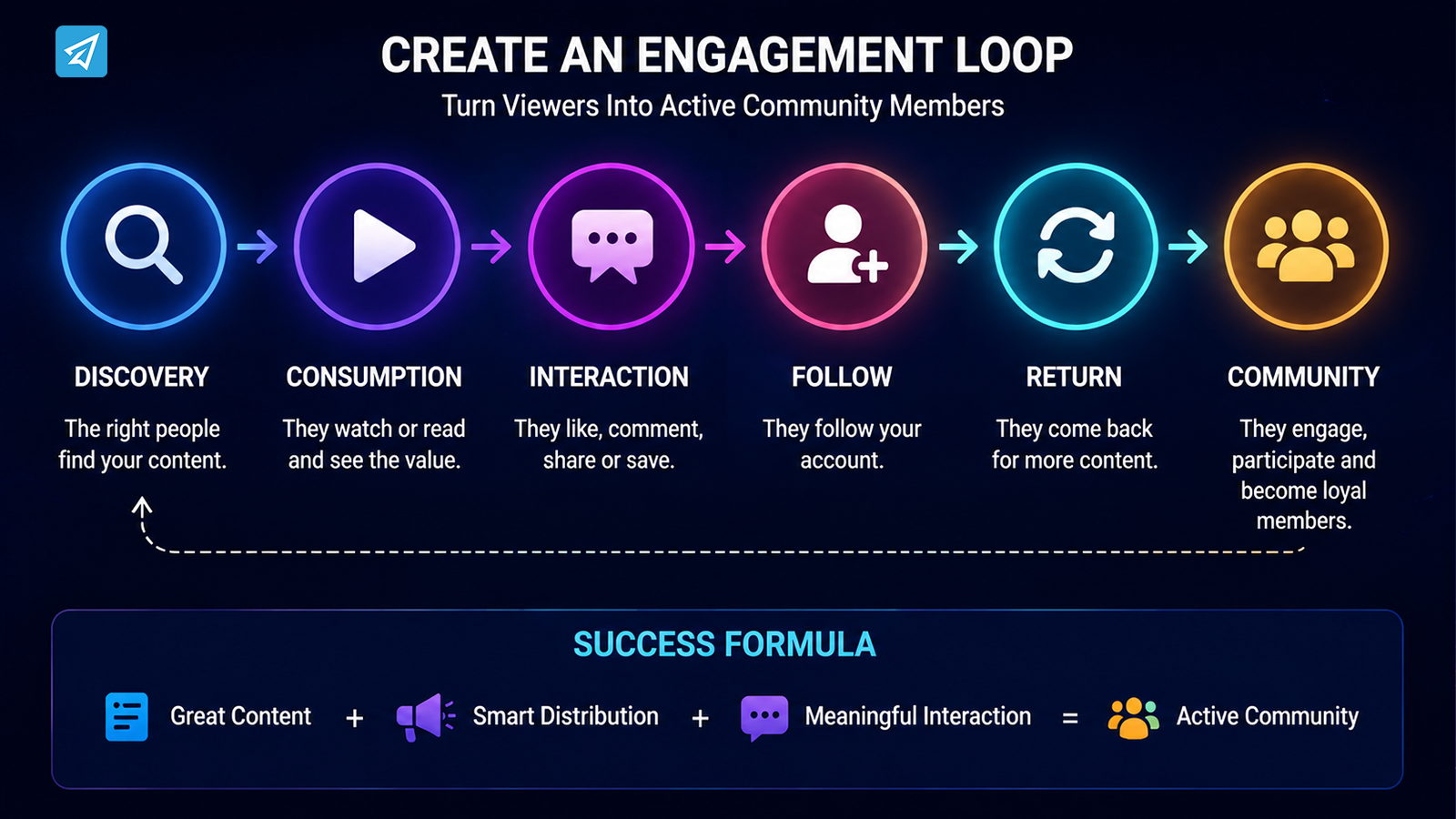
A strong social media account should not depend on isolated viral posts.
Think in terms of an engagement loop:
Discovery → Content Consumption → Interaction → Follow → Return → Community Participation
For example, someone discovers a short educational video. The video answers a specific problem and encourages them to follow for more practical advice. Later, another post asks a related question. The follower responds, sees the brand replying, and becomes more likely to participate again.
This is more valuable than a single spike in reactions because it creates a relationship between the account and its audience.
To strengthen the loop, examine every stage:
- Discovery: Can the right people find the content?
- Consumption: Does the opening communicate value quickly?
- Interaction: Is there a natural reason to respond?
- Follow: Is the account clearly worth following?
- Return: Is there a consistent reason to come back?
- Community: Does interaction receive meaningful responses?
Use Distribution as Part of the Content Strategy
Even excellent content can underperform if too few relevant people see it.
Distribution can include:
- Publishing consistently
- Cross-platform content repurposing
- Collaborations
- Community participation
- Search-friendly captions and titles
- Relevant hashtags where appropriate
- Sharing useful content through existing audiences
- Paid or supporting distribution when appropriate
Distribution should not mean sending every piece of content everywhere. Adapt the content to the platform and audience.
A YouTube tutorial may become a short TikTok explanation. A detailed article may become an X discussion. A useful idea may become a Telegram post followed by a community question.
The underlying idea remains consistent while the presentation changes.
Measure Engagement Beyond Likes
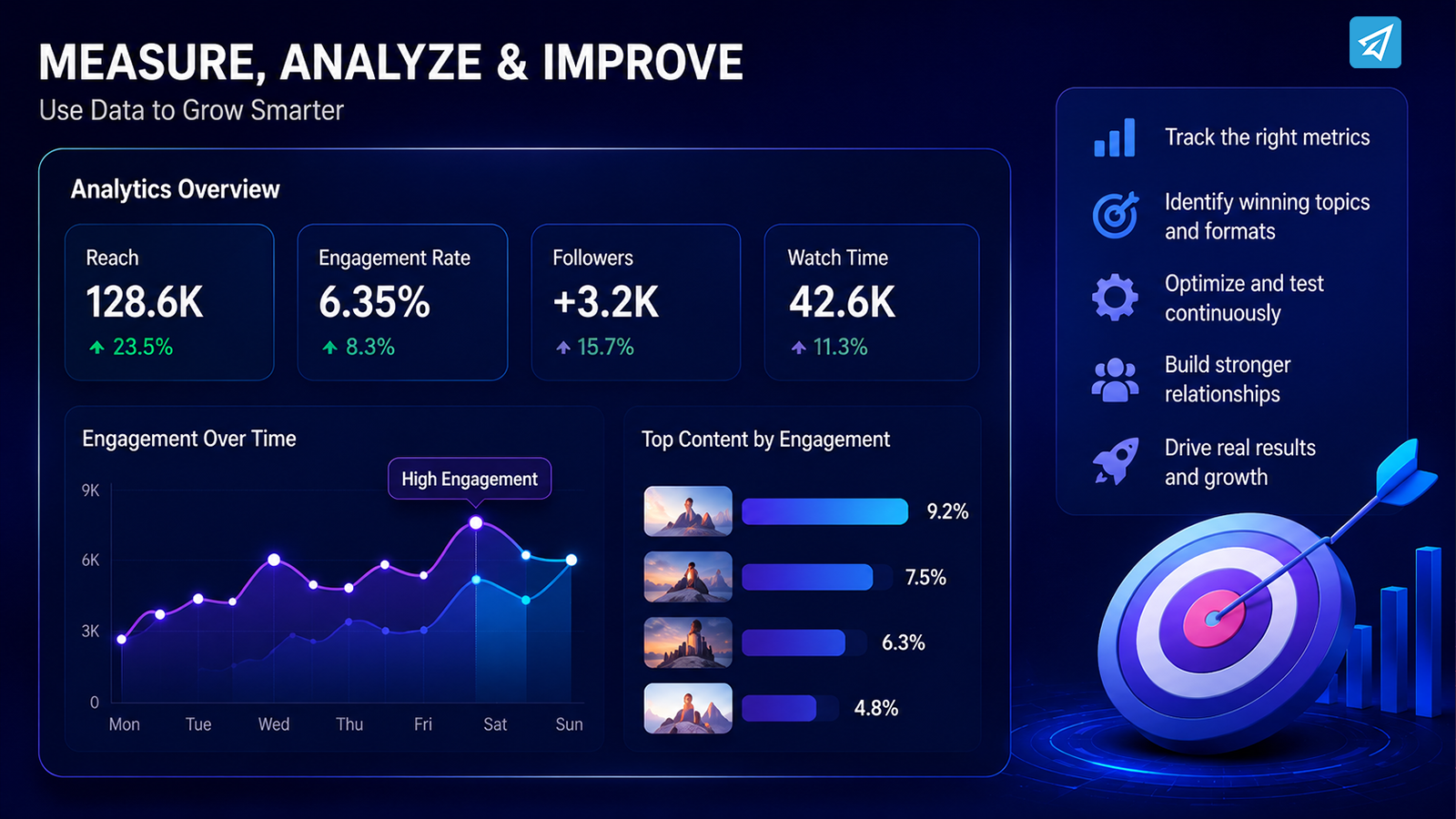
If you want to improve social media performance, measure more than visible reactions.
Useful metrics can include:
- Reach
- Impressions
- Views
- Followers gained
- Reactions
- Comments
- Shares
- Saves
- Click-through rate
- Engagement rate
- Watch time
- Retention
- Conversions
The right metrics depend on your objective.
For example, a brand awareness campaign may prioritize reach and impressions. A creator may care more about retention and followers gained. A community manager may focus on comments, reactions, and returning participation. A business campaign may ultimately need to connect social activity with clicks and conversions.
Look for Patterns, Not Isolated Numbers
One post receiving unusually high engagement does not automatically mean you have discovered a winning strategy.
Instead, compare multiple pieces of content.
Ask:
- Which topics consistently generate interaction?
- Which formats attract the longest attention?
- Which posts generate followers rather than temporary views?
- Which calls to action encourage meaningful responses?
- Which platforms produce the most relevant traffic?
- Which content creates repeat engagement?
Then use those findings to plan the next content cycle.
Use Supporting Tools Only After Defining the Goal
Once your strategy is clear, supporting tools can make execution easier.
An SMM Panel can be one component of that execution layer when you need a structured way to order supported social media growth services. For example, OnlyTG SMM Panel supports Telegram, Instagram, TikTok, YouTube, Facebook, and X, with services covering followers, views, reactions, and other available metrics.
The important distinction is that a growth tool does not replace the underlying strategy.
It should not replace:
- Audience research
- Content quality
- Community management
- Platform-specific strategy
- Analytics
- Customer understanding
Instead, think of tools as operational support within a larger system:
Strategy → Content → Distribution → Measurement → Optimization → Supporting Tools
This approach keeps social media growth focused on sustainable audience development rather than on any single metric.
How to Use OnlyTG SMM Panel as a Supporting Tool
If you decide that an SMM Panel fits your execution workflow, the process should begin with choosing the service that matches a clearly defined campaign objective.
Option 1: Telegram Bot
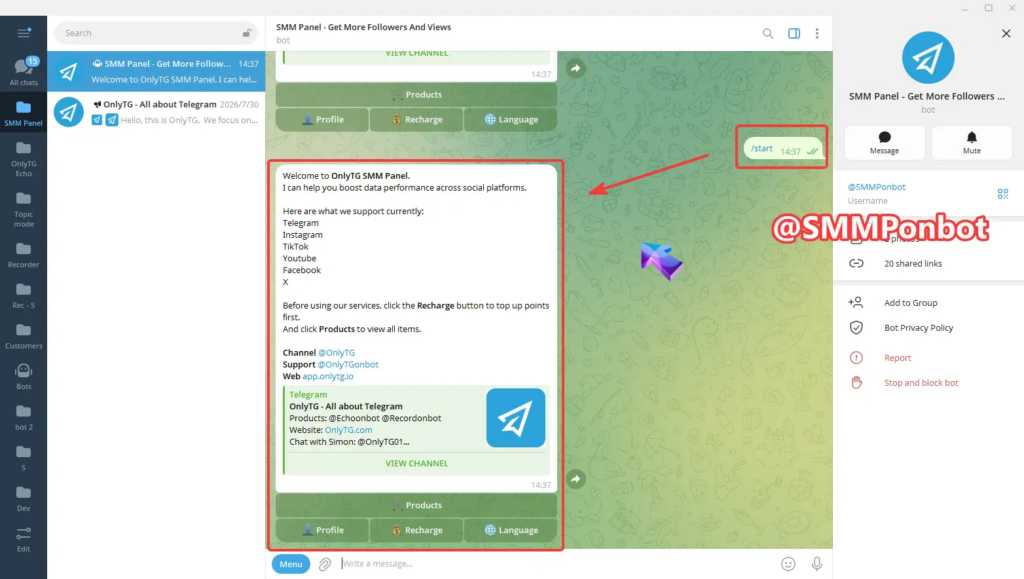
Step 1 — Open the Bot
Find @SMMPonbot on Telegram and send /start.
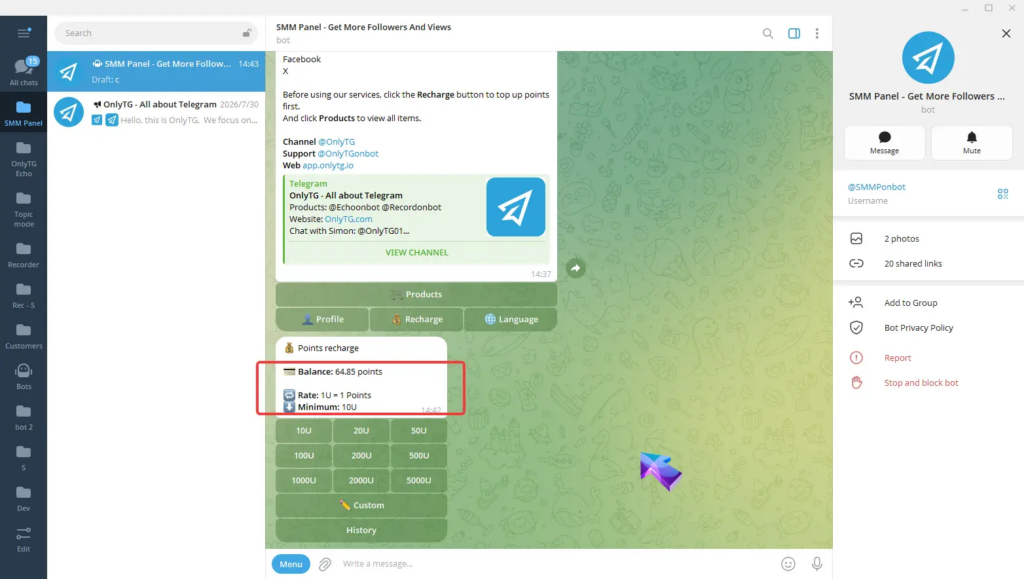
Step 2 — Add Balance
Use Recharge to fund the account. OnlyTG’s documentation currently lists 1 USDT = 1 point and a minimum recharge of 10 USDT.
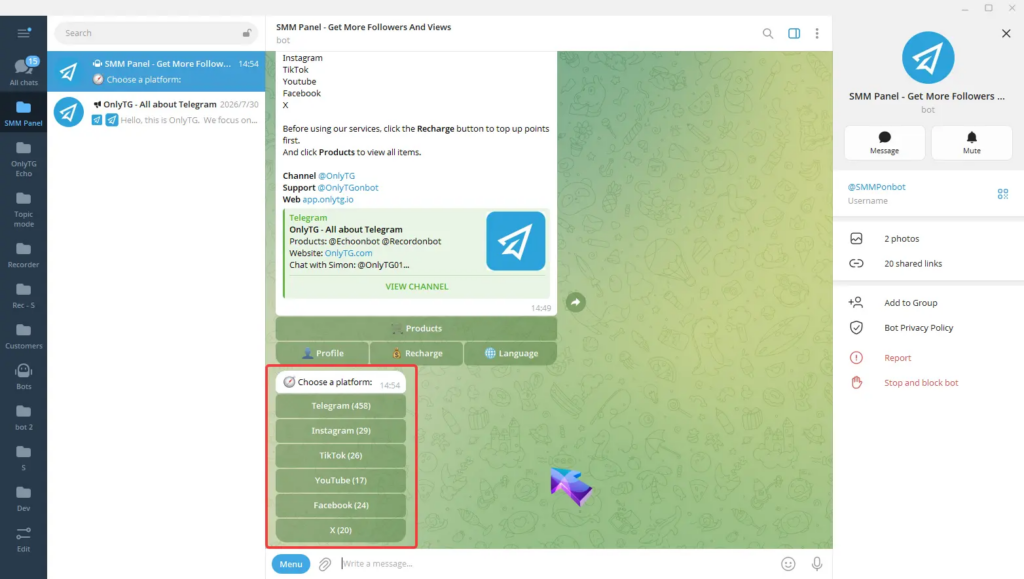
Step 3 — Select the Platform and Growth Type
Open Products, choose the platform, then select the relevant growth category.
Step 4 — Review the Service
Check the service information, including price, quantity information, estimated waiting time, and notes.
Step 5 — Create the Order
Select Buy, enter the target link and quantity, review the details, and confirm.
Step 6 — Monitor the Order
Use Profile → Orders to review order records and status.
Option 2: OnlyTG Console
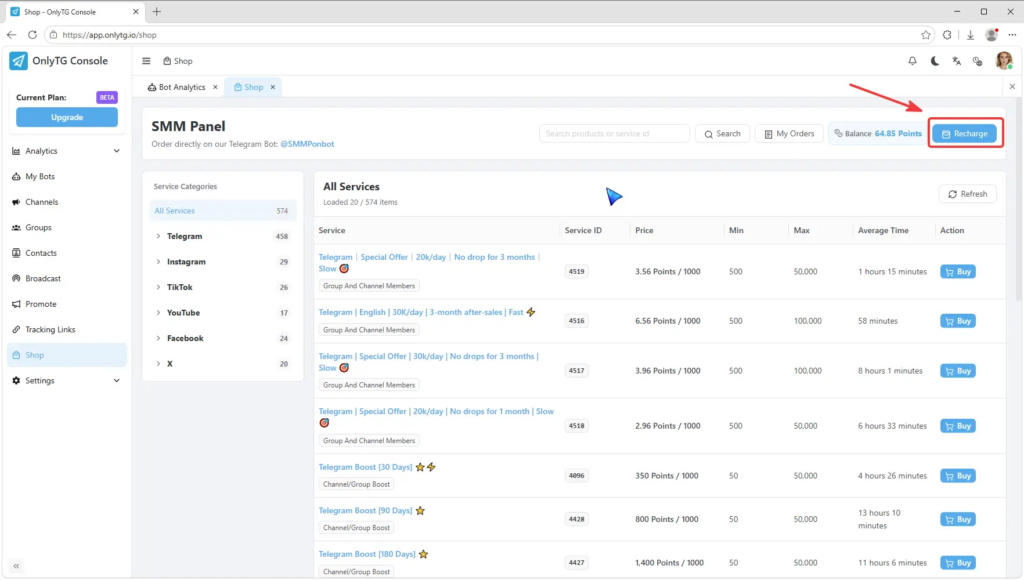
The Console provides a browser-based workflow.
Open app.onlytg.io, log in, and select Shop. Choose a platform and growth category, review the available services, enter the target link and quantity, and create the order. The Console also provides service details and an My Orders area for reviewing order records and statuses.
Common Mistakes That Limit Social Media Engagement
Even well-funded campaigns can struggle when the fundamentals are missing.
Chasing Vanity Metrics
A large number can look impressive without representing meaningful audience development. Always connect metrics to a specific goal.
Posting Without a Clear Audience
Content designed for everyone often becomes relevant to no one.
Using the Same Content Everywhere
Cross-platform distribution is useful, but direct duplication can ignore differences in audience behavior and content format.
Ignoring Existing Followers
Growth is not only about attracting new people. Existing followers are an important source of engagement, feedback, retention, and advocacy.
Changing Strategy Too Quickly
Social media performance naturally fluctuates. Give experiments enough time and compare meaningful patterns before abandoning an approach.
The Real Goal Is a Better Audience, Not Just Bigger Numbers
The most useful way to think about social media growth is as a progression:
Reach → Attention → Engagement → Follow → Retention → Action
Each stage has a different purpose.
More reach can create opportunities for discovery. Better content turns attention into consumption. Relevant prompts create engagement. A clear value proposition encourages follows. Consistent content supports retention. Finally, a strong relationship between the audience and the brand can support business actions.
That is why the best answer to how to increase social media engagement is not simply “post more” or “get more views.”
It is to build a system in which the right audience repeatedly encounters useful content, has reasons to participate, and can move naturally from viewer to follower to active community member.
Frequently Asked Questions
1. How can I increase social media engagement organically?
Start by understanding your audience, publishing content that solves specific problems, creating opportunities for conversation, and measuring which topics and formats consistently generate meaningful interaction. Organic growth becomes stronger when content, distribution, and community activity work together.
2. What is the most important metric for social media engagement?
There is no single metric that works for every account. Engagement rate, comments, shares, reactions, saves, watch time, retention, and follower growth can all be useful. Choose metrics according to the objective of the campaign rather than optimizing for one number.
3. Can an SMM Panel replace a social media growth strategy?
No. An SMM Panel can support specific execution tasks, but it should not replace audience research, content strategy, community management, analytics, or platform-specific planning. It works best as one supporting component of a broader social media growth system.
Build a Social Media Growth System That Compounds
Increasing engagement is not about finding one tactic that works forever. It is about creating a repeatable process: understand your audience, produce useful content, distribute it intelligently, measure meaningful outcomes, and continuously improve.
When the strategy is clear, supporting tools can help organize execution without becoming the strategy itself.
If you need additional execution support for supported social media growth metrics, explore the OnlyTG SMM Panel as one component of your broader social media growth workflow.