
A business can publish regularly, share product updates, and occasionally attract attention without developing a meaningful social media following. The problem is often not a lack of activity. It is that people who encounter the account do not see a clear reason to follow it.
Learning how to build a social media follower base requires more than collecting individual follows. Businesses need to create a recognizable identity, publish content that serves a specific audience, and give new visitors a reason to return. The objective is to develop an audience that has a genuine connection with the account’s subject, rather than simply increasing a visible number.
Start With a Reason People Would Want to Follow Your Account
Before trying to attract more followers, establish what people will receive by following the account.
A social media profile competes with countless other sources of information. Users make quick decisions about whether an account deserves a place in their feed. If its purpose is unclear, even well-produced content may generate occasional attention without encouraging long-term interest.
A useful starting point is to define the account through three questions:
- Who should follow this account? Identify the people most likely to benefit from its content, products, expertise, or community.
- What will they consistently find here? Describe the recurring information, entertainment, inspiration, or practical assistance the account provides.
- Why should they follow this account instead of another? Identify a meaningful difference in perspective, specialization, presentation, or audience focus.
Consider a small company that sells equipment for home coffee preparation. Its social media account could publish general product announcements, but that would give visitors relatively few reasons to return.
A more recognizable direction might be helping beginners understand coffee equipment, compare brewing methods, and solve common preparation problems.
This positioning creates a clearer expectation. Someone interested in home coffee preparation can understand what the account offers before deciding to follow it.
Build a specific audience before expanding your reach
A follower base becomes difficult to maintain when its members have little in common with the account’s subject.
Instead of defining the audience only through broad demographic categories, consider their interests, questions, and reasons for using the platform.
For example, a software company might distinguish between:
- Business owners looking for practical operational advice.
- Marketing professionals researching campaign methods.
- Existing customers seeking product guidance.
- Industry followers interested in trends and developments.
These groups may all be relevant to the company, but they do not necessarily need the same content.
Start with one primary audience segment. Build content around its recurring questions and expand into related segments when the account has established a recognizable content direction.
Turn Your Content Into a Reason to Come Back

A follower base grows more naturally when an account offers something people expect to receive again.
Individual posts can attract attention, but recurring content gives people a reason to maintain their interest.
This is why content planning should focus on recognizable themes rather than treating every publication as an isolated activity.
Develop two or three recurring content themes
Choose a small number of themes that connect directly to the audience’s interests.
A business account might use the following combination:
- Educational content: Explain common problems, practical methods, and useful industry knowledge.
- Product-related content: Demonstrate how products or services address specific customer needs.
- Community-oriented content: Share questions, customer perspectives, discussions, or relevant experiences.
The exact combination depends on the business. A creator may prioritize tutorials and entertainment, while a professional service provider may focus on educational explanations and industry insights.
The important point is consistency of subject matter, not publishing identical formats repeatedly.
When users encounter several posts from the same account, they should begin to recognize what it specializes in.
Create content that supports repeat consumption
Not every post needs to introduce a completely new subject.
Some topics are suitable for recurring formats:
- A weekly explanation of a common industry question.
- A regular product comparison.
- A series addressing beginner mistakes.
- Short demonstrations of useful techniques.
- Updates that help followers understand changes in a particular field.
Recurring formats reduce the effort required to plan content while helping audiences understand what they can expect.
However, repetition should not become duplication. Each publication should contribute a new example, explanation, perspective, or practical takeaway.
Make each post understandable without previous context
A potential follower may discover one post without knowing anything about the account.
Therefore, important content should communicate its value independently.
For example, instead of publishing a post titled “Part 7 of Our Marketing Series,” use a specific topic such as “Three Questions to Ask Before Launching a Social Media Campaign.”
The second approach gives new visitors an immediate reason to pay attention.
Series labels can still be used, but they should not prevent individual posts from attracting people who have never encountered the account before.
Give New Audiences More Ways to Discover Your Content

Publishing useful material is only one part of building a social media follower base. People must also have opportunities to encounter it.
The most appropriate discovery methods depend on the platform and the content format.
Match discovery methods to platform behavior
Different platforms offer different ways for content to reach people beyond an existing audience.
| Platform | Relevant discovery approach | Content direction |
|---|---|---|
| Reels, Explore, relevant hashtags, and collaborative posts | Visual demonstrations, carousels, and short educational videos | |
| TikTok | For You feed, topic relevance, and short-form video | Focused demonstrations, explanations, and entertaining niche content |
| YouTube | Search, recommendations, and Shorts | Tutorials, searchable explanations, and video series |
| Relevant groups, page sharing, and community discussions | Practical updates, discussions, and shareable resources | |
| X | Topic conversations, replies, and reposts | Timely commentary, concise insights, and industry discussions |
| Telegram | Channel sharing, relevant communities, and external promotion | Consistent updates, specialized information, and community-focused content |
These are different discovery environments, not interchangeable distribution channels. A video format that works well on TikTok may need a different presentation on YouTube or Instagram.
Choose platforms according to where the intended audience already spends time and what type of content the business can produce consistently.
Use partnerships to reach audiences with overlapping interests
Collaboration can introduce an account to people who already care about a related subject.
A small business, for example, might collaborate with a complementary brand, an industry creator, or a professional who serves a similar audience.
Before agreeing to a collaboration, check three things:
- The other account attracts people who are relevant to your intended audience.
- The proposed content provides value to both communities.
- The collaboration has a clear reason to introduce followers to your account.
A partnership should not be judged only by the number of people exposed to it. The more important question is whether the new audience has a reason to stay.
Make existing followers part of your distribution process
Followers can help content reach additional people when they find it useful enough to share.
Create material that supports natural sharing, such as practical checklists, helpful explanations, useful comparisons, or interesting industry observations.
You can also invite followers to contribute questions and experiences. Their responses can reveal new content opportunities while helping discussions develop around the account.
Avoid treating every interaction as a request to promote the brand. Give people something worth sharing first.
Convert Profile Visitors Into Actual Followers
An account can receive attention without building a corresponding follower base.
This often happens when visitors cannot quickly understand what the account offers or why its future content would be relevant.
The profile should therefore function as a clear explanation of the account’s value.
Make the profile communicate its purpose immediately
Review the following elements:
- Account name: Make it recognizable and easy to associate with the business or subject.
- Profile description: Explain who the account serves and what followers can expect.
- Profile image: Use a recognizable brand or creator identity.
- Pinned content: Highlight important introductory posts, useful resources, or representative content.
- Links: Direct visitors to a relevant website, product page, or other destination when appropriate.
A visitor should not need to examine dozens of posts to understand the account.
Give visitors a specific reason to follow
Calls to action work best when they explain the value of following.
- Follow for practical weekly marketing advice.
- Follow for new product demonstrations and usage tips.
- Follow for regular updates on a specific industry.
- Follow to learn more about a particular topic through a continuing content series.
These messages are more informative than simply asking people to follow.
The promise must also be realistic. If an account says it provides weekly tutorials, it should have a content plan capable of maintaining that schedule.
Measure Whether Your Follower Base Is Becoming More Relevant

Follower growth should be evaluated through more than the total number displayed on a profile.
A growing account may still attract people who have little interest in its subject. That creates a difference between numerical growth and audience development.
Track a small group of metrics that explain how people move from discovering the account to following it.
| Metric | What it helps you understand | What to do next |
|---|---|---|
| Reach and impressions | Whether content is being discovered | Review topics, formats, and distribution sources |
| Profile visits | Whether content creates interest in the account | Check content relevance and profile presentation |
| New followers | Whether visitors decide to follow | Improve the account’s value proposition and calls to action |
| Engagement from followers | Whether the audience remains interested | Review content relevance and encourage meaningful discussion |
| Unfollows | Whether the account is maintaining audience expectations | Compare recent content with the interests that originally attracted followers |
Look at these indicators together.
For example, if reach increases but profile visits remain limited, the content may attract attention without communicating a compelling reason to explore the account.
If profile visits increase but new followers do not, review the account description, pinned posts, and consistency between the content and profile promise.
If follower numbers rise but engagement becomes weaker, investigate whether the new audience is actually interested in the subjects being published.
The purpose of measurement is to identify which part of the follower acquisition process needs attention.
How to Use OnlyTG SMM Panel as a Supporting Tool
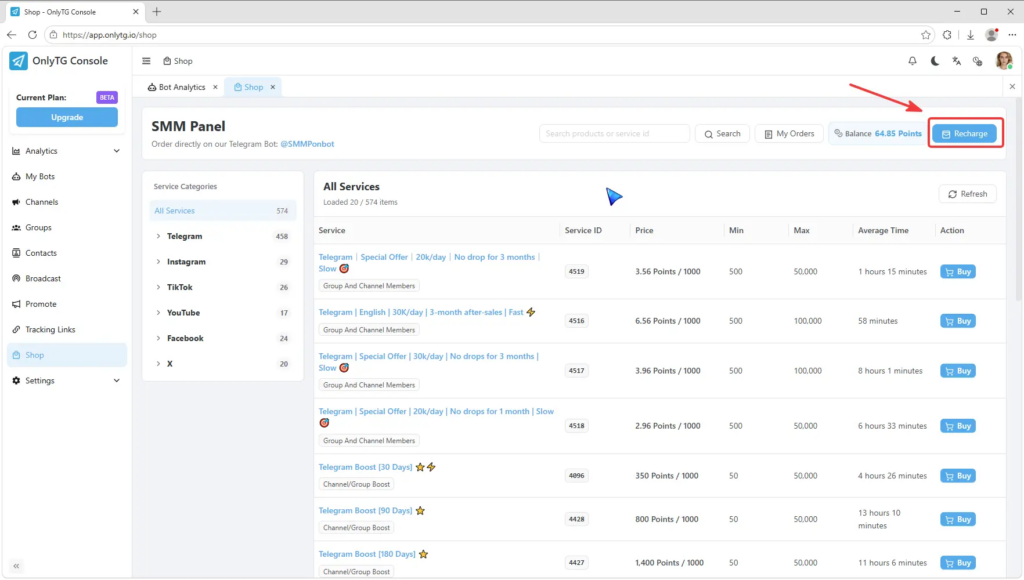
If an SMM panel fits a specific operational need, OnlyTG keeps the ordering process relatively straightforward. You can use the Telegram bot or the OnlyTG Console. The official documentation describes selecting a platform and growth type, choosing a service, reviewing its available details, entering the target link and quantity, and confirming the order.
Option 1: Telegram Bot
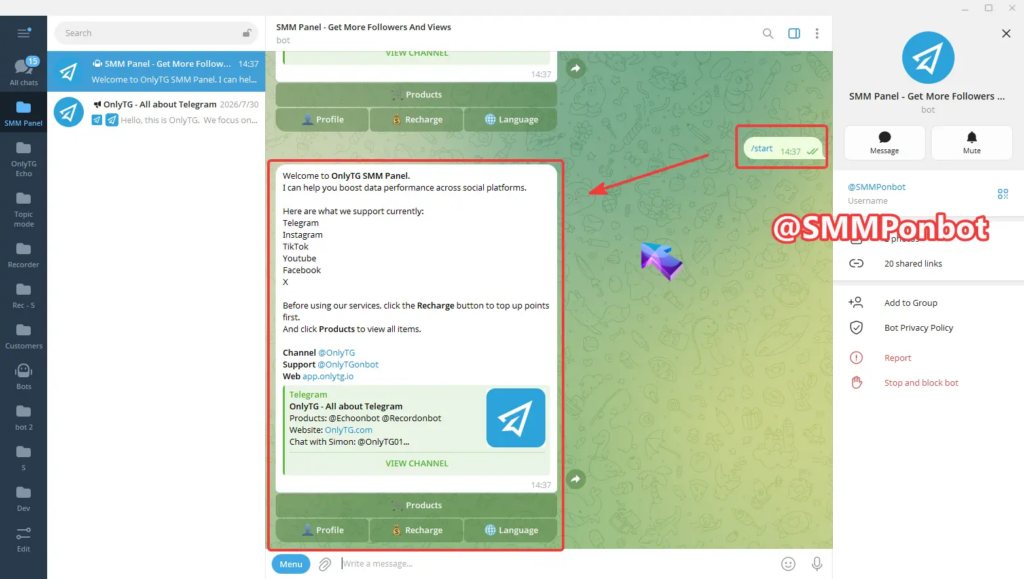
Step 1 — Open the Bot
Find @SMMPonbot on Telegram and send /start.
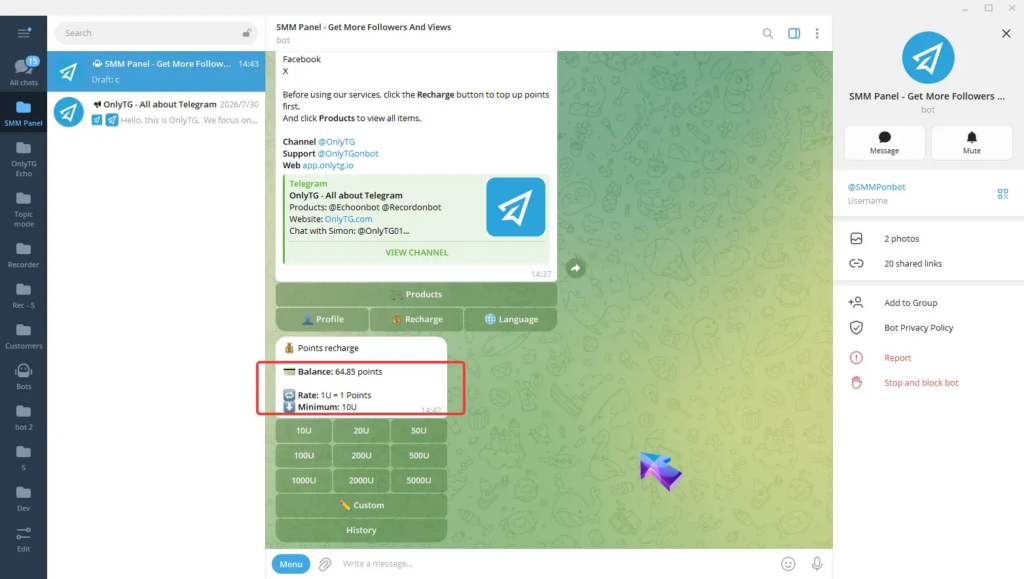
Step 2 — Add Balance
Use Recharge to fund the account. OnlyTG’s documentation currently lists 1 USDT = 1 point and a minimum recharge of 10 USDT.
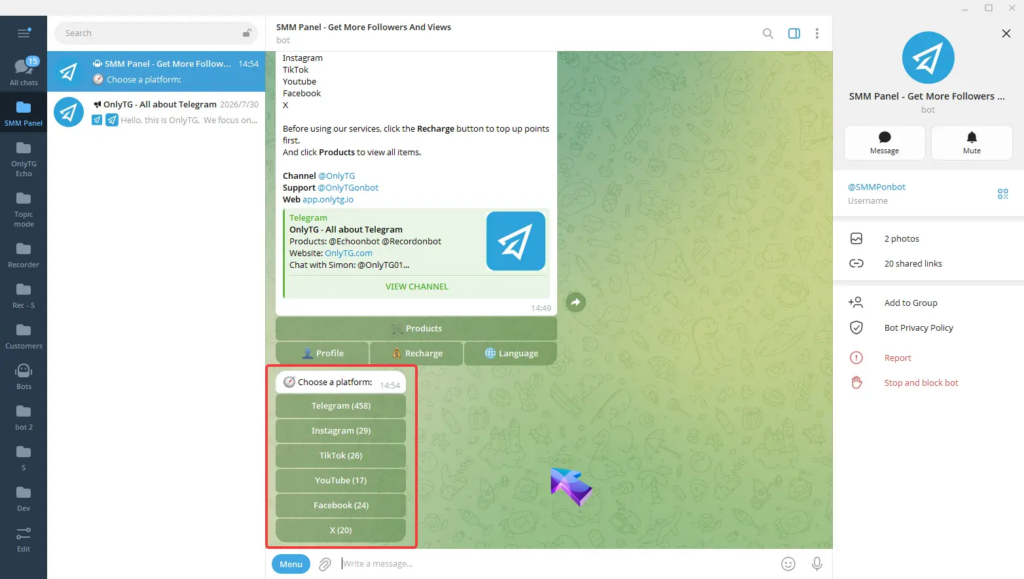
Step 3 — Select the Platform and Growth Type
Open Products, choose the platform, then select the relevant growth category.
Step 4 — Review the Service
Check the service information, including price, quantity information, estimated waiting time, and notes.
Step 5 — Create the Order
Select Buy, enter the target link and quantity, review the details, and confirm.
Step 6 — Monitor the Order
Use Profile → Orders to review order records and status.
Option 2: OnlyTG Console
The Console provides a browser-based workflow.
Open app.onlytg.io, log in, and select Shop. Choose a platform and growth category, review the available services, enter the target link and quantity, and create the order. The Console also provides service details and an My Orders area for reviewing order records and statuses.
Avoid Building a Follower Base That Cannot Support Your Goals
Several growth approaches can increase visible activity without creating a useful audience.
Attracting people through unrelated promotions: A giveaway may bring attention, but people who only want the prize may have little interest in future content. Choose incentives that relate directly to your business or subject.
Changing content direction too frequently: If every publication targets a different audience, visitors may struggle to understand what following the account will provide. Keep a recognizable central theme while testing new formats.
Treating follower numbers as the final objective: A larger number does not automatically mean stronger customer relationships or better business performance. Evaluate whether followers interact with relevant content and take meaningful next steps.
Relying on purchased metrics as a substitute for audience development: Metric-related services do not replace genuine interest, customer relationships, or organic community participation. Keep operational metric support separate from the evaluation of meaningful audience growth.
A sustainable follower base is built through a clear promise, consistent delivery, relevant discovery, and ongoing audience understanding.
Conclusion: Build an Audience That Has a Reason to Stay
Learning how to build a social media follower base is ultimately about creating a relationship between an account and the people it serves.
Start by identifying a specific audience and explaining why your account is worth following. Develop recognizable content themes, make individual posts discoverable, and ensure that profile visitors understand what they will receive by becoming followers.
Then evaluate the quality of that growth rather than relying exclusively on follower counts.
For businesses and creators, the most useful follower base is not necessarily the largest one. It is the audience that continues to find value in the account’s content, recognizes its purpose, and has a reason to remain connected.
Frequently Asked Questions
1. How long does it take to build a social media follower base?
There is no universal timeline. Growth depends on the platform, audience demand, content relevance, publishing consistency, and distribution opportunities. Focus on identifying repeatable content that attracts the right audience instead of expecting a fixed number of followers within a specific period.
2. Should a business focus on one social media platform or several?
Start with the platform that best matches your intended audience and content capabilities. Establish a consistent presence there before expanding. Managing several platforms without enough resources to maintain relevant content can weaken the overall follower-building process.
3. How can I tell whether my social media followers are valuable to my business?
Look beyond total follower numbers. Evaluate whether followers engage with relevant content, visit your website, ask meaningful questions, or take actions related to your business objectives. The right indicators depend on what your social media account is intended to achieve.