
Daily recurring Telegram promotional posts can still drive steady traffic, sign-ups, and sales in 2026, but only if they feel useful, timed well, and easy to act on. Telegram is not a feed that rewards volume for its own sake. It rewards clarity, consistency, and audience trust.
If your channel posts too much, the audience tunes out. If you post too little, the offer disappears from memory. This guide shows how to build a repeatable posting system, choose the right cadence, avoid spam triggers, and add light automation only where it actually saves time.
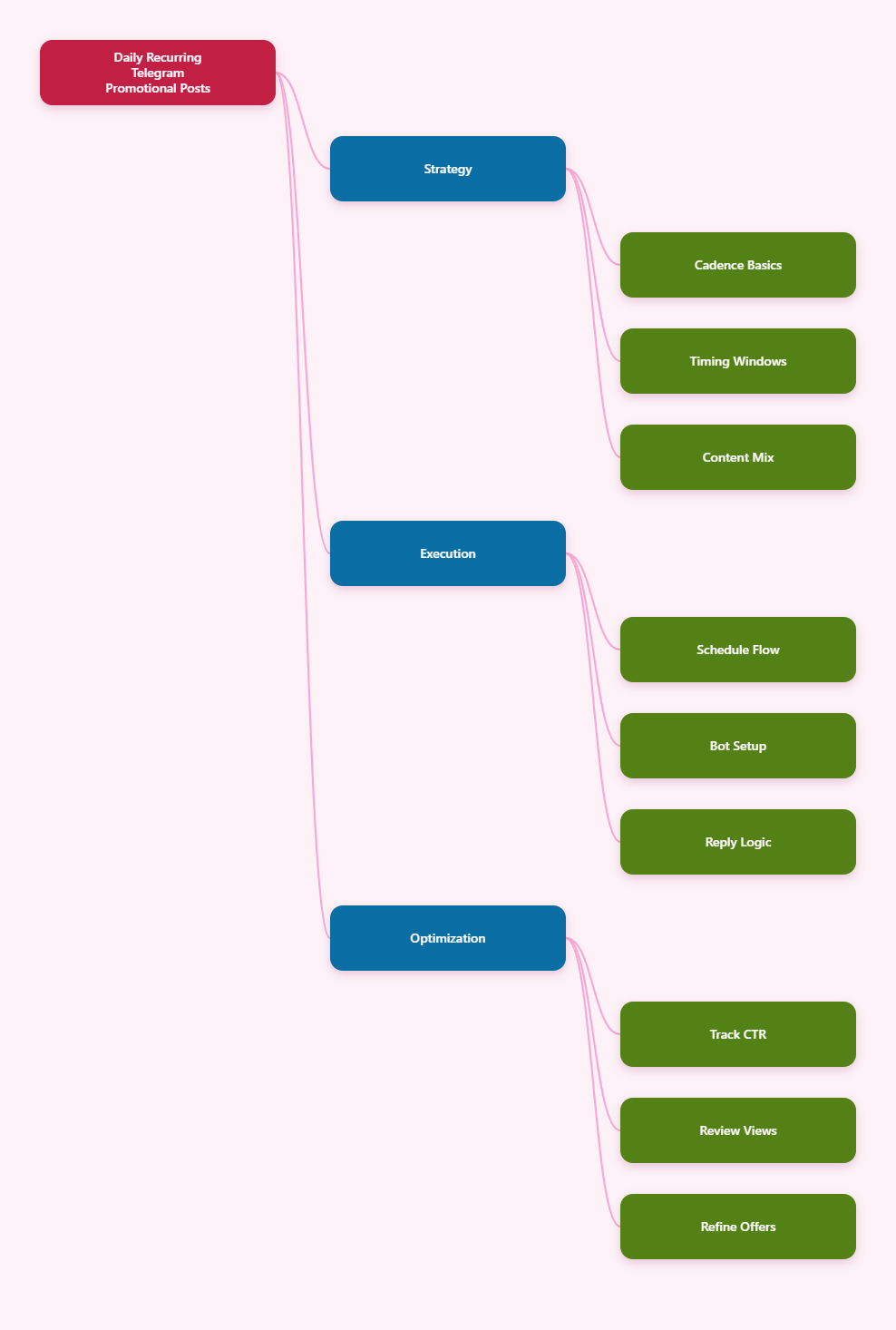
Why daily recurring Telegram promotional posts still work in 2026
Telegram channels are broadcast tools, not algorithmic timelines. Posts appear in chronological order, subscribers can see the history, and admins control the publishing rhythm. That makes Telegram especially strong for recurring offers, reminders, launches, and updates that need repetition without depending on a ranking system.
For marketers, that is the real advantage. A good post does not need to go viral if it keeps showing up in a predictable way and gives people a reason to click. In many 2026 publishing guides, one to three posts per day is still the most practical range for most non-news channels.
The main mistake is treating recurring promotion like a copy-paste loop. Repetition works best when the angle changes. One day you lead with social proof, the next with a use case, and the next with a deadline. The offer stays familiar, but the message feels fresh.
What Telegram is good at
- Direct broadcast to opted-in subscribers
- Clear view counts for each post
- Simple publishing across channels and groups
- Fast reading on mobile devices
That mix makes Telegram ideal for promotions that need persistence. You can repeat the same core message over several days without relying on paid reach every time. But the content still needs a reason to exist beyond the sale itself.
What Telegram is not good at
- Cold outreach to uninterested strangers
- High-frequency spammy promotion
- Invisible testing without link tracking
- Unstructured posting without a content plan
Telegram’s terms and spam guidance are clear enough: do not contact people who do not expect your messages, and do not treat the platform like an open invitation to blast offers. Daily recurring Telegram promotional posts should live inside owned audiences, not random inboxes.
What usually goes wrong with recurring promotions?
Most failed Telegram promotion systems do not fail because the offer is bad. They fail because the posting rhythm, timing, and message structure are weak. If people stop opening the posts, the channel looks active but performs badly.
In practice, three problems show up again and again: overposting, poor timing, and weak tracking. Fix those three, and the rest of the workflow becomes much easier to manage.
The overposting problem
Posting too often is one of the fastest ways to wear out a channel. For most niches, heavy daily promotion creates fatigue before it creates demand. A public channel can handle more than a private brand community, but even then, every extra post competes with the last one.
A healthier pattern is to separate core promotions from supporting content. If you post a promotional message every day, mix in proof, education, or a short update that makes the promotion feel earned. People tolerate repetition better when it is useful repetition.
The timing problem
Telegram usage is still heavily time-based. Multiple 2026 guides point to weekday windows such as 1 PM to 4 PM and 6 PM to 10 PM as strong periods for many audiences. That does not mean every channel should copy those hours blindly, but it is a sensible starting point.
If your audience spans multiple time zones, choose the main audience time zone first. A recurring post that lands at the right local time is usually more valuable than a post sent at a convenient time for the admin.
The tracking problem
Views are helpful, but they are not enough. A recurring promotion needs link clicks, replies, and downstream conversions to tell you whether the offer is working. A post that gets seen but never clicked is not a win.
Use a consistent link format and track performance by angle, day, and time slot. Over a few weeks, the pattern will show you which message types get attention and which ones stall out.
A simple operating model for daily recurring Telegram promotional posts
The easiest way to make daily recurring Telegram promotional posts sustainable is to run them like a small editorial system. You do not need a huge content team. You need a repeatable structure.
Start with four buckets: offer, proof, education, and reminder. Then assign each bucket to a day or time window. The result is a message stream that feels planned rather than improvised.
- Offer: A direct CTA tied to a product, form, or landing page.
- Proof: Results, screenshots, testimonials, or use-case evidence.
- Education: A tip, mini guide, or problem-solving post.
- Reminder: Deadline, seat limit, feature refresh, or final call.
This pattern works because not every post has to sell in the same way. Some posts create awareness. Some build trust. Some close the loop. The channel stays active without feeling repetitive.
| Method | What it supports | Best use case | Main limitation |
|---|---|---|---|
| Native Telegram scheduling | One-time scheduled posts, edit, reschedule, send now, delete | Launch dates, holiday promos, fixed reminders | Recurring promotion still needs extra workflow |
| Manual daily posting | Full control over every message | Fast-changing offers and real-time updates | Hard to maintain consistently over time |
| Bot-assisted workflow | Repeat replies, menus, broadcast tasks, tracked links | Lead capture, support, and recurring CTA flows | Needs setup and clear publishing rules |
For many teams, the best approach is hybrid. Use manual judgment for the main post, then use automation for the repetitive support layer. That keeps the channel human without making the workflow fragile.
How to build a lightweight recurring system without spam
Spam risk is not just about volume. It is also about relevance and consent. Telegram’s spam guidance is simple: only contact people if you are sure they expect messages from you. That is why channels and opted-in communities are better than cold blasting strangers.
To stay clean, make sure every recurring promotional post has a clear reason to exist. A feature update, a new proof point, a deadline, or a new angle is enough. If the message does not add context, do not send it.
Use one main CTA per post
Daily posts should not behave like cluttered landing pages. Pick one action and keep the rest of the post supporting that action. If you want clicks, ask for clicks. If you want replies, ask for replies. Mixed signals lower conversion.
Rotate the angle, not the offer
The same offer can be framed in many ways. A product launch can be presented as a feature list, a customer result, a problem-solution story, or a deadline reminder. This keeps daily recurring Telegram promotional posts from sounding identical.
Measure what actually matters
Track at least four things: post views, link clicks, reply volume, and conversions. If a post gets high views but low clicks, the hook is weak. If it gets clicks but no conversions, the landing page or offer may need work.
That is the point where a small automation layer helps. You do not need it for strategy. You need it for the repetitive parts that slow the team down.
Where OnlyTG Echo@EchoOnBot fits
When the pain point is repetitive replies, simple routing, and handling audience questions after a promotional post, OnlyTG Echo@EchoOnBot can support the workflow without turning the article into a bot-first strategy. The setup starts with the basics: create a Telegram bot in BotFather, then add the token inside OnlyTG Echo@EchoOnBot.
From there, the practical tutorial flow is straightforward. Set a Start Message so new users get an intro when they tap /start. Add auto-reply or keyword reply rules for common intents such as pricing, demo, or shipping. Use Quick Reply and Bot Menu buttons to reduce friction when people arrive from a daily promo post.
- Step 1: Create the bot in BotFather and copy the token.
- Step 2: Paste the token into OnlyTG Echo@EchoOnBot and connect the bot.
- Step 3: Configure Start Message, keyword replies, and menu buttons.
- Step 4: Use tracking links to separate which daily post drove the action.
Three practical use cases stand out. First, a SaaS channel posts a daily feature reminder and uses keyword replies to answer “pricing” or “trial” instantly. Second, an ecommerce brand posts a limited-stock reminder and routes common questions like “shipping” to a quick reply. Third, an education channel posts a webinar CTA and uses the start flow to guide new subscribers to the replay and FAQ.
OnlyTG Echo@EchoOnBot also includes other useful pieces such as broadcast tasks, group management, contact bans, and message recall. Those functions matter most when your audience grows and the same daily promotion starts generating more inbound questions than one person can handle manually.
Practical rules to follow in 2026
- Keep most channels in the 1 to 3 posts per day range unless you are running a news-style feed.
- Use weekday timing first, then adjust by audience behavior.
- Mix promo posts with proof and education.
- One post, one CTA, one measurable outcome.
- Avoid cold outreach and unsolicited group adds.
- Use recurring promotion as a system, not a habit loop.
- Review performance weekly, not daily, unless you are in a fast-moving niche.
If you want daily recurring Telegram promotional posts to compound instead of annoy, consistency matters more than intensity. A clean rhythm, a clear offer, and a simple support layer usually outperform a louder but less thoughtful approach.
FAQ
How many promotional posts should I send per day?
For most channels, one to three posts per day is a safer range than flooding the feed. News-style channels can post more, but brand and education channels usually perform better with moderation.
Does Telegram support recurring scheduled posts natively?
The standard client is mainly built for one-time scheduling. For recurring promotion, most teams use a bot or external workflow so the cadence stays consistent.
What is the best time to post on Telegram?
Many 2026 guides point to weekdays, especially the afternoon and evening windows. A practical starting point is 1 PM to 4 PM and 6 PM to 10 PM in your audience’s main time zone.
Are promotional posts allowed on Telegram?
Yes, but they should be relevant and aligned with Telegram’s spam and abuse rules. The important part is to avoid unsolicited outreach and keep promotions inside expected, opted-in environments.
Should I use channels or groups for promotions?
Use channels for broadcast-style promotion and groups for discussion or support. Many teams use both: the channel handles the daily post, and the group handles replies or community interaction.
What should I track besides views?
Track link clicks, replies, and conversions. Views tell you reach, but they do not tell you whether the promotion actually moved anyone to act.
How can I reduce manual work after each post?
Use a simple bot layer for common questions, menus, and starter messages. That way, the promotional post can stay focused while the repetitive support load is handled automatically.
Closing thoughts
Daily recurring Telegram promotional posts work best when they are planned like a media rhythm, not treated like a spam cycle. Keep the cadence steady, the message useful, and the CTA easy to understand. That is usually enough to win attention without burning it out.
If your current workflow still depends on too much manual replying, a lightweight assistant such as OnlyTG Echo@EchoOnBot can help you keep the promotion flow organized while you focus on offer quality and timing. The tool should support the strategy, not replace it.