
Telegram is still one of the most direct ways to reach an audience. Channels can broadcast to unlimited subscribers, groups can host very large communities, and public content can be discovered through search, forwards, hashtags, and Telegram’s similar channel recommendations.
This guide focuses on what is practical in 2026. It is based on Telegram’s official product updates, FAQs, and API documentation, plus recent reporting and implementation guides that reflect how creators and businesses are using the platform now.
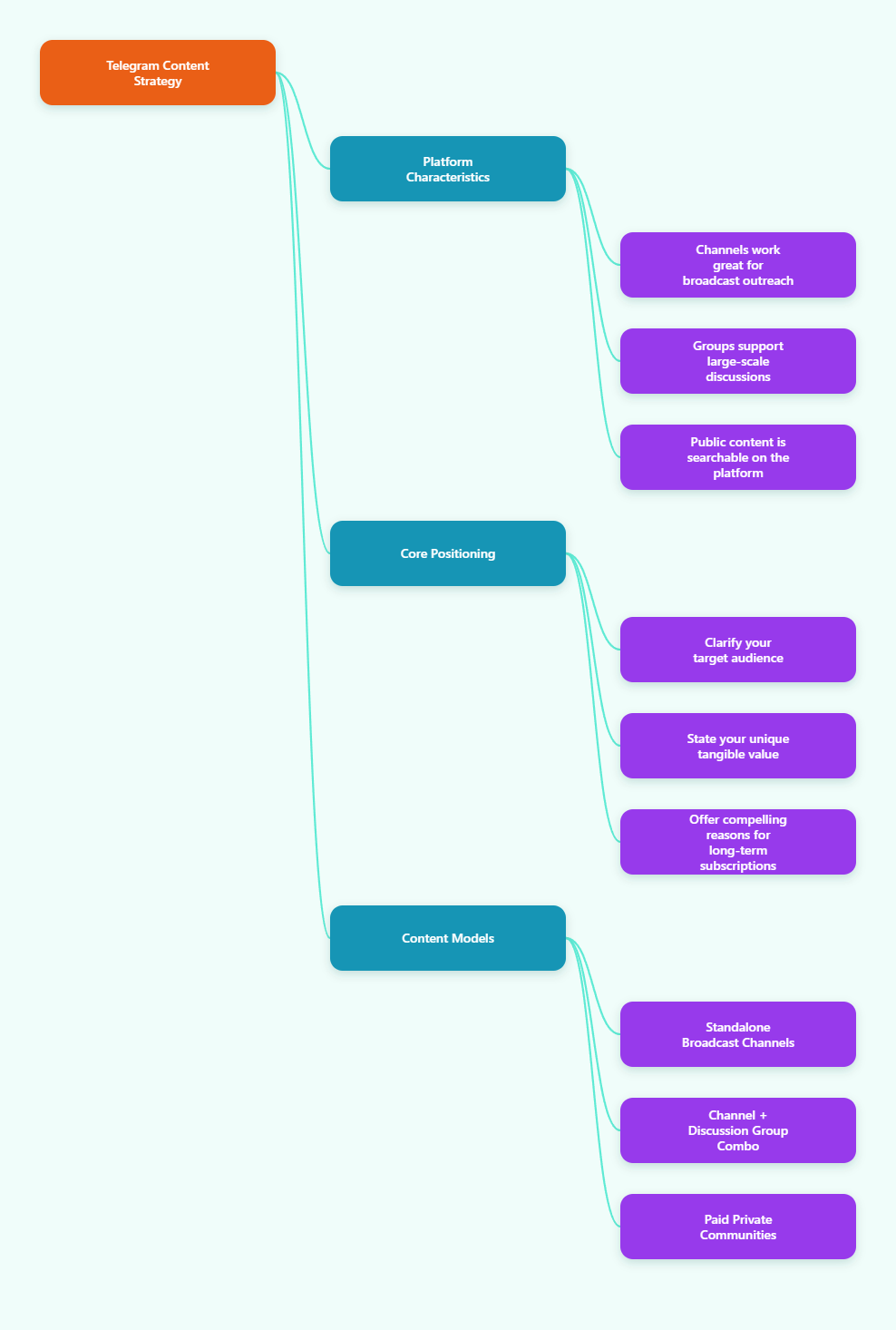
What makes Telegram different from other platforms
A strong Telegram content strategy starts with the structure of the app itself.
- Channels are built for broadcasting. Only admins post, and channels can have an unlimited number of subscribers.
- Groups are built for discussion. Telegram’s FAQ says groups can support up to 200,000 members.
- Public channels can be found through usernames, names, descriptions, public posts, and related discovery features.
- Private channels are usually accessed by invite link and are not broadly searchable.
- Message delivery is direct. Subscribers receive channel posts in their chat list, which makes consistency and relevance more important than chasing volume.
In practice, Telegram rewards clarity more than noise. People join for a reason, and they leave quickly when a channel loses focus.
Start with one clear channel promise
The best Telegram channels are easy to understand in a few seconds. Before planning formats or schedules, define the promise of the channel.
Ask three questions:
- Who is this channel for?
- What specific value will they get?
- Why should they stay subscribed after the first week?
Good answers are narrow. For example:
- Daily AI product news with short explanations for founders
- Crypto research notes for long-term investors
- Local deals and event updates for one city
- Customer support updates and product tips for existing users
Weak answers are broad, such as “tech content” or “business updates.” Telegram works best when people know exactly what will appear in the feed.
Choose the right content model
Not every Telegram channel should use the same publishing style. Your Telegram content strategy should fit your audience’s reason for joining.
1. Broadcast-first channel
Best for news, announcements, analysis, and creator updates.
- Short posts with links, images, and fast takeaways
- Low friction for subscribers
- Works well with Stories, reactions, and scheduled posts
2. Channel plus discussion group
Best when you want feedback, questions, or community conversation.
- Link a discussion group to the channel
- Each channel post can open a comment thread automatically
- Useful for education, product communities, and niche interest groups
This matters because Telegram channel comments are not a standalone switch. They are enabled by linking a discussion group to the channel.
3. Paid or member-only community
Best for premium research, classes, insider updates, or memberships.
- Use a private channel, group, or both
- Set clear publishing expectations
- Use polls and discussion to reduce churn
Telegram also supports creator monetization features such as Star Reactions and Star Subscriptions, introduced in 2024, but those work best after the content model already proves demand.
Build around 3 to 5 repeatable content pillars
Most channels become inconsistent because every post is invented from scratch. A better Telegram content strategy uses repeatable content pillars.
For most channels, three to five pillars are enough.
Example for a software company channel:
- Product updates: releases, fixes, roadmap notes
- How-to content: short tutorials, setup tips, workflows
- Customer proof: use cases, testimonials, case notes
- Interactive posts: polls, Q&A prompts, feedback requests
- Stories: behind-the-scenes updates and quick reminders
Example for a creator channel:
- Daily insight or lesson
- Weekly curated links
- Opinion posts on current trends
- Polls or quizzes
- Member updates and limited offers
These pillars make planning easier and help subscribers recognize the rhythm of the channel.
Use a realistic posting cadence
Telegram does not require constant posting. In fact, too many posts can reduce attention per message.
Recent Telegram publishing guides and analytics-based articles consistently recommend moderation over overload. A common pattern for active channels in 2026 is:
- 1 to 3 posts per day for most public channels
- 5 to 7 posts per week for brands, educators, and creators who want consistency without fatigue
- Higher volume only for true news feeds or time-sensitive alert channels
The exact number depends on the niche, but the principle is stable: subscribers tolerate regular value better than unpredictable bursts.
A practical weekly cadence might look like this:
- Monday: one educational post and one short update
- Tuesday: one case study or example
- Wednesday: one poll or discussion prompt
- Thursday: one curated roundup
- Friday: one opinion post or weekly recap
- Weekend: one lighter post, Story, or reminder
If you currently post rarely, do not jump straight to high frequency. Increase slowly, then watch views, reactions, comments, forwards, and unsubscribes.
Write for Telegram’s reading behavior
People do not read Telegram the same way they read a long blog post. They scan quickly inside a chat list full of other messages.
That means your Telegram content strategy should favor compact structure:
- Lead with the main point in the first line
- Keep paragraphs short
- Use bullets for steps, options, or summaries
- Add one clear call to action, not five
- Make links feel worth tapping by explaining what the user will get
Posts that usually work well on Telegram include:
- Mini explainers with one useful takeaway
- Curated lists of tools, resources, or news
- Checklists and templates
- Opinion posts tied to a current event or update
- Short before-and-after examples
Posts that often underperform include vague motivation, oversized intros, and link dumps with no context.
Use Stories when they fit the job
Channel Stories became available in 2023 through Telegram’s boost system. Premium users can boost channels and supergroups, and levels unlock additional features. Official FAQ and API materials show that higher levels can unlock more Stories per day and additional customization features.
Stories are useful because they sit in a more visible surface than ordinary posts and work well for light, fast content.
Good uses for Stories:
- Reminders about a new post
- Behind-the-scenes clips
- Quick event coverage
- Countdowns and launches
- Casual audience check-ins
Do not move your best channel content into Stories only. Stories disappear, while channel posts remain in history and are easier to revisit, forward, and search around.
A simple rule is to use Stories for immediacy and regular posts for durable value.
Turn one-way broadcasting into light interaction
Telegram channels perform better when subscribers have a low-effort way to respond. You do not need to turn every post into a debate, but some interaction helps you learn what people care about.
Comments
Comments are useful when the topic benefits from clarification or community input.
- Enable them by linking a discussion group
- Use them for product feedback, AMA posts, or educational content
- Moderate actively so the thread stays useful
Reactions
Reactions are lighter than comments and easier to scale.
- Use them on short-form posts, announcements, and opinion posts
- Watch which post types get saved, forwarded, or reacted to repeatedly
Polls and quizzes
Telegram polls are one of the most practical built-in tools on the platform. Telegram has supported polls since 2018 and expanded them with visible votes, multiple answers, and quiz mode.
Polls work well for:
- Audience research
- Topic selection
- Knowledge checks
- Fast engagement during quieter weeks
Useful poll prompts include:
- Which topic do you want next?
- What is your biggest challenge with X?
- Should we publish this as a checklist, video, or thread?
- How often do you want updates on this topic?
One or two strong polls per week is usually enough for most channels.
Design for discovery, not just publishing
A Telegram content strategy is incomplete if it only covers what to post. You also need to think about how new people find the channel.
Telegram discovery is not identical to web search, but public channels can still benefit from good structure.
- Use a clear channel name
- Choose a readable public username if the channel is public
- Write a specific channel description with your main topic
- Use consistent topic language in posts
- Use relevant hashtags carefully, not excessively
Official Telegram materials and recent search guides indicate that public titles, usernames, descriptions, joined channels, recommendations, and public content all affect discoverability in different ways.
Two platform features matter especially in 2026:
- Similar Channels: introduced in late 2023, this helps users find related public channels.
- Hashtag and public post discovery: public posts and hashtags can help users reach content and then tap through to the parent channel.
This means your content should be understandable even when seen out of context as a forwarded post, a public search result, or a hashtag result.
Use native analytics to make decisions
Telegram offers detailed statistics for channels and supergroups, but official API documentation notes that these stats are available to admins only once a channel is large enough. The exact threshold is controlled server-side, not publicly fixed in the documentation.
When statistics are available, use them to answer practical questions:
- Which post formats get the highest views?
- Which topics trigger forwards or comments?
- What days and times produce stronger reach?
- Are Stories helping, or just adding noise?
- Does posting more increase total reach or only reduce per-post attention?
Do not evaluate your Telegram content strategy on subscriber count alone. A smaller channel with strong opens, forwards, and replies can outperform a larger but passive one.
At minimum, track:
- Views per post
- Reaction volume
- Comment volume and quality
- Forwards or shares when visible
- Subscriber growth and drop-off after specific posts
Match content to business and monetization features carefully
Telegram added Business features in 2024, including opening hours, location, quick replies, automated messages, chatbot support, and a custom start page for business accounts. These features are more useful for customer communication than for channel publishing alone, but they can support a broader content system.
For example:
- A channel publishes updates and education
- A business account handles direct questions and quick replies
- A bot manages onboarding, support, or lead capture
For creators and publishers, Telegram also offers monetization tools such as paid support through Stars and subscription-oriented features announced in 2024. Use these only after the free content already proves retention. Monetization does not fix weak content; it amplifies strong positioning.
A practical 30-day Telegram content strategy
If you want a simple implementation plan, start here.
Week 1: Set the foundation
- Define one audience and one clear promise
- Create 3 to 5 content pillars
- Clean up the channel name, username, and description
- Decide whether comments should be enabled through a discussion group
Week 2: Publish consistently
- Post once per day or five times per week
- Test two post formats, such as mini explainers and curated lists
- Add one poll
- Write stronger first lines to improve opens and reading depth
Week 3: Add interaction
- Enable reactions if appropriate
- Use one discussion post that invites real replies
- Try one Story if your channel has access through boosts
- Note which topics earn the strongest response
Week 4: Review and refine
- Compare top-performing and weak-performing posts
- Reduce formats that create noise without engagement
- Keep the best recurring post as a weekly series
- Adjust cadence based on performance, not guesswork
Common mistakes to avoid
- Posting without a format: random updates make it harder for subscribers to build a habit.
- Chasing volume: more posts do not automatically mean more attention.
- Ignoring comments: if you enable discussion, unanswered threads weaken trust.
- Using every feature at once: Stories, polls, comments, and paid tools should support the core message, not distract from it.
- Being too broad: Telegram channels grow faster when the topic is specific and consistent.
Final takeaway
The best Telegram content strategy in 2026 is not the most complicated one. It is the one that fits Telegram’s actual strengths: direct distribution, clear audience intent, lightweight interaction, and repeatable publishing.