
Recurring Telegram discount posts can still work extremely well in 2026, but only if they feel intentional. The problem is not repetition itself. The problem is lazy repetition: the same code, the same copy, the same timing, and the same level of urgency every week.
Telegram now sits on a massive audience base, with more than 1 billion monthly active users and roughly 450-500 million daily active users reported across recent 2025-2026 data. That scale makes the platform attractive for e-commerce teams that want direct reach without fighting a noisy feed algorithm.
In this guide, you will learn how to build a recurring discount system that supports inventory, protects margin, and keeps subscribers engaged. You will also see where automation fits, where it fails, and how to keep Telegram posts useful instead of spammy.
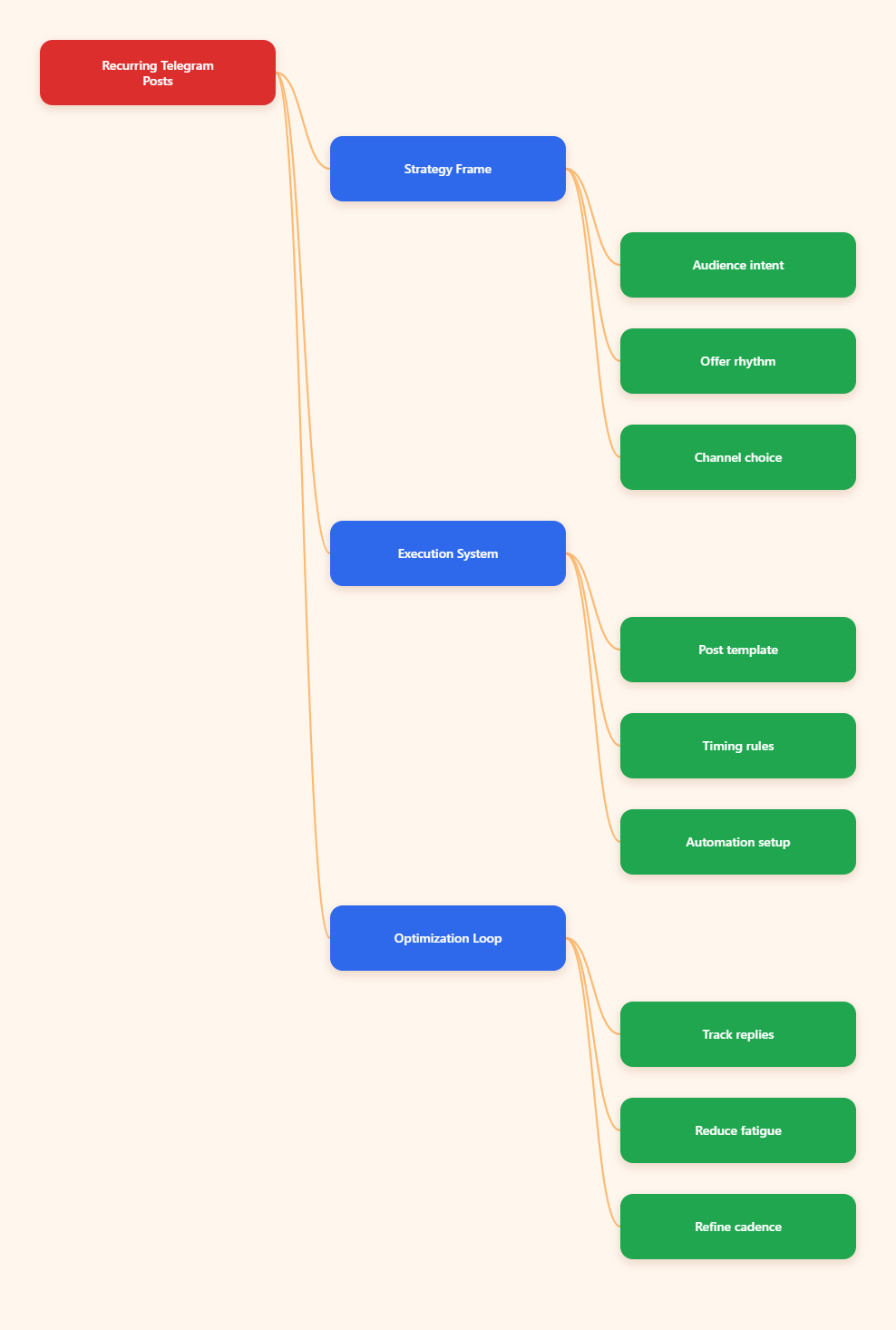
Why recurring Telegram discount posts still matter in 2026
Telegram behaves differently from most social platforms. A channel is closer to a broadcast inbox than a discovery feed. That means your message has a better chance to be seen by the people who already chose to hear from you.
For e-commerce brands, that matters because discounts are not only about lowering prices. They are also about timing. A good offer helps clear stock, move seasonal inventory, re-activate dormant buyers, and create a clean reason to return.
But recurring posts need structure. If your audience can predict that every message is a discount blast, they stop reading for value and start waiting for the next markdown. That is how channels lose trust and full-price demand.
The best recurring Telegram discount posts solve a business problem. They do not just announce a sale. They support a campaign goal: launch, clear, bundle, re-engage, or reward.
What goes wrong when discount posts repeat too often?
The first failure is discount fatigue. When the same offer appears too often, subscribers learn that patience is more profitable than action. That weakens urgency and reduces the perceived value of your products.
The second failure is margin leakage. Many teams see a short-term bump and keep repeating the same pattern, even when the discount is no longer needed. The result is predictable: lower average order value, weaker brand perception, and less room to run real promotions later.
The third failure is poor measurement. If you reuse the same post style, the same code, and the same timing, it becomes hard to tell what actually worked. Was it the discount depth, the creative, the product, or the channel timing?
The fourth failure is audience mismatch. A channel with loyal buyers should not be treated the same way as a price-sensitive clearance audience. The wrong recurring message will attract the wrong subscriber.
| Cadence | Best Use Case | Audience Effect | Main Risk |
|---|---|---|---|
| Weekly | Clearance, seasonal leftovers, fast-moving stock | Creates a predictable buying rhythm | Fatigue if the offer never changes |
| Biweekly | Evergreen promos, bundle tests, creator drops | Leaves room for value posts between offers | Too slow for urgent inventory pressure |
| Monthly | Major sales, VIP events, holiday pushes | Builds stronger anticipation and scarcity | Missed sales windows if stock moves quickly |
How to structure e-commerce recurring Telegram discount posts
A healthy Telegram channel usually works better with a mix of content, not only discounts. A practical content balance is useful posts, proof posts, and direct offers. Many operators use a 70/20/10 style split, where most posts teach, inform, or help, while a smaller share sells.
That approach is especially useful in e-commerce because people do not join a channel only to buy immediately. They also want product context, delivery updates, early access, restock alerts, and social proof before they act.
To keep recurring discount posts effective, build each one around the same basic structure:
- A short hook that explains why the offer matters now.
- The exact product, bundle, or category involved.
- The reason the deal exists, such as clearance or launch support.
- A deadline, stock note, or access window.
- A clean call to action with one link.
This structure keeps the post readable and prevents the channel from sounding like a coupon dump.
Use channels for broadcast, groups for feedback
If your goal is reach, Telegram channels are the stronger fit. They are designed for one-to-many delivery. That makes them better for discount announcements, product drops, and scheduled promotions.
If your goal is conversation, Telegram groups are better. Groups work when you need product questions, community proof, onboarding, or customer support. For many e-commerce teams, the strongest setup is a channel for offers and a group for discussion.
That separation keeps promotional posts clean while still giving buyers a place to ask questions. It also makes performance easier to read, because campaign posts are not buried under chat noise.
Write recurring offers as campaigns, not coupons
The easiest way to avoid spam is to stop thinking in codes and start thinking in campaigns. A campaign has a purpose, a time window, and a measurable outcome.
For example, a skincare brand might run a biweekly bundle offer for slow-moving hero items. A fashion store might run a monthly size-clearance post. A gadget seller might use short, planned drops around restocks and accessory bundles.
That campaign logic makes each recurring post easier to explain. It also gives subscribers a reason to keep reading, because every offer feels tied to a real business event.
Set guardrails before you schedule anything
Recurrence needs rules. Without them, you end up discounting whenever sales dip. That is not strategy. That is reaction.
Set a minimum time gap between major promotions. Decide which products are excluded. Define a margin floor. Choose whether the discount will be percent-based, fixed-value, free shipping, or bundle-based. Then keep those rules visible to the team.
One of the easiest ways to preserve trust is to vary the mechanism. A 15% code, a free-shipping threshold, and a bundle bonus are not the same message. They may all drive sales, but they do not condition the audience in the same way.
How to automate recurring Telegram discount posts without sounding robotic
Automation is useful when it helps you stay consistent. It is dangerous when it removes judgment. The right workflow should reduce manual posting without removing human review.
Telegram already supports business-friendly features such as automated messages, quick replies, custom start pages, and chatbot integration through Telegram Business. That means teams can build cleaner workflows around offers, support, and follow-up.
If you need a lightweight bot-based workflow for repeating discount content, OnlyTG Echo@EchoOnBot can fit into that process. Use it when you want to prepare a post once, keep the wording under control, and reuse the same structure on a defined schedule.
A simple setup usually looks like this:
- Open the bot and start the setup flow.
- Connect the Telegram channel that will publish the offers.
- Prepare a reusable discount template with the product, deadline, and link.
- Choose the posting time and the recurrence pattern.
- Test one draft before activating the full sequence.
That workflow solves a common pain point: teams often know what to post, but they fail to post it on time. A controlled automation layer helps keep the schedule steady without turning the channel into a copy-paste machine.
Real-world use case 1: seasonal clearance
A home goods seller has 200 units left after a seasonal collection closes. The team schedules a short series of discount posts over two weeks. The first post frames the clearance as final stock. The second highlights the best-selling items left. The third adds a deadline and a reminder that sizes and colors are limited.
This kind of sequence works because each message serves a different job. It does not repeat the same line three times. It builds urgency in stages.
Real-world use case 2: bundle support for a launch
A DTC brand launches a new product but wants to protect the main item’s price. Instead of cutting the hero product, the channel posts a recurring bundle incentive on accessories. That keeps the launch premium while still creating a reason to buy now.
In this case, recurring posts are not about discounting everything. They are about steering demand into a more profitable bundle structure.
Real-world use case 3: VIP subscriber reward
A private Telegram channel for a fashion retailer uses monthly reward posts for repeat buyers. The offer is not public. It is framed as early access or a subscriber-only perk, which gives the channel a stronger sense of exclusivity.
That is important because audiences often respond better to access than to raw price cuts. If the deal feels reserved for insiders, the channel keeps its premium tone while still creating action.
Other useful features to keep in mind
Beyond recurring posting, automation workflows often help with repeated reminders, quick-response handling, and scheduled announcements. Those small efficiencies matter when a channel is active across multiple time zones or tied to fast-changing stock levels.
OnlyTG Echo@EchoOnBot is most useful when you want repeatable execution without rebuilding the same post flow every week. If your campaign calendar changes often, that kind of repeatable structure can save time and reduce posting mistakes.
Practical rules for better recurring Telegram discount posts
- Keep most posts useful, not promotional.
- Rotate the offer type so the audience does not get trained to wait.
- Use one main action per post.
- Match cadence to inventory pressure, not habit.
- Separate broadcast content from discussion.
- Review views, replies, clicks, and actual orders after each run.
- Archive weak templates and keep the ones that convert cleanly.
These rules sound simple, but they are where most Telegram programs improve. The difference between a channel that converts and a channel that gets muted is usually discipline, not creativity.
FAQ: e-commerce recurring Telegram discount posts in 2026
How often should I post discounts on Telegram?
There is no universal number. Weekly can work for clearance. Biweekly is safer for evergreen promotions. Monthly is better for larger events. Choose the cadence that matches stock movement and buyer expectations.
Should I use the same discount code every time?
Usually no. Reusing the same code too often makes the offer feel permanent. It is often better to rotate the message, the mechanic, or the product focus so the channel does not feel repetitive.
Is a Telegram channel better than a group for sales?
For direct promotions, yes. Channels are better for broadcast and control. Groups are better for replies, trust, and support. Many brands use both, but they should not serve the same job.
What metrics matter most?
Start with views, link clicks, and actual orders. Then look at reply quality, forward behavior, and repeat purchase patterns. A post with high views but weak sales may be attracting the wrong audience.
How do I avoid discount fatigue?
Use a content mix, not just sales posts. Rotate the offer type. Leave enough time between major promotions. And make sure every discount solves a real business problem, such as clearance or launch support.
Can automation hurt Telegram performance?
Yes, if it removes judgment. Automation should handle timing and repetition, not strategy. Always review the post, the offer, and the cadence before you publish.
Where does OnlyTG Echo@EchoOnBot fit best?
It fits best when you want a repeatable discount workflow with less manual posting. It is especially useful for scheduled campaigns, recurring announcements, and channel operations that need consistency.
Final thoughts
Recurring Telegram discount posts can absolutely support e-commerce growth in 2026, but only when they are built like a system. Keep the channel useful, tie each offer to a clear business reason, and avoid turning repetition into noise.
If your calendar is getting harder to manage, a simple automation layer can help. Used carefully, OnlyTG Echo@EchoOnBot can support the posting rhythm without forcing you to rebuild the same campaign every week.