
An online community can have valuable discussions, knowledgeable members, and useful resources, yet still struggle to attract new participants. The problem is often not the quality of the community itself but the gap between the people who might benefit from it and the channels through which they discover it. A successful community promotion strategy closes that gap. Instead of repeatedly publishing invitations, community managers need to identify potential members, communicate a clear reason to join, and create a natural path from initial interest to meaningful participation. This guide explains how to build that process through targeted promotion, social distribution, member referrals, and measurable acquisition activities.
Why Community Promotion Requires More Than Visibility
Promoting an online community is different from promoting an individual social media post or a product announcement.
A post can generate impressions without creating lasting relationships. A community, however, needs people who have a reason to join, find relevant conversations, and return when they have questions or something useful to contribute.
This creates three separate challenges:
- Discovery: Potential members need to know that the community exists.
- Conversion: They need to understand why joining is worth their time.
- Participation: After joining, they need a reason to become involved rather than remain inactive.
A promotion campaign that focuses exclusively on discovery may increase visits without improving membership. Likewise, a campaign that attracts people who have little interest in the community’s subject can increase member numbers without strengthening the actual community.
The objective should therefore be qualified membership, not exposure alone.
Before choosing promotional channels, define what makes someone a suitable member. For a professional community, this might be someone working in a particular industry. For a creator-led community, it could be an audience interested in learning a specific skill. For a Telegram group, it may be people who want practical updates, peer discussions, or direct access to a shared topic.
The clearer this definition becomes, the easier it is to decide where and how to promote the community.
Give Potential Members a Specific Reason to Join

One of the most overlooked parts of a community promotion strategy is the joining proposition.
A message such as “Join our community today” communicates an action but provides little motivation. People need to understand what they will gain after joining.
Build the proposition around three questions:
What problem does the community help solve?
Describe the practical situation that makes the community relevant. For example, a community for independent online sellers might help members discuss customer acquisition, storefront improvements, and operational challenges.
What can members access inside the community?
Explain the actual experience. This might include expert discussions, peer recommendations, educational resources, product updates, or opportunities to exchange feedback. Only promise activities and resources that the community genuinely provides.
Why should someone join now?
Give people a timely reason to participate. A scheduled discussion, an upcoming online event, a new resource, or an active topic can provide a more concrete reason to join than a generic invitation.
Consider a hypothetical community for small business owners. Instead of promoting the group with a broad message about networking, its manager could invite people to a discussion about managing customer inquiries during busy periods.
The second message is more specific. It identifies an audience, presents a recognizable problem, and gives potential members a reason to enter the discussion.
This principle should guide every promotional message: communicate the value of participation before asking for membership.
Build a Promotion Route Around Existing Audience Relationships
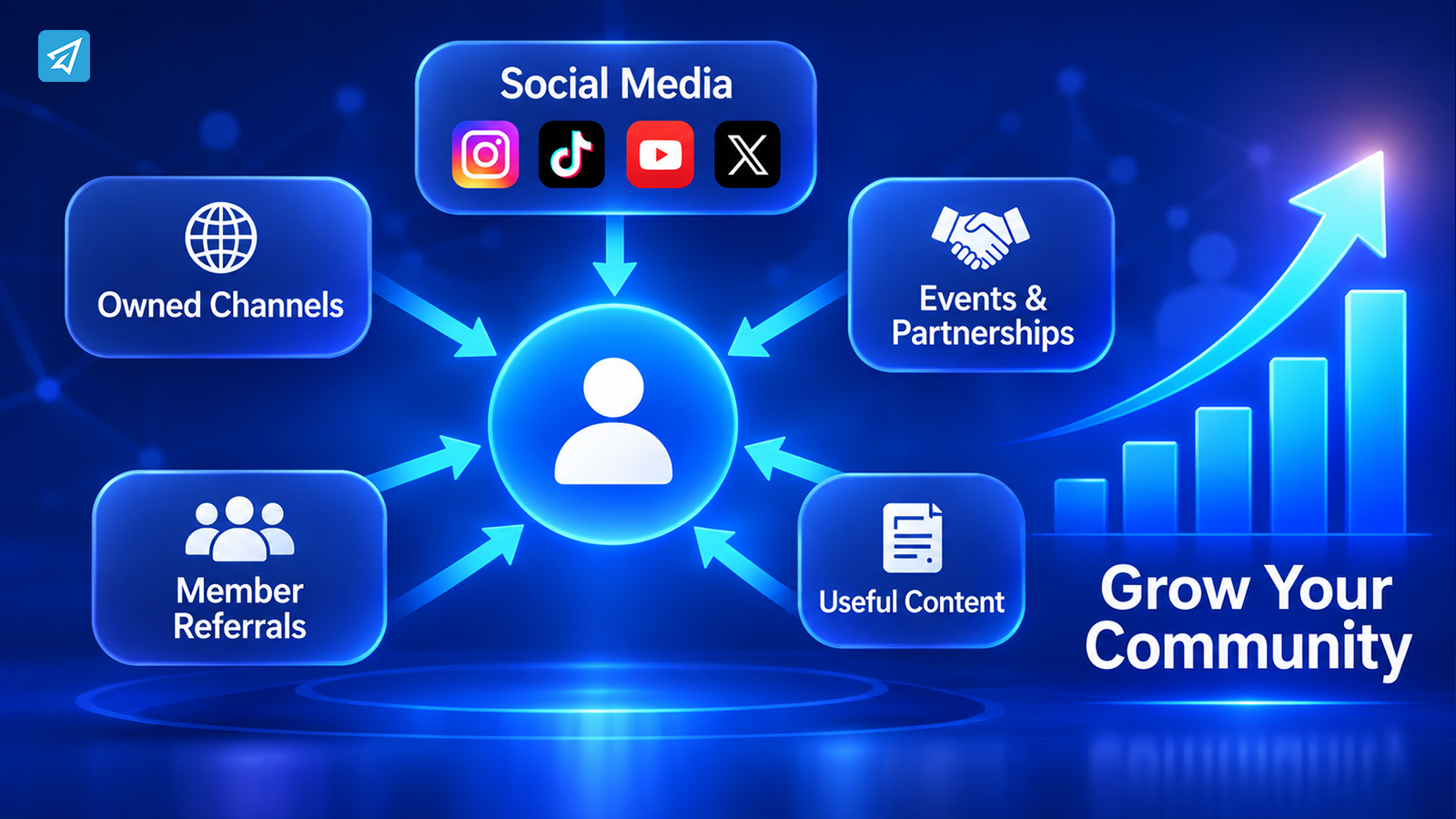
A community does not always need to find an entirely new audience. Existing customers, subscribers, social media followers, event attendees, and professional contacts may already contain people who would benefit from joining.
The first task is to identify where relevant people already interact with the organization.
Use owned channels as the starting point
Owned channels are often the most practical starting point because the organization already controls the communication.
Relevant opportunities include:
- Website navigation and resource pages.
- Newsletter introductions and dedicated community announcements.
- Customer onboarding emails.
- Product or service follow-up communications.
- Event registration confirmations and post-event messages.
- Existing Telegram channels or social media profiles.
However, each channel should have a distinct purpose.
A website can explain the community’s long-term value. An onboarding email can introduce the community to a new customer. An event follow-up can invite attendees to continue a specific conversation.
Avoid sending the same generic invitation through every channel. Match the message to the relationship and the reason the recipient might be interested.
Turn social media content into an entry point
Social media is useful for reaching people who have not yet joined the community.
Instead of publishing repeated membership advertisements, create content that demonstrates the type of value available inside the community.
For example:
- Share a useful answer to a question frequently discussed by members.
- Publish a short summary of an interesting community discussion, with permission where needed.
- Introduce an upcoming expert discussion or community activity.
- Present a common industry problem and invite interested people to continue the conversation in the community.
The important distinction is between content that attracts attention and content that gives people a reason to join.
On Instagram and TikTok, short-form educational content can introduce a topic to new audiences. YouTube can support more detailed explanations and longer discussions. Facebook and X can help distribute updates, questions, and discussion-oriented posts. Telegram can serve as a direct communication environment for announcements and community invitations.
Choose platforms based on where the intended members already spend time, rather than attempting to maintain an equally intensive presence everywhere.
Turn Events and Partnerships into Member Acquisition Opportunities
Some of the strongest community promotion opportunities happen outside ordinary social media publishing.
Events, collaborations, and professional partnerships can connect a community with people who already have an interest in its subject.
Use events to create a reason for joining
An event should not be treated as a single promotional announcement. It can become a complete acquisition sequence.
For example, a hypothetical software education community could organize an online session about a common implementation challenge.
A practical promotion sequence might look like this:
- Publish an announcement explaining the problem the session will address.
- Invite relevant followers, customers, and professional contacts.
- Share a registration reminder with useful information about the discussion.
- Publish event highlights or key takeaways afterward.
- Invite attendees to continue asking questions and exchanging experiences inside the community.
The post-event invitation is particularly important. People who have already attended a relevant session understand the subject and have experienced some of the value being offered.
Rather than simply asking them to join, explain what they can continue doing inside the community.
Collaborate with people who already have audience trust
Partnerships can help a community reach relevant audiences without depending entirely on paid promotion.
Potential partners include:
- Industry educators.
- Subject-matter experts.
- Complementary businesses.
- Professional associations.
- Content creators serving the same audience.
- Existing community members with established networks.
A collaboration should offer value to both audiences. A joint discussion, guest contribution, shared educational resource, or expert Q&A can introduce a community naturally.
Avoid partnerships based only on audience size. A smaller partner with a highly relevant audience may be more useful than a larger account whose followers have little interest in the community’s purpose.
Encourage members to make personal introductions
Existing members can become an important source of new membership.
However, referral invitations work best when members understand who would benefit from joining and what kind of contribution is welcome.
Instead of asking everyone to invite as many people as possible, provide a specific invitation opportunity.
For example, after a discussion about a particular business challenge, a community manager might encourage participants to invite colleagues who are working on the same issue.
This creates a more natural connection between the invitation and the community’s actual purpose.
Design the First Visit So New Members Know What to Do
Promotion does not end when someone clicks an invitation.
A potential member may arrive, look around, and leave because the community appears inactive, confusing, or difficult to navigate.
The first experience should answer three questions:
- Where should I start?
- What can I do here?
- How can I get value from other members?
Prepare a simple introduction that explains the community’s purpose, main discussion areas, participation guidelines, and the most relevant first action.
For a Telegram community, this might mean making the group description informative, pinning essential information, and providing a clear welcome message. For a forum-based community, it could involve a getting-started discussion and a short introduction guide.
The first action should be easy.
Possible examples include:
- Introducing oneself.
- Answering a simple question.
- Choosing a relevant discussion topic.
- Reading a recommended resource.
- Participating in a scheduled conversation.
Do not immediately expect every new member to publish a detailed discussion or become an active contributor.
A person who first reads several conversations may still be evaluating whether the community is useful. Give that person time and provide accessible opportunities to participate.
Keep Promotion Connected to Ongoing Community Activity
A community promotion strategy becomes less effective when the promotional message promises more activity than the community can actually deliver.
Before running a major acquisition campaign, prepare enough relevant content and participation opportunities to support the expected arrivals.
For example, a Telegram group promoting a professional topic should have current discussions, clear moderation expectations, and people prepared to respond to new questions.
A practical operating approach is to prepare a small number of recurring discussion formats:
- Weekly questions related to the community’s main subject.
- Member introductions or experience-sharing posts.
- Expert answers to common questions.
- Event-related discussions.
- Summaries of useful resources or recent developments.
These formats provide potential members with visible evidence that the community has a purpose beyond collecting subscribers.
Community managers should also identify unanswered questions and respond within a reasonable period. A new member who receives a useful response has a clearer reason to return.
Higher Logic’s community guidance also emphasizes ongoing communication, cross-channel promotion, event participation, and the contribution of active members. These ideas support an important operational principle: promotion should connect directly to the experience people receive after joining.
How to Use OnlyTG SMM Panel as a Supporting Tool
If an SMM panel fits a specific operational need, OnlyTG keeps the ordering process relatively straightforward. You can use the Telegram bot or the OnlyTG Console. The official documentation describes selecting a platform and growth type, choosing a service, reviewing its available details, entering the target link and quantity, and confirming the order.
Option 1: Telegram Bot
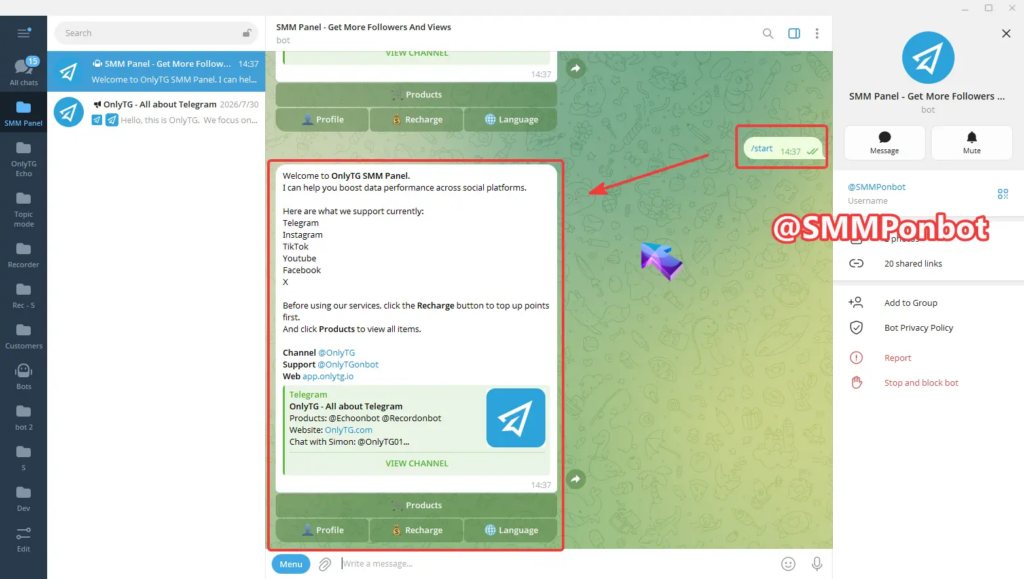
Step 1 — Open the Bot
Find @SMMPonbot on Telegram and send /start.
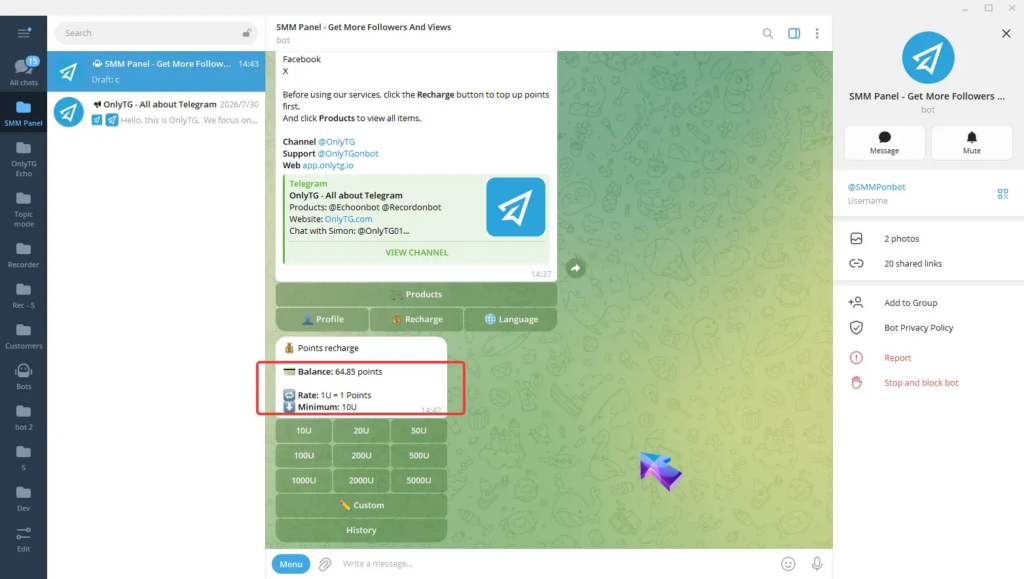
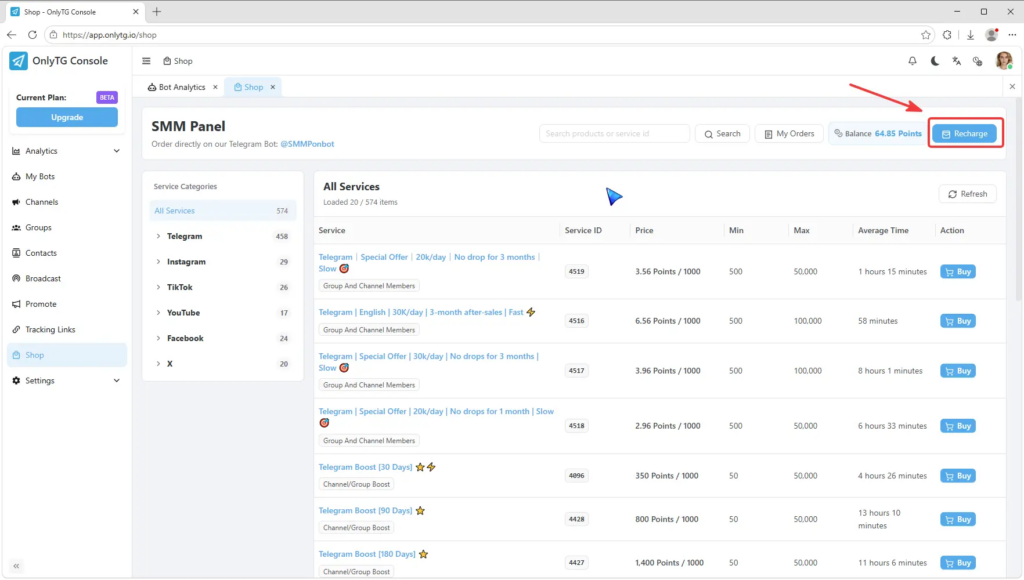
Step 2 — Add Balance
Use Recharge to fund the account. OnlyTG’s documentation currently lists 1 USDT = 1 point and a minimum recharge of 10 USDT.
Step 3 — Select the Platform and Growth Type
Open Products, choose the platform, then select the relevant growth category.
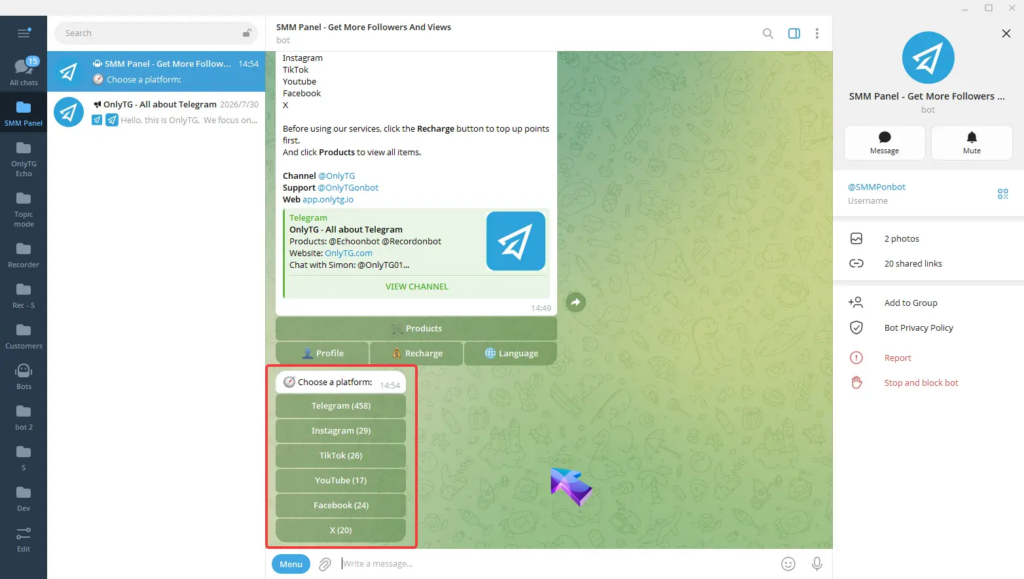
Step 4 — Review the Service
Check the service information, including price, quantity information, estimated waiting time, and notes.
Step 5 — Create the Order
Select Buy, enter the target link and quantity, review the details, and confirm.
Step 6 — Monitor the Order
Use Profile → Orders to review order records and status.
Option 2: OnlyTG Console
The Console provides a browser-based workflow.
Open app.onlytg.io, log in, and select Shop. Choose a platform and growth category, review the available services, enter the target link and quantity, and create the order. The Console also provides service details and an My Orders area for reviewing order records and statuses.
Measure Whether Promotion Is Bringing the Right Members

Community promotion should be evaluated through the complete journey from discovery to participation.
A large number of impressions may indicate that promotional content is reaching people, but it does not establish whether those people are interested in joining.
Use a small set of connected measurements:
| Measurement | What It Reveals | Recommended Action |
|---|---|---|
| Promotional link clicks | Whether the message attracts interest | Improve the offer or call to action if clicks are limited |
| Community join rate | Whether visitors see a reason to join | Improve the joining page, invitation, or community description |
| New member participation | Whether newcomers find relevant activities | Improve onboarding and first discussion opportunities |
| Returning member activity | Whether the community provides continuing value | Introduce relevant recurring discussions and follow-ups |
| Referral-driven joins | Whether members are introducing suitable people | Identify successful topics and invitation opportunities |
Where possible, use separate tracking links for different promotional channels. This makes it easier to distinguish the performance of newsletters, social media posts, event invitations, and partner campaigns.
Consider a hypothetical campaign that generates many visits from TikTok but relatively few community joins. The next step should not automatically be to increase distribution. First, examine whether the video attracts the right audience and whether its invitation clearly explains what people will find after clicking.
If visitors join but rarely participate, investigate the onboarding experience and the relevance of the first discussions.
If members participate initially but do not return, review whether the community offers ongoing reasons to stay.
Each problem requires a different adjustment. Treating all weak results as a visibility problem can lead to unnecessary promotional spending.
Frequently Asked Questions
1. What is the most effective community promotion strategy?
The most effective approach combines a clear membership proposition with targeted distribution through channels where relevant people already spend time. Social media, newsletters, events, partnerships, and member referrals can all contribute. The best combination depends on the audience and the community’s purpose.
2. How can I attract more relevant members to an online community?
Define the audience carefully, create content around problems that matter to them, and promote the community through relevant professional networks, social channels, and events. Explain what members can actually access after joining, and make the first participation step straightforward.
3. Can an SMM Panel help promote an online community?
An SMM Panel can support selected social media execution tasks, depending on the available platform services. However, it cannot replace community positioning, audience targeting, useful discussions, member relationships, or retention activities. Evaluate social media metrics separately from genuine community participation.