
A small skincare business wants to introduce a new product line. Its marketing team has prepared promotional images, short videos, and product announcements, but publishing them across Instagram, TikTok, and Facebook does not automatically create a recognizable campaign. Audiences may see individual posts without understanding the larger brand message or having a reason to participate. Effective social media brand campaigns solve this problem by connecting individual pieces of content through one recognizable idea. The goal is not simply to publish more promotional material, but to give people a consistent reason to notice, remember, and engage with a brand.
Why Some Brand Campaigns Get Attention but Fail to Build Recognition
A social media campaign can generate views, likes, and comments without leaving a lasting impression. This often happens when individual posts attract attention but do not reinforce a shared brand identity.
Consider the difference between two approaches.
The first business publishes several unrelated promotional posts. One introduces a product, another announces a discount, and a third shares a generic motivational message. Each post may have some value, but audiences have little reason to connect them.
The second business builds its content around one recognizable campaign concept. Every post communicates a different aspect of the same idea, uses consistent messaging, and encourages audiences to take part in a related activity.
The second approach gives people a clearer connection between the content and the brand.
For businesses planning social media brand campaigns, this distinction matters because campaign performance should be evaluated beyond individual post engagement.
Three questions help identify whether a campaign is building recognition:
- Recognition: Can people identify the brand or campaign when they encounter its content?
- Association: Do audiences understand what the brand represents or what problem its campaign addresses?
- Participation: Are people responding, sharing, discussing, or creating content connected to the campaign?
A campaign that generates attention without establishing these connections may create temporary exposure rather than lasting brand interest.
Start with One Brand Idea, Not a Collection of Promotional Posts
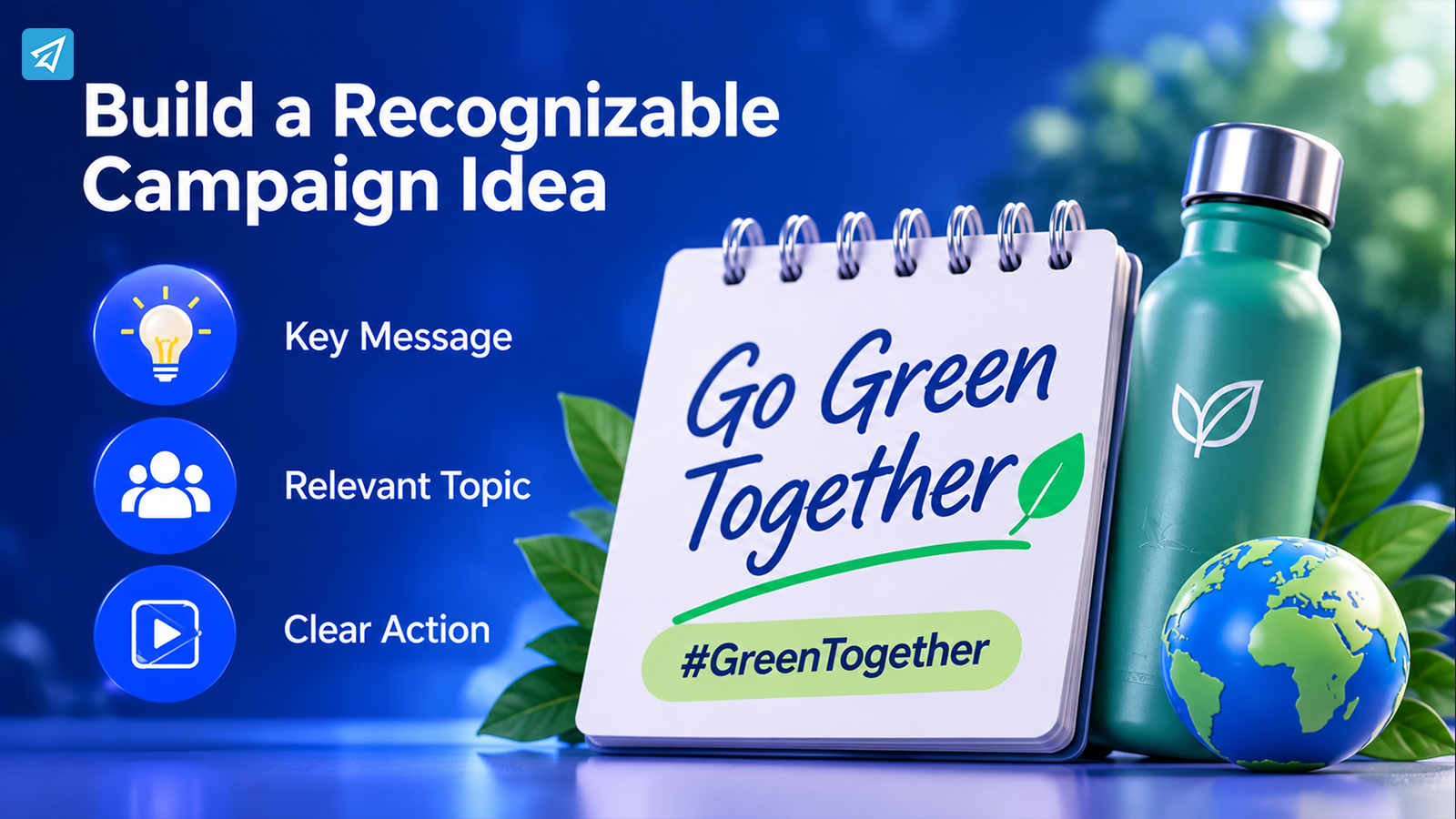
Before selecting platforms or preparing creative assets, define the central idea that audiences should remember.
A useful campaign concept usually connects three elements:
- A recognizable brand message.
- A subject that matters to the intended audience.
- An action that audiences can understand and participate in.
For example, imagine a hypothetical reusable-water-bottle company that wants to promote environmentally conscious daily habits.
Instead of repeatedly publishing product advertisements, the company could develop a campaign around replacing one disposable bottle each day with a reusable alternative.
The product remains part of the message, but the campaign gives people a broader reason to participate. Customers can share their routines, demonstrate how they use the bottle, or discuss small changes they have made.
This approach creates several content opportunities without requiring the brand to invent an entirely new promotional message for every post.
Make the campaign recognizable without making every post identical
Consistency does not mean publishing the same creative asset repeatedly.
A campaign can maintain recognizable elements while changing the format and information presented.
Useful elements include:
- A short campaign name or central message.
- Consistent visual elements, such as colors or recurring design details.
- A recognizable hashtag when it genuinely helps organize participation.
- A clear relationship between each post and the overall campaign.
- A consistent tone that reflects the brand’s positioning.
The objective is to make separate pieces of content feel connected without making the campaign repetitive.
A simple test is to remove the logo from a selection of campaign posts. If the remaining content has no recognizable connection, the campaign may need a stronger visual or messaging identity.
Choose a Campaign Mechanic That Gives People a Reason to Participate
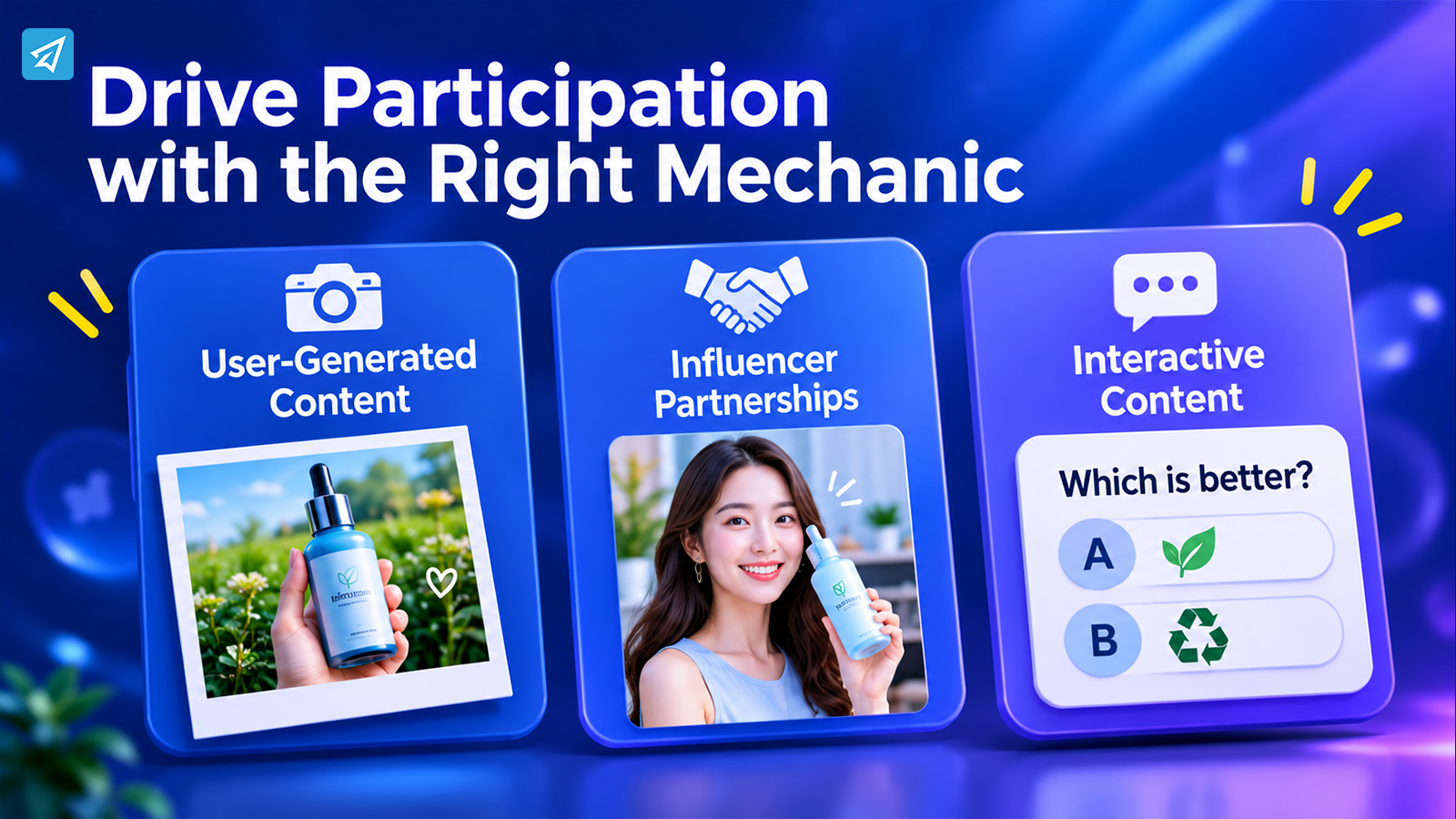
A brand idea explains what the campaign is about. A campaign mechanic explains what people can actually do.
This is where many social media brand campaigns become difficult to execute. Businesses develop attractive creative concepts but leave audiences with no clear next step.
The participation method should match the campaign objective and the behavior of its intended audience.
User-generated content for customer involvement
User-generated content (UGC) works when customers have something meaningful or interesting to contribute.
A food brand, for example, could invite customers to share their own ways of preparing a particular product. A fitness brand might encourage participants to document a personal routine or milestone.
The brand can then highlight suitable submissions, respond to participants, or incorporate customer perspectives into future campaign content, with appropriate permission.
The important part is that participation should feel natural. Asking people to publish promotional material without giving them an interesting reason to do so is unlikely to create meaningful involvement.
Influencer partnerships for audience relevance
Influencers and creators can introduce a campaign to communities that already have an interest in its subject.
However, follower count alone is not a sufficient selection criterion.
Before choosing a partner, examine:
- Whether their audience overlaps with the intended customer group.
- Whether their normal content fits the campaign topic.
- Whether their communication style suits the brand.
- Whether they can present the campaign naturally rather than simply repeat an advertising message.
A smaller creator with a relevant community may provide a better contextual introduction than a much larger account with an unrelated audience.
Interactive content for direct engagement
Polls, questions, challenges, and discussion prompts can give audiences a simple way to respond.
For example, a home-decoration brand could ask followers to choose between two room-design concepts and then publish a follow-up showing how the selected idea could be applied.
This creates a connected sequence: the audience contributes an opinion, the brand responds, and the next piece of content acknowledges that participation.
For a campaign to remain recognizable, these activities should connect to the same central message rather than becoming unrelated engagement exercises.
Adapt One Campaign Concept to Different Social Media Platforms
A multi-platform campaign should have a consistent identity, but its content should not be copied identically everywhere.
Each platform provides a different environment for discovering and interacting with brand content.
| Platform | Suitable campaign role | Practical execution |
|---|---|---|
| Visual brand identity and customer participation | Use Reels, Stories, visual posts, and relevant audience contributions | |
| TikTok | Creative discovery and participatory video content | Develop short, native-feeling videos, demonstrations, and campaign challenges |
| YouTube | Deeper explanations and longer-lasting content discovery | Publish product stories, demonstrations, interviews, and supporting videos |
| Community discussion and information distribution | Share campaign updates, discussion-oriented posts, and relevant community content | |
| X | Timely conversations and brand communication | Use concise updates, relevant discussions, and responses to audience conversations |
| Telegram | Direct communication and community participation | Share campaign announcements, updates, and ongoing channel or group discussions |
These platforms are supported by OnlyTG SMM Panel, but their inclusion in a campaign should depend on audience behavior rather than service availability.
Build a connected content sequence
Instead of releasing unrelated content simultaneously, organize campaign materials around the audience’s journey.
A practical sequence could include:
1. Introduce the campaign idea.
Publish a clear announcement explaining the campaign theme and why it matters. Keep the central message easy to understand.
2. Demonstrate the idea.
Use short videos, images, tutorials, or product demonstrations to show how the campaign concept applies in real situations.
3. Invite participation.
Introduce a question, challenge, customer contribution opportunity, or creator collaboration. Explain exactly what participants should do.
4. Highlight the conversation.
Respond to relevant comments, share appropriate audience contributions, and publish follow-up content that reflects what people are discussing.
5. Reinforce the brand message.
Close the main campaign sequence with a summary, product connection, or next step that helps audiences associate the experience with the brand.
This sequence gives campaign content a purpose beyond filling a publishing calendar.
Give the Campaign a Clear Distribution Plan
Even a well-designed campaign needs a practical distribution approach. Publishing the same post repeatedly is not a substitute for helping relevant audiences discover the campaign.
Start by identifying where potential participants already spend time.
For a consumer product, relevant discovery opportunities may include creator collaborations, customer communities, complementary brands, existing email subscribers, and the company’s established social accounts.
The distribution plan should answer three questions:
- Where is the intended audience most likely to encounter the campaign?
- Which partners or existing channels can introduce the campaign to that audience?
- What content will make people interested enough to explore the brand further?
A small business does not necessarily need to launch on six platforms at once. Starting with one or two relevant platforms can make it easier to maintain consistent messaging and respond to audience feedback.
Cross-platform promotion should also provide a reason to visit another channel. For example, an Instagram post might introduce a product concept, while a longer YouTube video provides a detailed demonstration. Simply duplicating the same content everywhere creates little additional value.
Measure Whether the Campaign Is Building Brand Interest

Campaign metrics should be connected to the outcome the business actually wants.
High engagement on one post does not automatically indicate that the overall campaign is strengthening brand recognition.
Separate measurement into three practical areas.
Exposure: Are the right people discovering the campaign?
Review relevant reach, impressions, video views, and content distribution performance.
If exposure remains limited, examine the distribution sources, publishing format, topic relevance, and collaboration opportunities.
If exposure increases but audiences show little interest in subsequent content, the campaign may be attracting attention without communicating a compelling brand message.
Participation: Are people doing something with the campaign?
Look at meaningful comments, shares, relevant mentions, responses, hashtag participation, and customer-created content where applicable.
A large number of superficial interactions may not indicate genuine interest.
For example, if a campaign receives likes but almost no discussion or audience contributions, consider whether the participation request is clear and worthwhile.
Brand interest: Are people exploring the business?
Depending on the platform and available analytics, examine profile visits, follower changes, channel subscriptions, website visits, and other relevant actions.
Interpret these indicators together rather than treating one number as proof of campaign success.
| Campaign observation | Possible interpretation | Recommended action |
|---|---|---|
| High views but few profile visits | Content attracts attention but offers a weak reason to explore the brand | Strengthen brand identification and the next-step message |
| Many likes but little participation | The content is easy to consume but does not invite meaningful involvement | Introduce a relevant question or simple participation mechanic |
| Strong creator exposure but weak audience relevance | The partnership reaches people who may not fit the target audience | Reassess creator-audience alignment |
| Growing interest but inconsistent engagement | New visitors may not find a consistent campaign experience | Align profile content and follow-up posts with the campaign idea |
Set a measurement period before launching. Compare campaign performance with the account’s own previous activity and evaluate changes in context. Avoid inventing universal engagement benchmarks or assuming that every campaign should produce the same type of outcome.
How to Use OnlyTG SMM Panel as a Supporting Tool
If an SMM panel fits a specific operational need, OnlyTG keeps the ordering process relatively straightforward. You can use the Telegram bot or the OnlyTG Console. The official documentation describes selecting a platform and growth type, choosing a service, reviewing its available details, entering the target link and quantity, and confirming the order.
Option 1: Telegram Bot
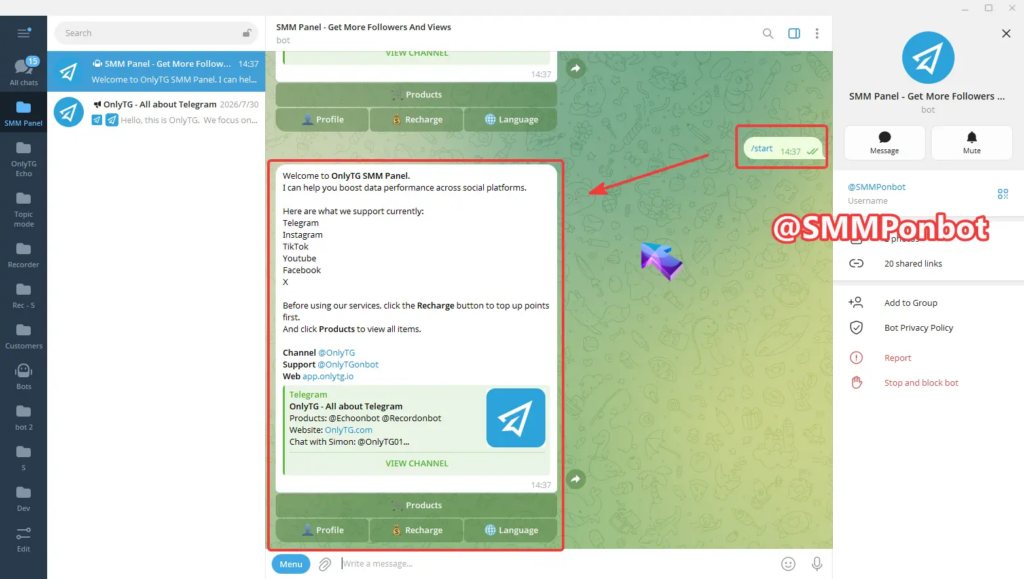
Step 1 — Open the Bot
Find @SMMPonbot on Telegram and send /start.
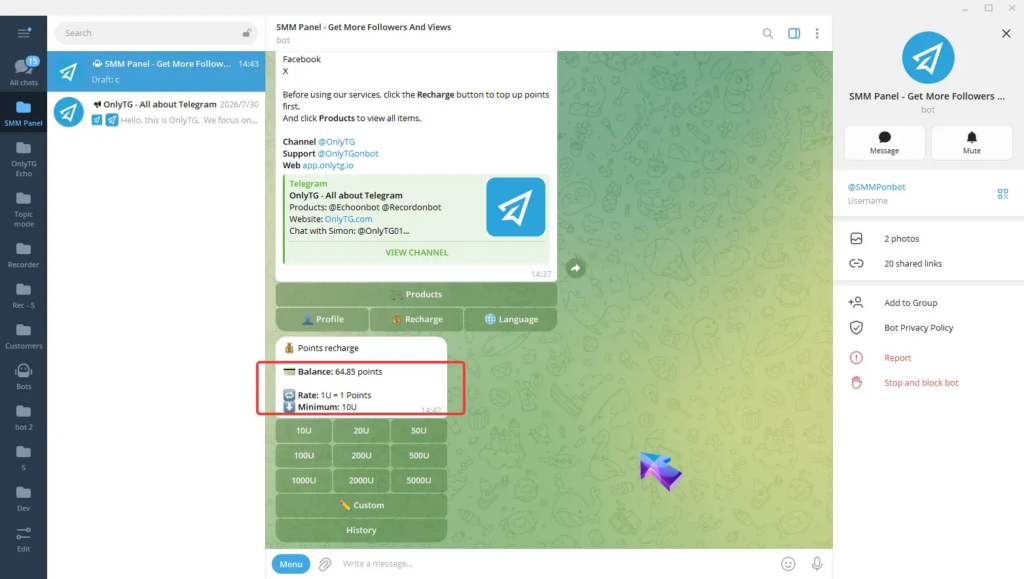
Step 2 — Add Balance
Use Recharge to fund the account. OnlyTG’s documentation currently lists 1 USDT = 1 point and a minimum recharge of 10 USDT.
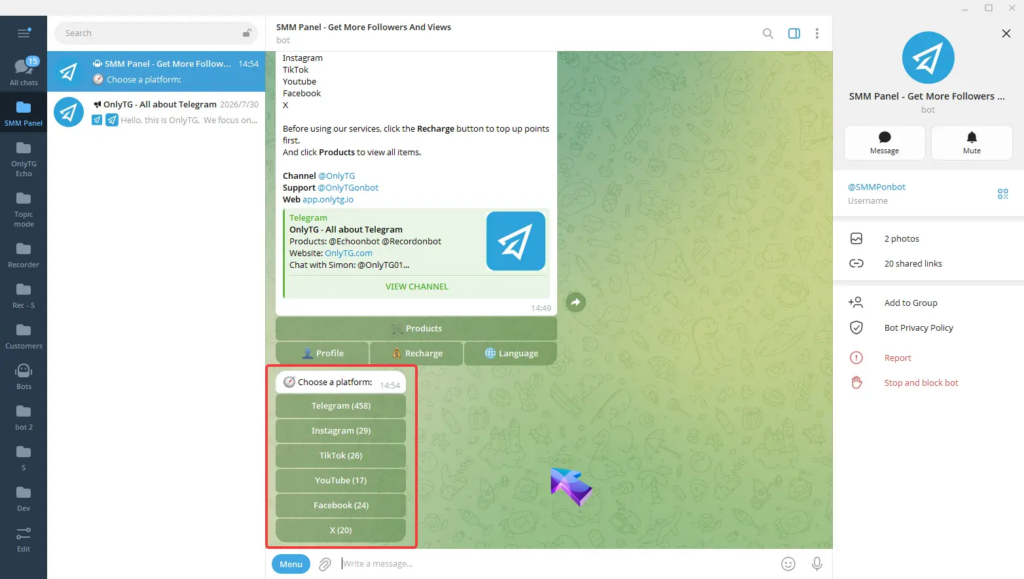
Step 3 — Select the Platform and Growth Type
Open Products, choose the platform, then select the relevant growth category.
Step 4 — Review the Service
Check the service information, including price, quantity information, estimated waiting time, and notes.
Step 5 — Create the Order
Select Buy, enter the target link and quantity, review the details, and confirm.
Step 6 — Monitor the Order
Use Profile → Orders to review order records and status.
Option 2: OnlyTG Console
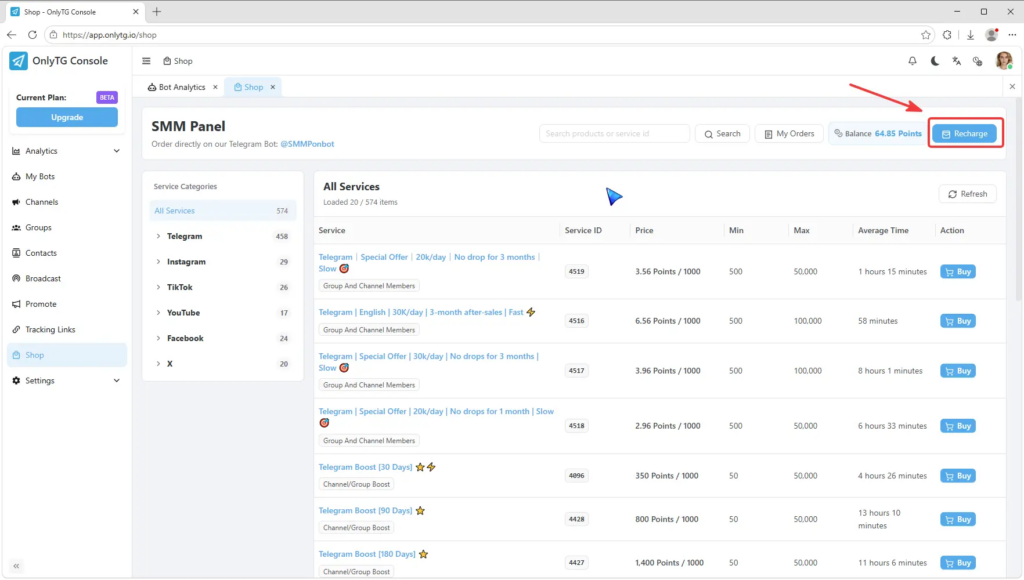
The Console provides a browser-based workflow.
Open app.onlytg.io, log in, and select Shop. Choose a platform and growth category, review the available services, enter the target link and quantity, and create the order. The Console also provides service details and an My Orders area for reviewing order records and statuses.
What to Fix When a Brand Campaign Loses Momentum
A campaign does not necessarily need a completely new idea when performance weakens. Sometimes a specific part of its execution needs adjustment.
The campaign message is difficult to remember.
If individual posts communicate different benefits without a shared idea, audiences may struggle to connect them. Simplify the central message and make sure each new piece of content reinforces it.
People see the campaign but do not participate.
The participation request may require too much effort or offer too little relevance. Reduce unnecessary steps and give people a clear reason to respond.
Different platforms feel disconnected.
If each account uses different messaging and creative direction, the campaign can lose its identity. Preserve the central concept while adapting the format to each platform.
A creator partnership produces attention without meaningful interest.
Review audience relevance and the creator’s relationship with the campaign topic. Reach alone is not enough to establish a useful partnership.
The campaign generates activity but provides little learning.
If the team only records views and likes, it may not understand why the campaign performed as it did. Review exposure, participation, and brand-interest indicators together, then document which creative elements and distribution sources deserve further testing.
Build Your Next Campaign Around a Message People Can Recognize
Strong social media brand campaigns do more than place promotional content in front of an audience. They create a recognizable idea, give people a reason to participate, and connect individual interactions to a consistent brand message.
Start with one campaign concept that reflects your positioning and your audience’s interests. Choose a participation method that feels natural, adapt the creative work to the platforms that matter, and measure whether people are moving beyond passive exposure to genuine brand interest.
When additional execution support is appropriate, OnlyTG SMM Panel can be considered as one supporting resource within that wider workflow.
Explore OnlyTG SMM Panel and plan your next social media brand campaign around a clear, measurable objective.