

A new social media account has a frustrating problem: you can publish good content and still have almost nobody seeing it. Imagine a small e-commerce brand launching a new account with no followers, no established reach, and no reliable data about what its future audience wants. The first goal is not to go viral. It is to build a repeatable path from the right audience discovering the account to deciding to follow it.
That means audience growth should be treated as a workflow rather than a collection of isolated posting tips. You need to define who you want to attract, create content for that audience, make the account discoverable, encourage interaction, measure what happens, and improve the process based on evidence.
Start With the Audience You Actually Want
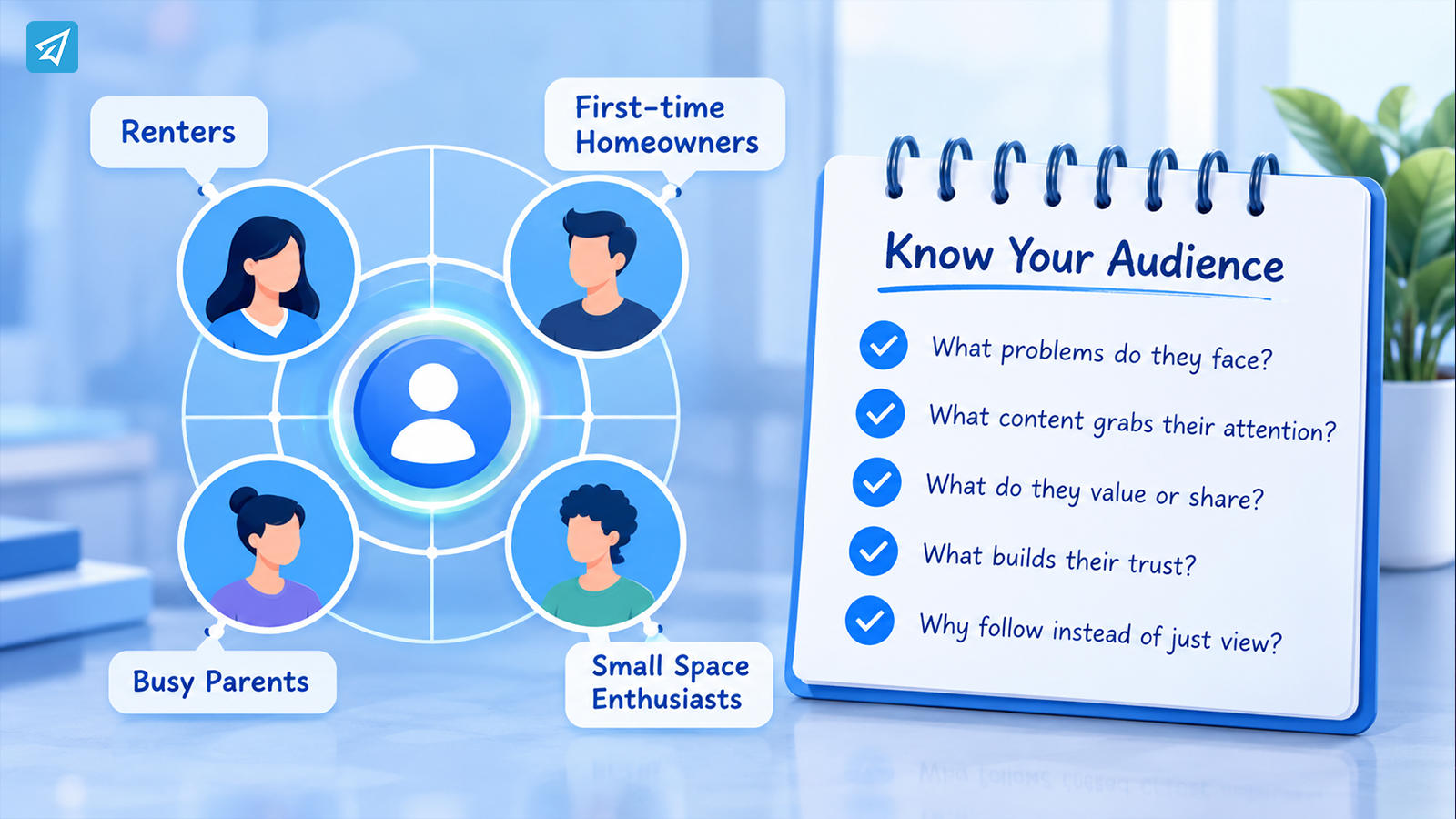
When an account has zero followers, it is tempting to focus on the number you want to reach. A better starting point is identifying who those followers should be.
Suppose the e-commerce brand sells practical home-organization products. Its potential audience is not simply “people who use social media.” It might be renters, first-time homeowners, busy parents, or people interested in organizing small spaces.
That distinction affects almost every later decision.
Ask:
- What problem does this audience regularly encounter?
- What information would make them stop scrolling?
- What content would they save or share?
- What would make them trust a new account?
- What reason would they have to follow instead of simply viewing one post?
This is the foundation of building a social media audience from scratch. A large but irrelevant audience is much less useful than a smaller group that consistently responds to the subject of your account.
Turn the Audience Into a Content System
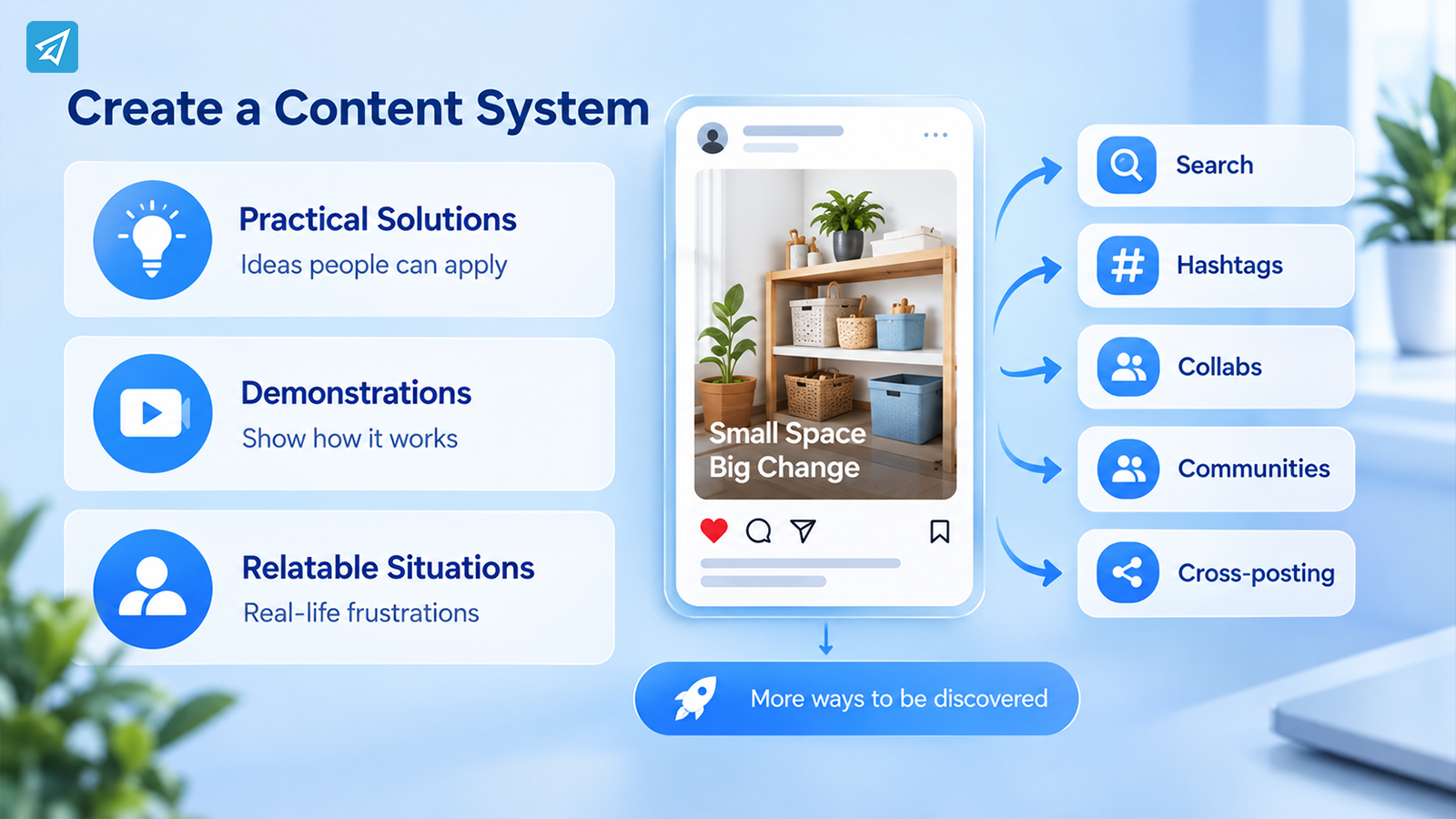
Once the audience is clear, create a small set of content themes instead of deciding what to post from scratch every day.
For the hypothetical home-organization brand, content could revolve around three themes:
- Practical solutions — organization ideas people can immediately apply.
- Demonstrations — showing how products or techniques solve specific problems.
- Relatable situations — common frustrations around clutter, storage, and limited space.
The point is not to make every post promotional. If every piece of content asks people to buy something, a new account gives users little reason to stay.
A stronger content mix gives people several reasons to return: learn something, discover an idea, see a useful demonstration, or participate in a conversation.
At this stage, consistency matters because you need enough content to learn from. But consistency does not mean publishing identical posts on a rigid schedule. It means maintaining a reliable publishing rhythm while testing different topics, formats, hooks, and messages.
Choose the Platform Around Audience Behavior
You do not need to build every social account at the same time.
Start where the target audience is most likely to discover and consume the type of content you can realistically produce.
- Instagram can fit visual products, demonstrations, lifestyle content, and community interaction.
- TikTok can fit short demonstrations, educational clips, entertainment, and discovery-oriented content.
- YouTube can fit deeper explanations, tutorials, reviews, and searchable video content.
- Telegram can fit direct community communication, channel content, and recurring audience interaction.
- Facebook can be useful for communities, local audiences, and content distribution.
- X can fit conversation-driven content, commentary, and real-time participation.
The important question is not which platform is universally best. It is whether the platform’s content and audience behavior fit your growth objective.
For a new account, concentrating your effort on one primary platform can also make testing easier. Once you understand what works, successful content can be adapted for other channels.
Make Discovery Part of the Content Strategy
Publishing content answers only one question: what are you giving people?
You also need to answer: how will people find it?
A new account has little built-in distribution, so discovery needs to be designed into the workflow.
Depending on the platform and audience, this can include:
- Search-friendly profile and content language
- Relevant keywords and topics
- Platform-native discovery features
- Cross-platform content distribution
- Collaborations with complementary creators
- Participation in relevant communities
- Repurposing strong content into different formats
- Sharing useful content through existing customer or subscriber channels
Imagine the brand creates a useful short video showing how to organize a small kitchen. Instead of publishing it once and waiting, the team could turn the same idea into a short-form video, an image carousel, a longer explanation, and a discussion prompt.
The content idea stays consistent, while the distribution opportunities expand.
This is especially important when learning how to build a social media audience from scratch because early growth often depends on giving good content enough opportunities to be discovered.
Give People a Reason to Follow
A view does not automatically become a follower.
This creates an important checkpoint in the workflow: what happens after someone discovers your content?
Look at the complete profile experience.
Does the bio explain what the account is about?
Does the recent content reinforce the same topic?
Can a new visitor quickly understand who the account is for?
Is there a clear reason to return?
A useful content-to-follow path might look like:
Discovery → Content Value → Profile Visit → Relevance Check → Follow
If many people view your content but relatively few visit or follow the account, publishing more content may not solve the problem. The issue could be the connection between the individual post and the overall account.
This is why audience growth is not simply a publishing-volume problem.
Turn Early Followers Into Participants
Once the first people begin following, the next task is making the account worth participating in.
Respond to comments. Ask specific questions. Invite people to share their experience. Use feedback to create follow-up content. Pay attention to recurring questions and objections.
For example, if several followers ask how to organize a particular type of small room, that question can become the subject of the next post.
This creates a useful feedback loop:
Audience Question → Content Idea → New Post → Interaction → More Audience Insight
That loop is more valuable than treating engagement as a number that only needs to increase.
A new account should gradually become more informed by its audience. The more you learn about what people ask, save, discuss, or share, the easier it becomes to produce relevant content.
Use Metrics to Diagnose the Next Problem
When building a social media audience from scratch, avoid tracking every available metric equally. Start with the numbers that help explain the current stage of growth.
| Growth Signal | What It Can Tell You | Possible Next Action |
|---|---|---|
| Reach and views | Whether content is being discovered | Test topics, formats, hooks, and distribution |
| Profile visits | Whether content creates enough curiosity | Improve the connection between posts and profile positioning |
| Follower growth | Whether visitors see enough ongoing value | Review profile clarity and content consistency |
| Shares and saves | Whether content provides lasting or transferable value | Develop more content around successful themes |
| Comments and replies | Whether the audience has a reason to participate | Build follow-up posts around questions and conversations |
The key is to interpret metrics in context.
If views are increasing but follower growth remains weak, examine what happens after discovery.
If followers are increasing but interaction is declining, investigate whether the new audience is actually aligned with the content.
If engagement is strong but reach remains limited, look at distribution and discoverability.
The metric itself is not the conclusion. It is a signal that helps determine what to investigate next.
Run Small Tests Instead of Changing Everything

A new account has limited historical data, so optimization should be treated as a series of controlled experiments.
Do not change the topic, format, posting frequency, platform, caption style, and call to action simultaneously. If performance changes, you will not know which variable caused it.
Instead, test one meaningful change at a time.
For example:
Week 1: Test three content topics.
Week 2: Keep the strongest topic and test two formats.
Week 3: Keep the strongest format and test different hooks.
Week 4: Review which combinations consistently attract relevant visitors and followers.
The exact schedule can change depending on the platform and publishing volume. The principle is more important: use each content cycle to answer a specific question.
This turns “trying to grow” into a learning process.
Where Supporting Tools Fit Into the Workflow
At this point, a growth workflow has already established its strategic foundation:
Audience → Content → Platform → Distribution → Engagement → Measurement → Optimization
Only then does it make sense to consider execution tools.
An SMM Panel can support selected operational tasks around social media metrics, but it does not determine your audience, create your content strategy, manage your community, or tell you why an account is underperforming.
OnlyTG SMM Panel currently supports social media services for Telegram, Instagram, TikTok, YouTube, Facebook, and X. Its service catalog includes growth types such as followers, views, reactions, and other available social media metrics.
That makes it a supporting execution layer rather than the growth strategy itself.
For example, if your workflow already identifies a specific platform, target, metric, and operational requirement, you can use the panel to handle that selected execution task while continuing to manage content, audience development, engagement, and analytics separately.
The distinction matters: a change in a social media metric should not automatically be interpreted as the creation of real customers, stronger relationships, or higher revenue.
How to Use OnlyTG SMM Panel as a Supporting Tool
If an SMM panel fits a specific operational need, OnlyTG keeps the ordering process relatively straightforward. You can use the Telegram bot or the OnlyTG Console. The official documentation describes selecting a platform and growth type, choosing a service, reviewing its available details, entering the target link and quantity, and confirming the order.
Option 1: Telegram Bot
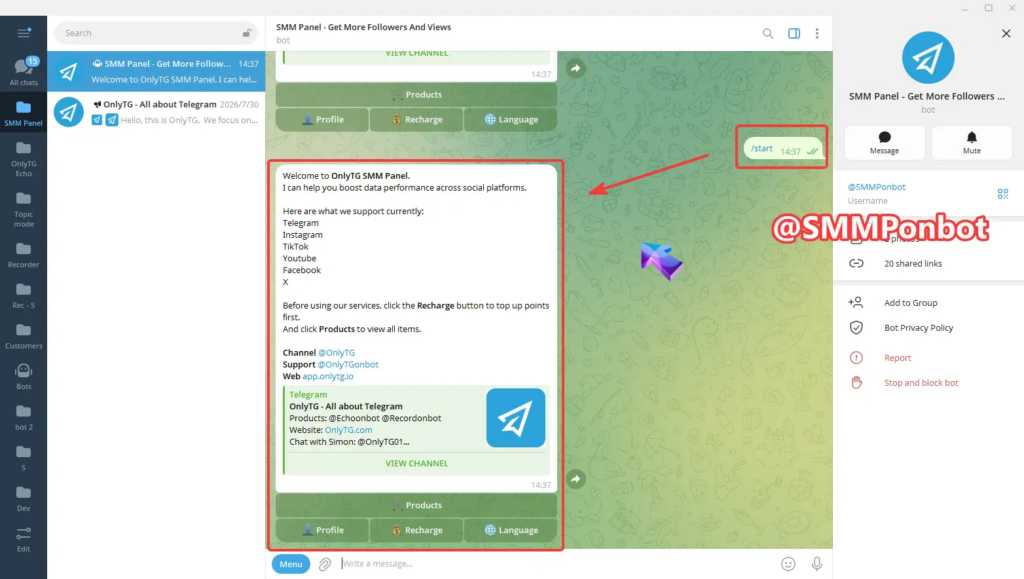
Step 1 — Open the Bot
Find @SMMPonbot on Telegram and send /start.
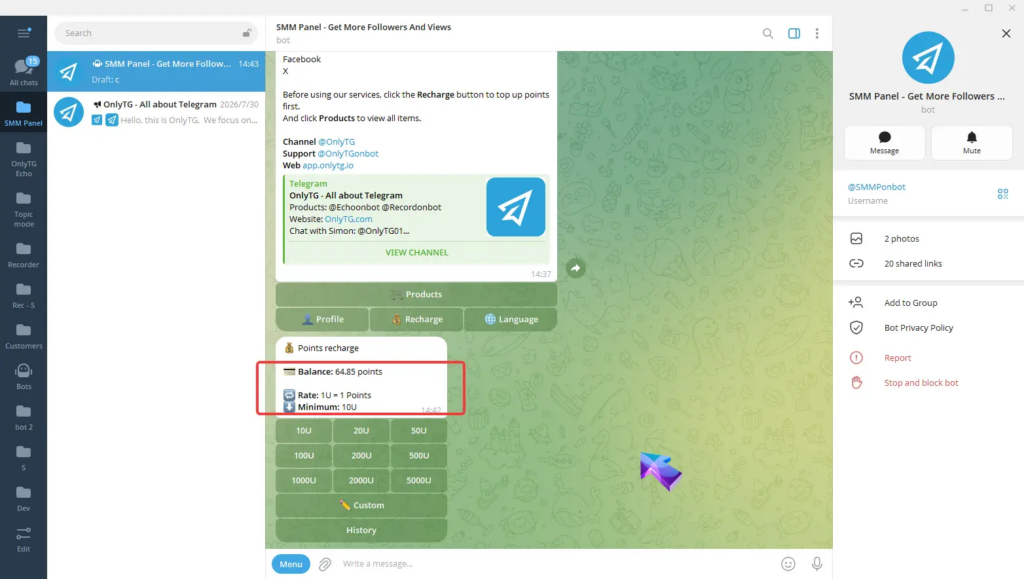
Step 2 — Add Balance
Use Recharge to fund the account. OnlyTG’s documentation currently lists 1 USDT = 1 point and a minimum recharge of 10 USDT.
Step 3 — Select the Platform and Growth Type
Open Products, choose the platform, then select the relevant growth category.
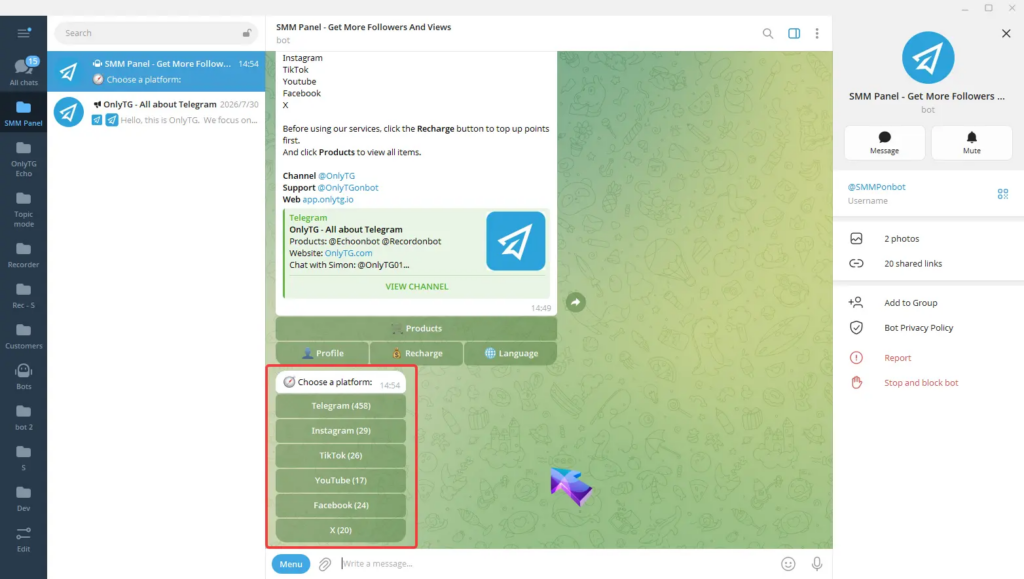
Step 4 — Review the Service
Check the service information, including price, quantity information, estimated waiting time, and notes.
Step 5 — Create the Order
Select Buy, enter the target link and quantity, review the details, and confirm.
Step 6 — Monitor the Order
Use Profile → Orders to review order records and status.
Option 2: OnlyTG Console
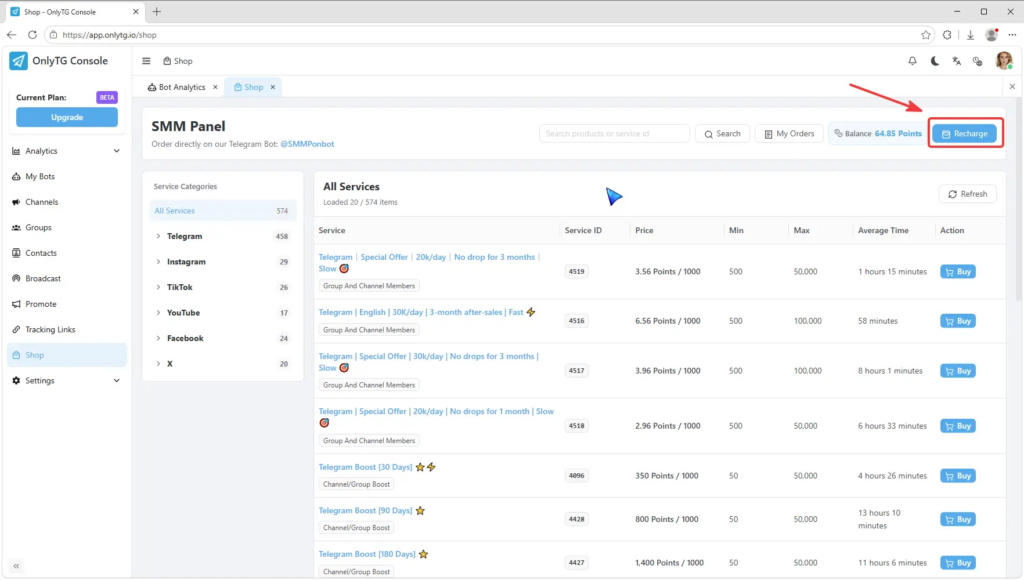
The Console provides a browser-based workflow.
Open app.onlytg.io, log in, and select Shop. Choose a platform and growth category, review the available services, enter the target link and quantity, and create the order. The Console also provides service details and an My Orders area for reviewing order records and statuses.
A Practical Checkpoint Before Scaling
Before increasing activity, review the entire path from discovery to follow.
Ask:
- Are we attracting the audience we actually want?
- Does the content clearly communicate the account’s value?
- Is the profile consistent with the content?
- Are people discovering the account through more than one route?
- Are engagement signals producing useful audience insights?
- Which content should be repeated?
- Which experiments should be changed or stopped?
If the answers are unclear, adding more volume may simply produce more data without solving the underlying problem.
A useful growth system should become easier to operate over time because each publishing cycle teaches you something about your audience.
Common Failure Points in a New Account
The most common problems usually appear at different stages of the workflow.
Audience stage: The account tries to appeal to everyone, so its content has no clear audience.
Content stage: Posts are consistently promotional without providing enough independent value.
Discovery stage: The team publishes useful content but gives little attention to how people will find it.
Conversion stage: Posts generate views, but the profile gives visitors no strong reason to follow.
Engagement stage: The account broadcasts content but does not use audience responses to shape future posts.
Measurement stage: The team tracks follower numbers without understanding reach, profile visits, engagement, or content performance.
Optimization stage: Too many variables are changed at once, making the results difficult to interpret.
Fixing the correct stage is usually more useful than simply increasing posting frequency.
Build the Audience Before Chasing the Number
Learning how to build a social media audience from scratch is ultimately about creating a repeatable system for attracting relevant people and giving them reasons to stay.
Start with the audience. Build content around its interests and problems. Choose a platform that fits the way that audience consumes information. Create multiple paths for discovery. Make the profile convert relevant visitors into followers. Turn audience interaction into new content ideas. Then use metrics to identify what deserves more attention.
Supporting tools can fit into that process when there is a specific execution requirement. They should remain one part of the workflow rather than becoming the workflow itself.
For a new account, the objective is not simply to make a number go up. It is to build an audience-development process that becomes more informed, more focused, and more repeatable with every content cycle.
Frequently Asked Questions
1. How do you build a social media audience from scratch?
Start by defining a specific audience and one primary growth objective. Create useful content around that audience’s interests, choose a platform where the audience can discover it, distribute content consistently, encourage interaction, and use performance data to improve the next content cycle.
2. How can a new social media account get its first followers?
Make the account easy to understand, publish content that serves a specific audience, and create several discovery paths through search, communities, collaborations, cross-platform distribution, or content sharing. Then make sure the profile gives visitors a clear reason to follow.
3. Can an SMM Panel help build a social media audience?
An SMM Panel can support selected social media growth activities and operational tasks. It should not be treated as a replacement for audience research, content strategy, community management, analytics, or platform-specific growth planning. OnlyTG SMM Panel supports services across Telegram, Instagram, TikTok, YouTube, Facebook, and X.