
Telegram is no longer just a broadcast channel or private community tool. In 2026, it is becoming a commerce layer where creators, Mini App founders, agencies, media brands, and cross-border merchants can acquire users, sell digital products, collect payments, and reinvest revenue into growth.
The opportunity is attractive because Telegram combines three assets that most social platforms keep separate: high-intent communities, programmable bots, and native payment rails through Telegram Stars. But the business challenge is also real.
This guide breaks down the commercial Telegram stack in practical terms. You will learn which monetization models fit different business types, how to price offers, what costs to expect, how Stars and TON withdrawals work, and how to build a repeatable acquisition-to-revenue loop without relying on vague growth hacks.
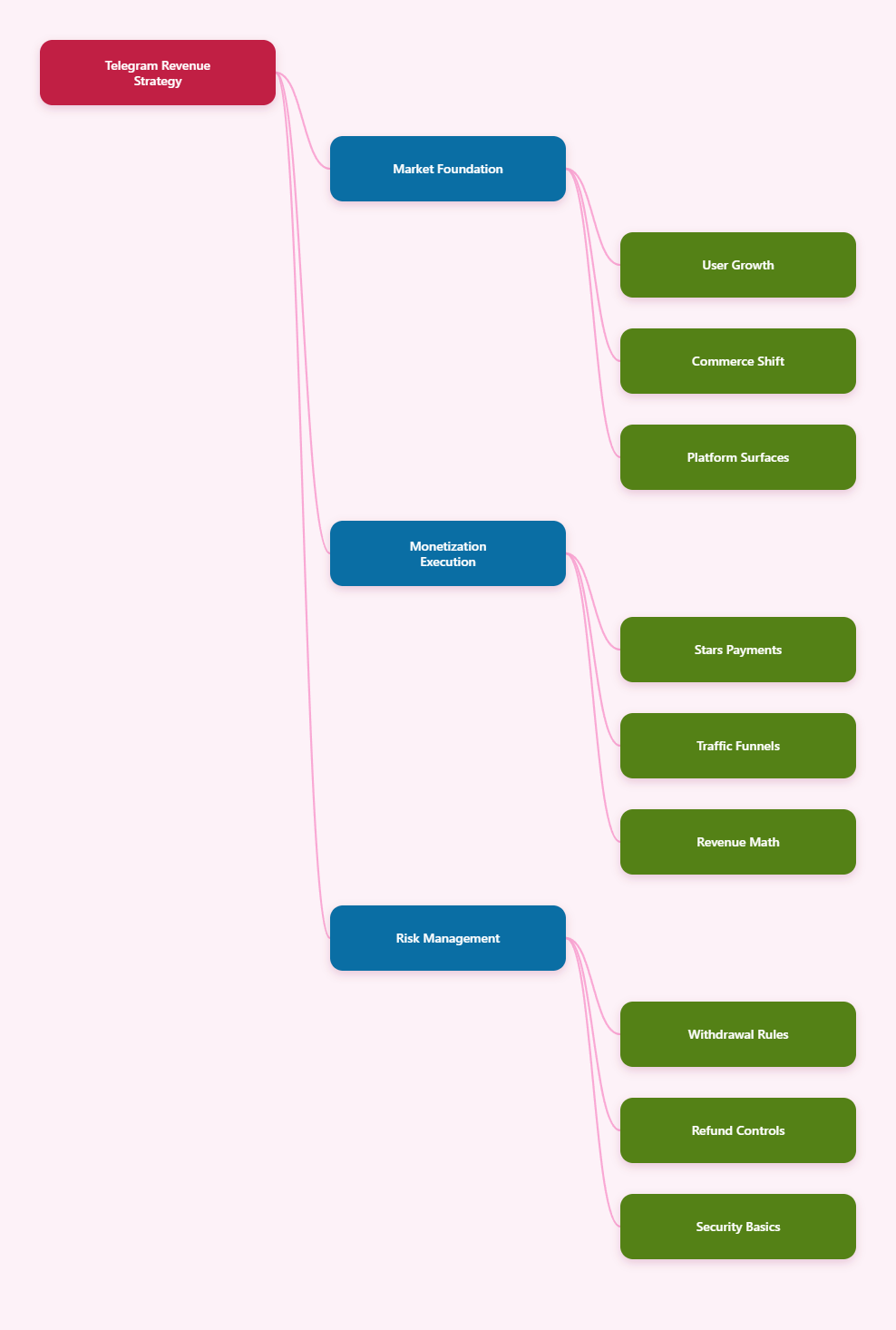
Telegram’s 2026 Business Context
Why businesses are taking Telegram seriously
Telegram crossed the 1 billion monthly active user milestone announced by Pavel Durov in 2025, and multiple 2026 statistics roundups continue to place the platform among the world’s major social and messaging networks. For businesses, the key point is not only audience size. It is the mix of channels, groups, bots, Mini Apps, paid media, and native payments.
Telegram’s commercial appeal is strongest in markets where users already treat messaging apps as operating systems:
- Crypto and Web3 communities selling tools, signals, education, and token-gated access.
- Creator businesses selling premium content, paid media, subscriptions, and donations.
- Gaming and utility Mini Apps selling energy, upgrades, dashboards, or premium features.
- Agencies managing community funnels, Sponsored Messages, and conversion bots.
- Cross-border merchants using Telegram as a support, retention, and upsell channel.
The shift from attention to transactions
Before Stars, many Telegram businesses pushed users to external checkout pages. That added friction, especially on mobile. Telegram Stars changed the flow for digital goods: bots and Mini Apps can accept Stars directly, using the XTR currency code in Telegram’s Bot Payments documentation.
This matters because one-tap native payment can improve conversion for small digital purchases. Instead of asking users to enter card details, a merchant can sell:
- Premium bot features.
- Locked content or paid media.
- Mini App subscriptions.
- Digital files, reports, templates, or lessons.
- Community perks and upgrades.
Telegram is not one channel
A common strategic mistake is treating Telegram as a single traffic source. In practice, the platform has several business surfaces:
- Channels for broadcast reach and media inventory.
- Groups for community trust and support.
- Bots for automation, segmentation, fulfillment, and payments.
- Mini Apps for product experiences inside Telegram.
- Sponsored Messages and ads for paid acquisition.
- Affiliate programs for distribution through creators and channels.
The Telegram Monetization Stack
Choose the model before choosing the tool
The best Telegram businesses start with a commercial model, not with a bot feature. A paid community, a Mini App, and a creator media funnel need different pricing, retention, and fulfillment logic.
Use this framework to match your business to the correct Telegram surface.
| Business Type | Best Telegram Surface | Primary Revenue | Key KPI |
|---|---|---|---|
| Creator or educator | Channel + bot | Subscriptions, paid media, tips | Paid conversion rate |
| Mini App founder | Mini App + bot | Stars purchases, tiers, upgrades | ARPDAU and retention |
| Agency | Ads + tracking bot | Management fees, performance fees | CAC to LTV ratio |
| SaaS or data tool | Bot + Mini App | Paid unlocks, recurring access | Trial-to-paid rate |
| Media channel | Channel + affiliates | Sponsorships, referrals, Stars | Revenue per subscriber |
Seven practical profit levers
Most Telegram revenue comes from a combination of seven levers:
- Paid digital goods: templates, reports, lessons, files, alerts, or premium utilities.
- Recurring access: weekly or monthly content, private groups, or Mini App tiers.
- Paid media: locked photos, videos, bundles, and premium posts.
- Tips and donations: useful for creators with loyal audiences.
- Affiliate programs: Telegram supports Mini App affiliate programs where promoters earn commissions in Stars.
- Advertising and sponsorships: brands pay for placement in channels or communities.
- Reinvestment loops: earned Stars can be used for rewards or, according to Telegram’s 2024 update, toward Telegram Ads at special rates.
What to sell first
If you are starting from zero, sell a narrow paid outcome instead of a broad membership. Examples:
- A $9 research pack for crypto traders.
- A 500-Star unlock for a Mini App analytics dashboard.
- A paid bot feature that saves users time every day.
- A 7-day premium content trial before monthly renewal.
Small offers reduce payment anxiety and generate real conversion data faster.
Telegram Stars Economics
What Stars are used for
Telegram Stars are virtual items used inside Telegram to pay for digital goods and services from bots and Mini Apps, support creators, purchase paid media, and interact with paid features. Official Telegram documentation states that digital goods and services sold via bots and Mini Apps must use Stars.
This makes Stars central to Telegram monetization, but they are not a universal business payment method. They are best for digital value delivered inside or immediately through Telegram.
Price, fees, and user behavior
Public 2026 market guides commonly report that Stars cost roughly $0.013 to $0.016 per Star, depending on purchase route, region, app store fees, and TON pricing. In-app purchases through Apple or Google are convenient but may include app store economics. Fragment and TON-based routes are often described as cheaper, but the final USD cost depends on TON market price and the purchase moment.
This has a direct conversion impact. If your audience understands how to buy telegram stars cheaply through official or Telegram-connected routes, high-volume purchases may become easier. However, businesses should avoid sending users to unsafe third-party sellers. Telegram’s Stars Terms also state that sales of Stars are generally final, while third-party developers may refund Stars if a bot or Mini App fails to deliver as promised.
| Stars Route | Typical 2026 Use | Cost Signal | Business Impact |
|---|---|---|---|
| In-app iOS or Android | Fast consumer purchase | Often around $0.016 per Star in guides | Lowest friction, higher buyer cost |
| Fragment or TON route | Cost-sensitive users | Often around $0.013 per Star, variable with TON | Better for larger purchases |
| Earned Stars | Creator or merchant revenue | Withdrawable via Fragment to TON | Cash-flow planning required |
| Purchased Stars | User spending balance | Not cash-out balance | Cannot be treated as liquid treasury |
Withdrawal and cash-flow rules
Telegram Stars earned from selling digital goods can be withdrawn through Fragment into TON, then converted through an exchange if needed. Public withdrawal guides in 2026 commonly cite several important constraints:
- Purchased Stars cannot be cashed out; only earned Stars are withdrawable.
- Minimum withdrawal is commonly reported as 1,000 Stars.
- Newly earned Stars may be subject to a 21-day holding period before withdrawal.
- Final bank cash-out requires TON liquidity, exchange access, and local compliance.
For operators, this means Stars revenue is not the same as same-day cash. A creator selling $5,000 in digital products may still need working capital for ad spend, moderation, design, and developer costs during the holding period.
Traffic Acquisition and Retention
Build the funnel around intent
Telegram funnels work best when the acquisition promise matches the paid offer. Do not run broad traffic into a generic channel and hope users discover your product. Instead, design a direct journey:
- Ad, referral, or external content promises a clear benefit.
- Landing bot captures the user and segments intent.
- Free preview demonstrates value quickly.
- Stars checkout unlocks the paid benefit.
- Retention bot triggers renewal, upsell, or referral.
Organic channels versus paid ads
Organic Telegram growth is trust-driven. Paid Telegram acquisition is measurement-driven. Most serious businesses need both.
- Organic communities lower CAC but take time to build credibility.
- Sponsored placements in relevant channels can create fast tests.
- Telegram Ads can support scaling when funnel economics are proven.
- Affiliate programs reward promoters only after downstream purchases.
For a Mini App, paid traffic should not be judged only by installs. The better metric is paid activation: users who complete a first Stars purchase or reach a monetizable event.
Retention beats one-time hype
The highest-margin Telegram businesses monetize repeatedly. A one-time content unlock is useful, but recurring engagement builds enterprise value.
Retention tactics include:
- Daily utility notifications with clear opt-in logic.
- Tiered feature limits that encourage upgrades.
- Weekly premium drops for subscribers.
- Community-only bonuses for paid users.
- Referral rewards funded by incremental revenue.
Revenue Models and ROI Math
A simple Stars revenue model
Assume a Telegram Mini App sells a premium feature for 500 Stars. If users effectively pay around $0.013 to $0.016 per Star, the user-facing value is roughly $6.50 to $8.00. The merchant should model net revenue conservatively, because purchase route, withdrawal conversion, TON volatility, and exchange costs can affect final cash.
The main equation is simple:
- Gross Stars revenue = buyers × Stars price per offer.
- Cash estimate = earned Stars × expected USD value per Star after conversion assumptions.
- Contribution margin = cash estimate − traffic cost − creator cost − tooling cost − support cost.
| Scenario | Users | Paid Conversion | Offer Price | Gross Stars | Approx. USD at $0.013 |
|---|---|---|---|---|---|
| Small creator launch | 2,000 | 3% | 300 Stars | 18,000 | $234 |
| Niche paid report | 10,000 | 2.5% | 800 Stars | 200,000 | $2,600 |
| Mini App feature | 50,000 | 4% | 500 Stars | 1,000,000 | $13,000 |
| Scaled subscription funnel | 100,000 | 5% | 1,000 Stars | 5,000,000 | $65,000 |
These are planning examples, not guaranteed payouts. Operators should update the USD value, TON conversion assumptions, and platform costs before making budget decisions.
Pricing recommendations
Telegram users respond well to simple tiers. Avoid too many packages at launch.
- Low tier: 100–300 Stars for impulse unlocks.
- Core tier: 500–1,000 Stars for the main paid value.
- Power tier: 2,500+ Stars for bundles, annual access, or advanced features.
For B2B or professional audiences, price by time saved or revenue potential. For entertainment and creator offers, price by exclusivity, frequency, and community identity.
When Telegram Ads make sense
Do not scale paid ads until you know three numbers:
- Your first-purchase conversion rate.
- Your average revenue per paying user.
- Your 30-day retention or repeat purchase rate.
If the first purchase barely covers acquisition cost, focus on upsells before increasing ad spend. If repeat purchases are strong, Telegram Ads, channel sponsorships, and affiliate commissions become growth accelerators rather than gambling expenses.
Operational Risks and Compliance
Policy and refund discipline
Telegram’s Stars Terms say Stars purchases are generally final, but developers can refund users if a bot or Mini App fails to deliver the advertised product. This makes fulfillment integrity a commercial issue, not just a support issue.
Every paid Telegram product should include:
- Clear description of what the user receives.
- Delivery confirmation inside the bot or Mini App.
- Refund handling for failed delivery.
- Support contact or ticket flow.
- Transaction logging for reconciliation.
Security for merchants and agencies
Telegram commerce often involves bots, APIs, wallets, and admin permissions. That creates operational risk. Keep keys, wallet seeds, and payment credentials server-side only. Never expose settlement secrets in a browser bundle, Mini App front end, public repository, or analytics log.
Minimum security checklist:
- Use two-step verification for admin accounts.
- Separate owner, moderator, developer, and finance roles.
- Maintain transaction exports and backup logs.
- Review bot permissions monthly.
- Use test payments before releasing new paid flows.
What not to monetize
Not every offer belongs on Telegram Stars. Avoid business models that depend on misleading claims, unsafe financial promises, counterfeit goods, regulated products without licenses, or unclear digital delivery. Telegram may be flexible as a platform, but payment disputes, user reports, and compliance failures can destroy a revenue channel quickly.
FAQ
Is Telegram a good platform for business monetization in 2026?
Yes, if your product benefits from community, automation, or fast digital delivery. Telegram is especially strong for creators, Mini Apps, Web3 tools, education, paid communities, and niche media. It is weaker for businesses that need complex physical fulfillment or heavy regulatory onboarding.
What are Telegram Stars used for?
Telegram Stars are used for digital goods and services inside Telegram bots and Mini Apps, paid media, creator support, gifts, and some platform-native features. Official bot payment documentation uses the XTR currency code for Stars transactions.
Can users buy telegram stars inside the app?
Yes. Users can buy Stars through Telegram’s in-app purchase flows where available. Some users also use Fragment or TON-connected routes. Costs may vary by route, region, app store fees, and TON price.
Can merchants withdraw Telegram Stars to cash?
Merchants and creators can withdraw earned Stars through Fragment to TON, then convert TON through an exchange if available in their jurisdiction. Purchased Stars are for spending inside Telegram and are not treated as a cash-out balance.
How long does Telegram Stars withdrawal take?
Public 2026 withdrawal guides commonly report a 21-day holding period for newly earned Stars and a minimum withdrawal threshold around 1,000 Stars. Final cash timing depends on Fragment, TON settlement, exchange processing, and local banking rails.
Are Telegram Mini Apps profitable?
They can be profitable when retention and repeat purchases are strong. The highest-potential Mini Apps usually sell recurring utility, game progression, analytics, premium content, or productivity features rather than one-time novelty items.
Should I use Telegram Ads or channel sponsorships?
Use sponsorships for early funnel testing because they are flexible and audience-specific. Use Telegram Ads when you already know your conversion rate, average revenue per user, and retention economics.
Conclusion
Telegram monetization in 2026 is about building a complete commercial system, not simply adding a payment button. The strongest businesses combine audience trust, bot automation, Mini App experiences, Stars payments, measurable acquisition, and disciplined cash-flow planning. Stars make small digital transactions easier, but operators still need to understand purchase routes, withdrawal delays, refund responsibilities, TON exposure, and security risks.