
If your Telegram inbox is full of leads, support questions, payment requests, and community messages, you do not have a sales system. You have a crowded chat list. Dual Telegram split sales is a cleaner way to organize Telegram selling in 2026 by separating discovery, conversion, support, and retention into clearly managed spaces.
This guide explains how to build that split without pretending Telegram is a full CRM by itself. You will learn where to use a personal or business account, when to use a channel, when a group makes sense, and how bots, Telegram Business tools, payments, and Mini Apps fit into the flow.
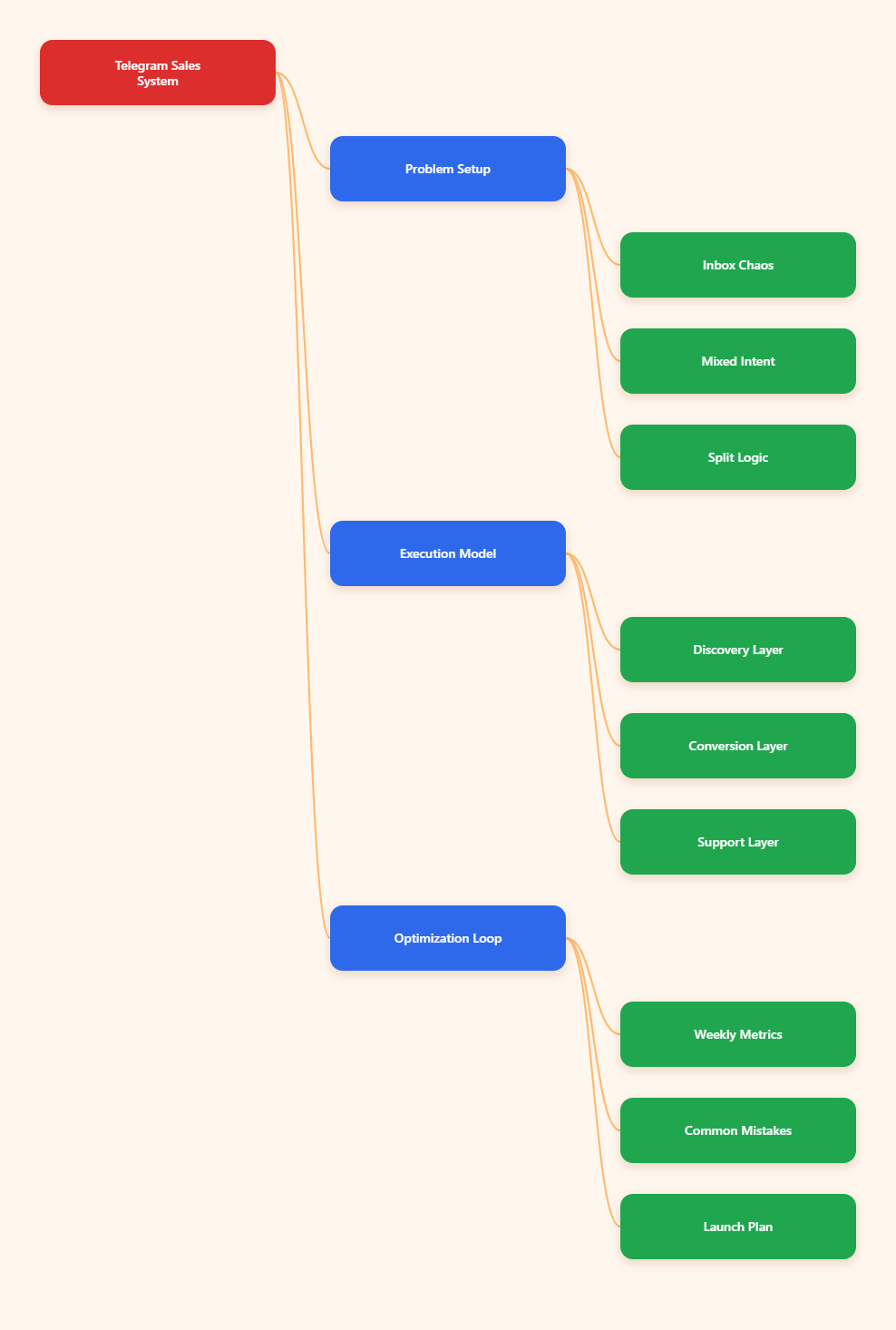
What Dual Telegram Split Sales Means
Dual Telegram split sales means dividing your Telegram sales operation into two connected layers instead of forcing everything through one account or one chat. The first layer attracts and qualifies people. The second layer handles buying, onboarding, support, and repeat sales.
For many small businesses, the split looks like this:
- Front layer: a channel, public group, ad campaign, or content account that brings people in.
- Sales layer: a Telegram Business account, bot, private chat, or Mini App that handles conversion.
- Support layer: a group, connected bot, or help inbox that protects the main sales chat from noise.
- Retention layer: a channel or segmented list where customers receive updates, drops, renewals, or education.
The word “dual” does not always mean only two Telegram accounts. It means two clear purposes: one path for attention, one path for transactions.
Why Telegram Sales Need a Split in 2026
Telegram is no longer just a private messaging app. Telegram founder Pavel Durov said in March 2025 that the app had passed 1 billion monthly active users, and Telegram’s official ecosystem now includes Business features, bots, channels, groups, payments, ads, and Mini Apps.
That growth creates opportunity, but it also creates operational risk. A single Telegram inbox can work when you have ten customers. It becomes fragile when you handle hundreds of prospects, refunds, invoices, product questions, affiliate partners, and community members.
The Main Problem: Mixed Intent
Most Telegram sales problems come from mixing different types of intent in one place. A cold lead, a ready buyer, a confused customer, and an angry user should not receive the same workflow.
When all of them message the same account, your team loses context. Response time drops, hot leads get buried, and support conversations interrupt revenue conversations.
What Telegram Officially Supports
Telegram provides several tools that make splitting possible. Telegram Business, launched in 2024, lets users add business hours, location, a custom start page, quick replies, greeting messages, away messages, and chatbot support.
Telegram’s official API documentation also describes connected business bots, which can process and answer messages on behalf of a user account. Telegram says Telegram Business features are currently available to Premium subscribers, while connected business bots are also available to non-Premium users according to its Premium API notes.
Where the Split Helps Most
A split setup is useful when your Telegram activity includes more than casual chat. It is especially practical for:
- Digital product sellers handling pre-sale questions and delivery support.
- Agencies receiving leads from content, ads, and referrals.
- Course creators managing launches, cohorts, and student support.
- E-commerce brands using Telegram for order updates and repeat purchases.
- Communities that need both public discussion and private monetization.
Dual Telegram Split Sales Setup: The Recommended 2026 Model
The best dual Telegram split sales model is not “use more accounts.” It is “use the right Telegram object for the right job.” Channels, groups, bots, business accounts, and Mini Apps each solve a different sales problem.
Start by mapping the buyer journey before creating more chats. Every Telegram asset should have a reason to exist.
Layer 1: Discovery and Trust
This layer is where strangers become interested prospects. A Telegram channel is usually the cleanest format because channels support one-to-many broadcasting and can have unlimited subscribers.
Use this layer for:
- Short educational posts.
- Product announcements.
- Case studies and proof.
- Launch reminders.
- Links to bots, forms, Mini Apps, or private sales chats.
A public group can support this layer if conversation is part of the product. Telegram groups support up to 200,000 members, making them useful for communities, feedback, onboarding, and peer discussion.
Layer 2: Qualification and Conversion
This is where the sale becomes personal. Use a Telegram Business account, a bot, or a private chat flow to qualify needs, answer objections, and send the next step.
Telegram Business quick replies are useful here because many questions repeat. For example, you can prepare answers for pricing, delivery time, refund rules, onboarding steps, product comparisons, and payment options.
The key is to keep this layer focused on buyers. Do not let general community chatter or support requests dominate it.
Layer 3: Payment and Delivery
Telegram bots can accept payments for goods and services through the Bot Payments API. Telegram states that it does not collect payment information and takes no commission, while payment processing is handled by supported providers.
For digital goods and services, Telegram also documents payments with Telegram Stars. If you sell digital access, media, or in-app value, check the current Bot Payments API rules before choosing your checkout path.
For a smoother buying experience, a Telegram Mini App can host a product catalog, cart, checkout, order status, or account area inside Telegram. This is useful when a normal chat becomes too slow for repeat transactions.
Channel vs Group vs Bot vs Business Account
Choosing the wrong Telegram format is the fastest way to create confusion. Use the table below as a practical decision tool.
| Telegram Asset | Best Use | Sales Role | Risk If Misused |
|---|---|---|---|
| Channel | Broadcasting to unlimited subscribers | Awareness, launches, retention | Low engagement if posts are only promotional |
| Group | Two-way discussion up to 200,000 members | Community, feedback, onboarding | Spam, noise, and support overload |
| Business Account | Direct customer communication | Qualification and closing | Inbox overload without rules |
| Bot | Automation, routing, payments, FAQs | Lead capture and transaction flow | Bad experience if it blocks human help |
| Mini App | Embedded web experience inside Telegram | Catalog, checkout, account portal | Unnecessary complexity for simple offers |
A strong setup often uses all five, but not on day one. Begin with the simplest split that reduces friction.
Step-by-Step Setup for a Clean Sales Split
You can build a Telegram sales split in one afternoon if you avoid overengineering. The process below works for solo operators, agencies, and small teams.
Step 1: Define Your Two Core Paths
Write down the two paths before touching Telegram settings. One path should serve prospects. The other should serve buyers and customers.
Example:
- Prospect path: channel post → bot questionnaire → sales chat.
- Customer path: payment confirmation → onboarding group → support bot.
This simple map prevents you from creating channels and groups that duplicate each other.
Step 2: Set Up Telegram Business Basics
If Telegram Business is available on your account, configure the basics first. Add accurate business hours, location if relevant, greeting messages, away messages, and a short start page that tells users what to do next.
Your start page should answer three questions:
- Who is this account for?
- What can the user ask here?
- What is the fastest next step?
Keep it specific. “Message us for anything” creates more work than it solves.
Step 3: Create Quick Replies for Repeat Questions
Quick replies are one of the most useful Telegram Business tools for sales. They reduce typing time and keep answers consistent.
Create replies for:
- Pricing and plan differences.
- Who the offer is for.
- Delivery or onboarding timeline.
- Refund and cancellation policy.
- Payment instructions.
- How to contact support after purchase.
Do not make them sound robotic. A good quick reply should feel like a prepared human answer, not a legal template.
Step 4: Route Leads With a Bot
A bot is useful when you need structure before a human joins. It can ask what the user wants, collect order details, send links, answer FAQs, or pass qualified leads to your team.
Use a bot to ask only what you truly need. Long forms inside chat reduce completion rates.
A practical lead-routing bot can ask:
- What are you interested in?
- Are you buying for yourself or a team?
- What is your budget range?
- Do you need help before purchasing?
Then it should send the user to the correct next step: sales chat, payment, support, or content.
Step 5: Separate Support From Sales
This is where many Telegram businesses fail. They keep support in the same chat where new buyers are asking questions.
Create a dedicated support path. That may be a support group, a help bot, or a separate business inbox depending on your volume.
Make the rule visible: sales chat is for choosing and buying; support chat is for existing customers. This protects response quality on both sides.
How to Use Content in a Split Telegram Funnel
Content is the bridge between attention and conversion. In a dual telegram split sales funnel, content should not only entertain; it should move users to the right Telegram destination.
Use Channels for Controlled Messaging
Channels are best when you need clarity. Since only admins post, subscribers are not distracted by side conversations.
Use a weekly content mix like this:
- One educational post that solves a narrow problem.
- One proof post showing a result, example, or lesson.
- One offer post with a clear next step.
- One reminder post for people who missed the first call to action.
Every post should point to one action, not five links.
Use Groups for Trust and Objections
Groups are useful when buyers need to see discussion before they trust you. They are especially effective for courses, paid communities, coaching, software onboarding, and niche professional groups.
Set rules early. Pin a welcome message, define what belongs in the group, and use admins or bots to reduce spam.
Use Private Chats for High-Intent Leads
Private chat is powerful because it feels personal. Reserve it for users who are close to buying or who need human guidance.
Do not push everyone into direct messages. If low-intent users flood your private chat, your best leads will wait too long.
Payments, Ads, and Mini Apps: What to Know
Telegram now gives businesses more than chat. You can sell through bots, promote through the Telegram Ad Platform, and create app-like buying experiences with Mini Apps.
Payments Should Be Simple and Documented
If you use Telegram bot payments, follow Telegram’s current Bot Payments API documentation and the rules of your payment provider. Keep receipts, order status, refund rules, and delivery terms easy to find.
Customers should never wonder whether they paid the right account.
Ads Should Point to a Focused Entry Point
Telegram’s Ad Platform is designed for sponsored messages in public one-to-many channels with at least 1,000 subscribers. Ads work best when they send users to a focused channel, bot, or Mini App instead of a messy general inbox.
Before spending on ads, prepare the destination. A good ad cannot fix a confusing funnel.
Mini Apps Are Best for Repeatable Buying
A Mini App is not required for every business. It becomes useful when customers need to browse products, manage a cart, check order status, access content, or return frequently.
If you sell one service manually, a Mini App may be too much. If you sell many items or repeat purchases, it can reduce friction.
Common Mistakes to Avoid
A split system helps only if it is clear. More Telegram assets can create more confusion if the rules are weak.
Mistake 1: Creating Too Many Accounts
Multiple accounts are not a strategy. Telegram officially supports adding multiple accounts with separate phone numbers in its apps, but scaling accounts without a workflow creates security, tracking, and management problems.
Use more accounts only when ownership, privacy, team access, or brand separation requires it.
Mistake 2: Automating Before Understanding the Conversation
Bots are powerful, but they should not hide your team from real buyer objections. Read real conversations first, then automate the repeated parts.
The best automation removes friction. Bad automation creates a wall.
Mistake 3: Treating a Group Like a Sales Page
A group is a community space, not a landing page. If every message is promotional, members stop reading.
Use groups for discussion, feedback, support, and social proof. Keep direct selling controlled and relevant.
Metrics to Track Weekly
You do not need a complicated dashboard to improve Telegram sales. Track the numbers that show whether the split is working.
- Channel-to-bot click rate: how many readers take the next step.
- Bot completion rate: how many users finish the qualification flow.
- Sales chat response time: how fast high-intent leads get answers.
- Lead-to-payment rate: how many qualified leads buy.
- Support deflection rate: how many common issues are solved without human help.
- Repeat purchase or renewal rate: how well the retention layer performs.
Review these weekly. If sales chat response time rises, support may be leaking into the wrong layer. If bot completion falls, your questions may be too long or too early.
A Simple 7-Day Launch Plan
If you are starting from a messy Telegram setup, do not rebuild everything at once. Use this seven-day plan.
Days 1-2: Audit and Map
List every Telegram asset you use today. Mark each one as discovery, conversion, support, payment, or retention.
Remove or archive anything that has no clear purpose.
Days 3-5: Build the Split
Set up your channel or group entry point, update your Telegram Business profile, write quick replies, and create a basic bot flow if needed.
Test the full path as a new customer. If a user needs to ask “what should I do next?”, the flow is not ready.
Days 6-7: Publish and Measure
Announce the new structure clearly. Tell users where to go for buying, support, updates, and community discussion.
Track clicks, replies, completed bot flows, and sales conversations for the first week. Improve one bottleneck at a time.
Final Thoughts
Telegram selling in 2026 works best when every chat has a job. A channel should not behave like a support desk. A support group should not become a checkout page. A private sales chat should not be buried under every small question.
Dual Telegram split sales gives you a practical operating model: one side attracts and educates, while the other side qualifies, converts, supports, and retains. Start with a simple split, use Telegram Business tools where they fit, add bots only where they reduce friction, and move complex buying into payments or Mini Apps when the volume justifies it.